

Close Menu
    Facebook X (Twitter) Instagram
    SciTechDaily
    • Biology
    • Chemistry
    • Earth
    • Health
    • Physics
    • Science
    • Space
    • Technology
    Facebook X (Twitter) Pinterest YouTube RSS
    SciTechDaily
    Home»Technology»Ions in the Machine: Performing Complex Calculations Using Simple Liquids Like Water
    Technology

    Ions in the Machine: Performing Complex Calculations Using Simple Liquids Like Water

    By Osaka UniversityJanuary 17, 20221 Comment4 Mins Read
    Facebook Twitter Pinterest Telegram LinkedIn WhatsApp Email Reddit
    Share
    Facebook Twitter LinkedIn Pinterest Telegram Email Reddit
    Reservoir Computing
    In reservoir computing, information propagation is like rippling waves on the surface of a body of water; hence, the term “reservoir” is used. The underwater electrode pictured is the actual multi-terminal electrode used in this study. Credit: Megumi Akai-Kasaya et al.

    Researchershave developed a novel reservoir computing system utilizing electrochemical reactions in Faradic current.

    This system, tested with different ionic solutions, shows promise for advanced computational tasks by leveraging the unique properties of electrochemical ion reactions for more efficient and cost-effective computing.

    After many decades of astonishing developments, advances in semiconductor-based computing are beginning to slow as transistors reach their physical limits in size and speed. However, the requirements for computing continue to grow, especially in artificial intelligence, where neural networks often have several millions of parameters. One solution to this problem is reservoir computing, and a team of researchers led by Osaka University, with colleagues from the University of Tokyo and Hokkaido University, have developed a simple system based on electrochemical reactions in Faradic current that they believe will jump-start developments in this field. 

    The Core of Reservoir Computing Systems

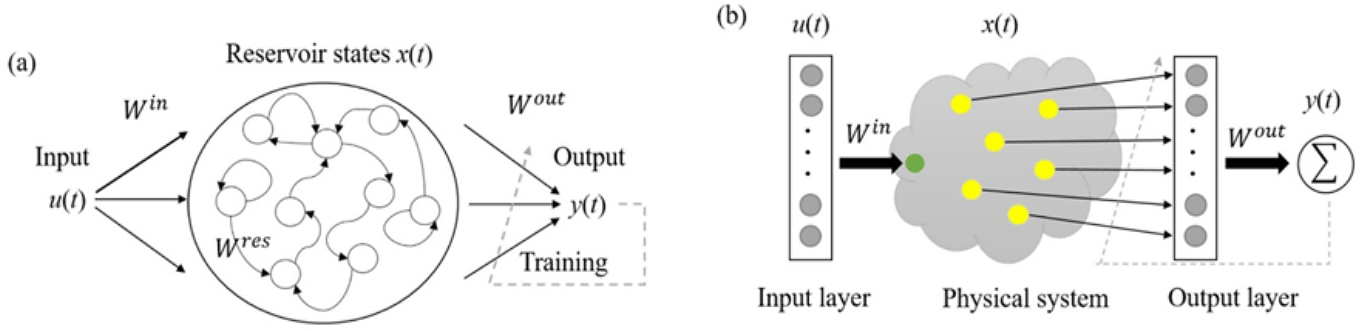
    Reservoir computing is a relatively recent idea in computing. Instead of traditional binary programs run on semiconductor chips, the reactions of a nonlinear dynamical system—the reservoir—are used to perform much of the calculation. Various nonlinear dynamical systems from quantum processes to optical laser components have been considered as reservoirs. In this study, the researchers looked at the ionic conductance of electrochemical solutions.
    Physical Reservoir Computing
    Physical reservoir computing and the construction of a molecular-based reservoir. (a) Structure of traditional reservoir computing. (b) Concept of our physical reservoir computing system. Credit: © 2022 Megumi Akai-Kasaya et al., Advanced Science

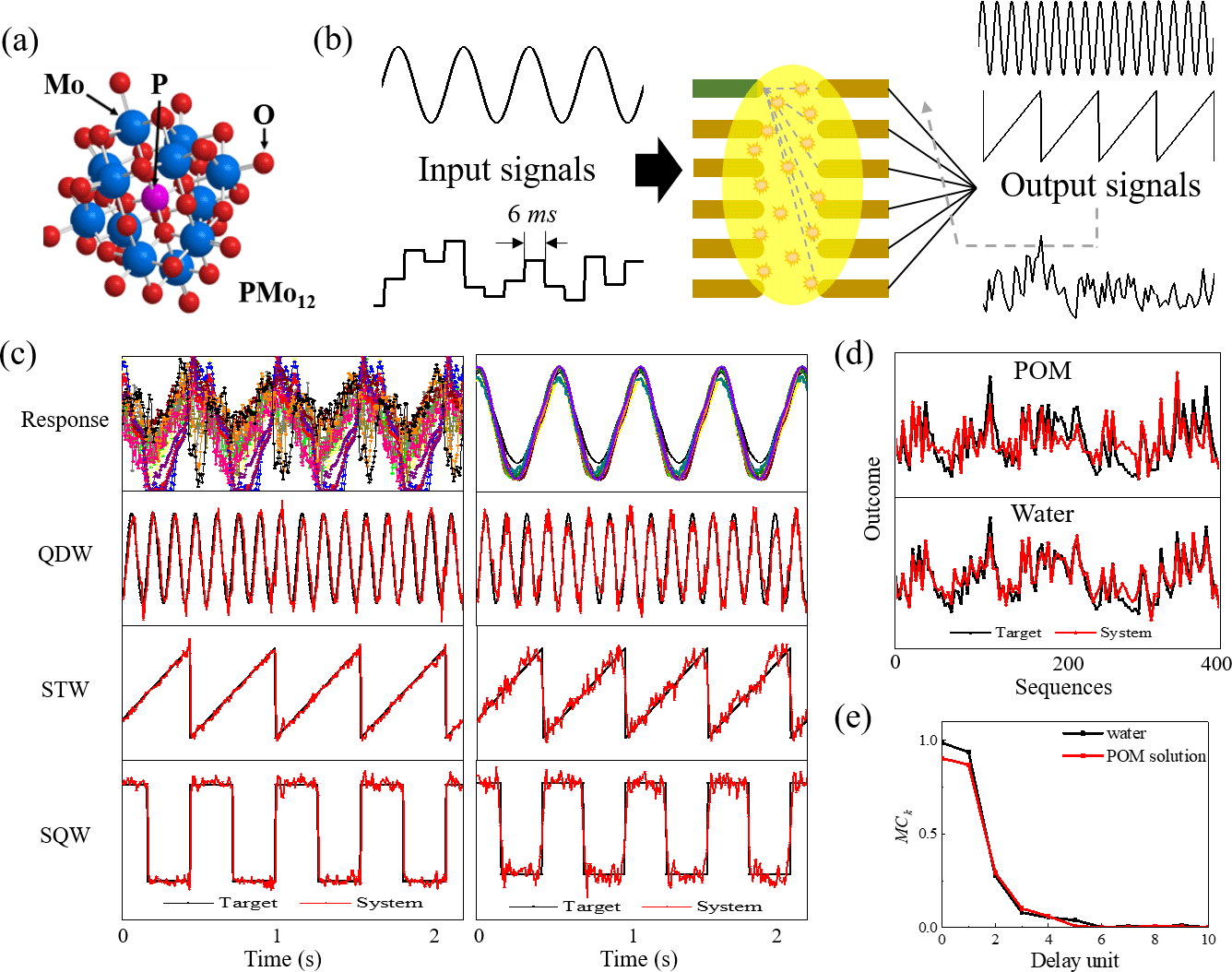
    “Our simple testing device consists of 90 pairs of planar electrodes with an ionic solution dropped on its surface,” explains Professor Megumi Akai-Kasaya, lead author of the study. “The response voltage to the input voltage is then used as the response of the reservoir.” This voltage response is due to both the ionic currents that pass through the solution and the electrochemical current. This input–output relationship is both nonlinear and reproducible, which makes it suitable for use in reservoir computing. A unique multiway data acquisition system on the device controls the readout nodes, which enables parallel testing.

    Evaluating Performance and Potential Applications

    The researchers used the device to evaluate two liquids: polyoxometalate molecules in solution and deionized water. The system displayed a “feedforward connection” between nodes, regardless of which sample was used. However, there were differences. “The polyoxometalate solution increased the diversity of the response current, which makes it good at predicting periodic signals,” says Professor Akai-Kasaya. “But it turns out that deionized water is best for solving second-order nonlinear problems.” The good performance of these solutions demonstrates their potential for more complicated tasks, such as handwriting font recognition, isolated word recognition, and other classification tasks.
    Polyoxometalate (POM) Molecule Structure
    (a) Structure of the polyoxometalate (POM) molecule. (b) Schematic of the electrochemical-reaction-based reservoir. (c) Responses of the POM solution (left) and deionized water (right) to a sinusoidal signal and their prediction performances on a quadruple sine (QDW) target signal. (d) Prediction performances of the POM solution and water on a nonlinear target signal. Credit: © 2022 Megumi Akai-Kasaya et al., Advanced Science

    Potential for Advanced Electrochemical Computing

    The researchers believe that proton or ion transfer with minimal electrochemical reactions over short durations has the potential for development as a more computationally powerful computing system that is low in cost and energy efficient. The simplicity of the proposed system opens up exciting new opportunities for developing computing systems based on electrochemical ion reactions.

    Reference: “Physical Implementation of Reservoir Computing through Electrochemical Reaction” by Shaohua Kan, Kohei Nakajima, Tetsuya Asai and Megumi Akai-Kasaya, 29 December 2021, Advanced Science.
    DOI: 10.1002/advs.202104076

    Never miss a breakthrough: Join the SciTechDaily newsletter.
    Follow us on Google and Google News.

    Computer Technology Computers University of Osaka
    Share. Facebook Twitter Pinterest LinkedIn Email Reddit

    Related Articles

    New Research Reveals That Classical Computers Can Surpass Their Quantum Counterparts

    Time Travel for Tomorrow: Using Future Perspectives To Shape Today’s Tech

    Not Science Fiction: How Optical Neural Networks Are Revolutionizing AI

    From Sci-Fi to Reality: Scientists Develop Unbreakable, Bendable Optical Sensor

    Unique New Material Could Generate More Computing Power and Memory Storage While Using Significantly Less Energy

    Why Is Computer Security Advice So Confusing?

    New Study: We Are Wasting Up to 20 Percent of Our Time on Computer Problems

    A New Field of Computing Powered by Human Brain Cells: “Organoid Intelligence”

    Atomic Layer Etching Could Lead to Ever-More Powerful Microchips and Supercomputers

    1 Comment

    1. Ava Marshall on January 17, 2022 10:03 am

      A bit clunky to say the least but our skill set and experience won the day. Poor ref with no regard to offside and he bottled it on the sin bin, red card all day long if it had been on sky

      see here>>>>

      Reply
    Leave A Reply Cancel Reply

    • Facebook
    • Twitter
    • Pinterest
    • YouTube

    Don't Miss a Discovery

    Subscribe for the Latest in Science & Tech!

    Trending News

    Mezcal “Worm” in a Bottle Mystery: DNA Testing Reveals a Surprise

    New Research Reveals That Your Morning Coffee Activates an Ancient Longevity Switch

    This Is What Makes You Irresistible to Mosquitoes

    Shockingly Powerful Giant Octopuses Ruled the Seas 100 Million Years Ago

    Scientists Stunned by New Organic Molecules Found on Mars

    Rewriting Dinosaur Evolution: Scientists Unearth Remarkable 150-Million-Year-Old Stegosaur Skull

    Omega-3 Supplements Linked to Cognitive Decline in Surprising New Study

    First-of-Its-Kind Discovery: Homer’s Iliad Found Embedded in a 1,600-Year-Old Egyptian Mummy

    Follow SciTechDaily
    • Facebook
    • Twitter
    • YouTube
    • Pinterest
    • Newsletter
    • RSS
    SciTech News
    • Biology News
    • Chemistry News
    • Earth News
    • Health News
    • Physics News
    • Science News
    • Space News
    • Technology News
    Recent Posts
    • A Common Vitamin Could Hold the Key to Treating Fatty Liver Disease
    • New Research Shows Vitamin B12 May Hold the Key to Healthy Aging
    • Scientists Map Thousands of Brain Connections With RNA Barcodes
    • This Gene Tweak Turns Strawberries Into Healthier, Tastier Superfruit
    • This New Chip Could Make GPUs Far More Efficient
    Copyright © 1998 - 2026 SciTechDaily. All Rights Reserved.
    • Science News
    • About
    • Contact
    • Editorial Board
    • Privacy Policy
    • Terms of Use

    Type above and press Enter to search. Press Esc to cancel.