

Imagine a gamma ray laser that safely eliminates cancer cells while leaving healthy tissue unharmed.
A University of Colorado Denver engineer is close to providing researchers with a powerful new tool that could bring science fiction concepts closer to reality.
Consider the potential of a gamma ray laser that can precisely destroy cancer cells without harming nearby healthy tissue. Or a device capable of probing the structure of the universe to test theories like Stephen Hawking’s idea of the multiverse.
Assistant Professor Aakash Sahai, PhD, from the Department of Electrical Engineering, has made a quantum-level advancement that could support the development of such possibilities. His discovery has generated significant interest in the quantum science community for its potential to transform the fields of physics, chemistry, and medicine. His work was highlighted on the cover of the June issue of Advanced Quantum Technologies, a leading journal in quantum materials and research.
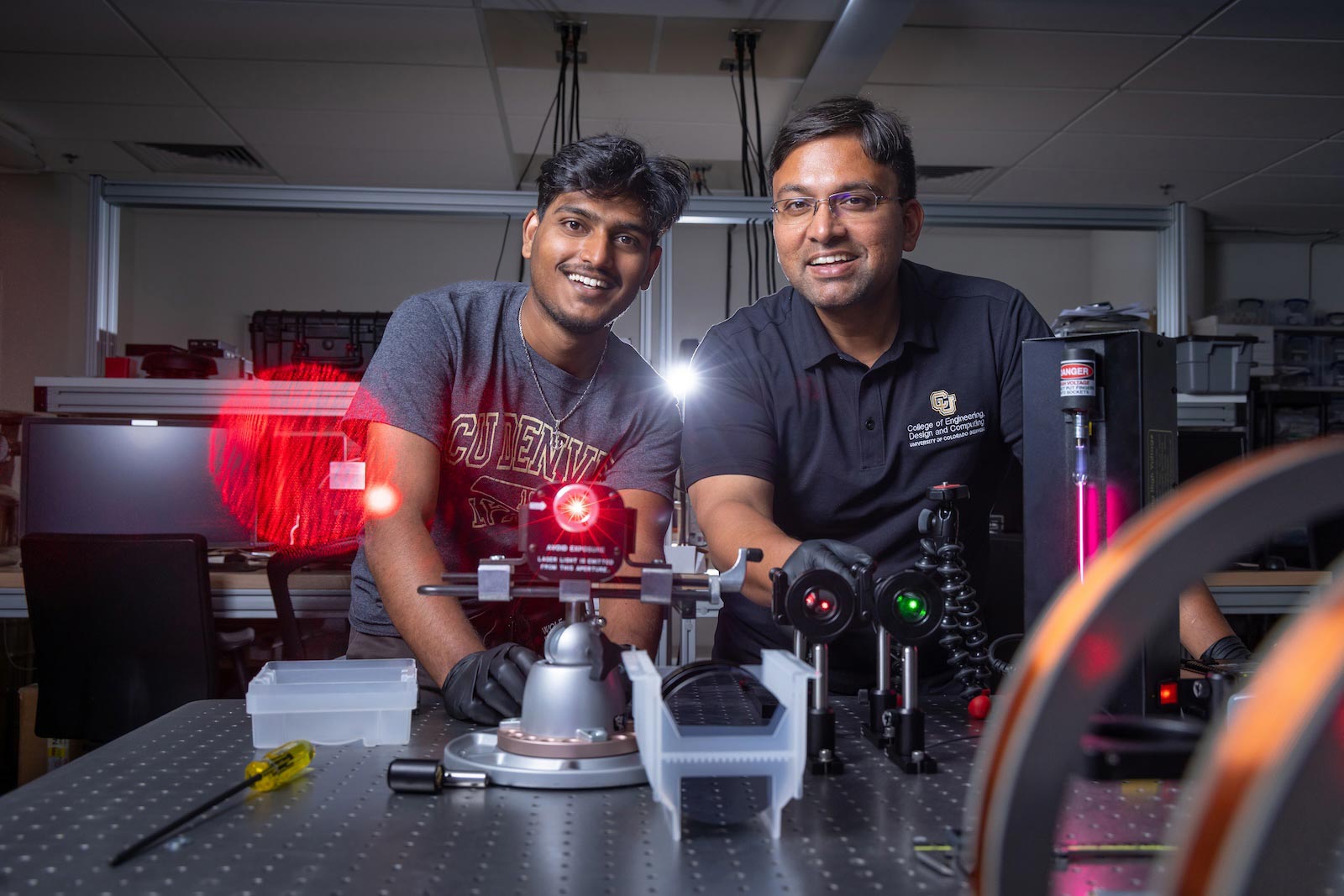
“It is very exciting because this technology will open up whole new fields of study and have a direct impact on the world,” Sahai said. “In the past, we’ve had technological breakthroughs that propelled us forward, such as the sub-atomic structure leading to lasers, computer chips, and LEDs. This innovation, which is also based on material science, is along the same lines.”
How It Works
Sahai has discovered a method for generating ultra-intense electromagnetic fields in a lab setting, reaching strengths that were previously unattainable. These fields arise from the rapid oscillation and scattering of electrons within materials and are central to technologies ranging from microprocessors to powerful particle accelerators used in the search for dark matter.
Historically, producing such strong fields has required massive, complex infrastructures. For instance, the Large Hadron Collider at CERN in Switzerland spans 16.7 miles and uses advanced radiofrequency systems and superconducting magnets to propel high-energy beams. Operating facilities of this scale demand significant funding, extensive infrastructure, and carries inherent technical risks.
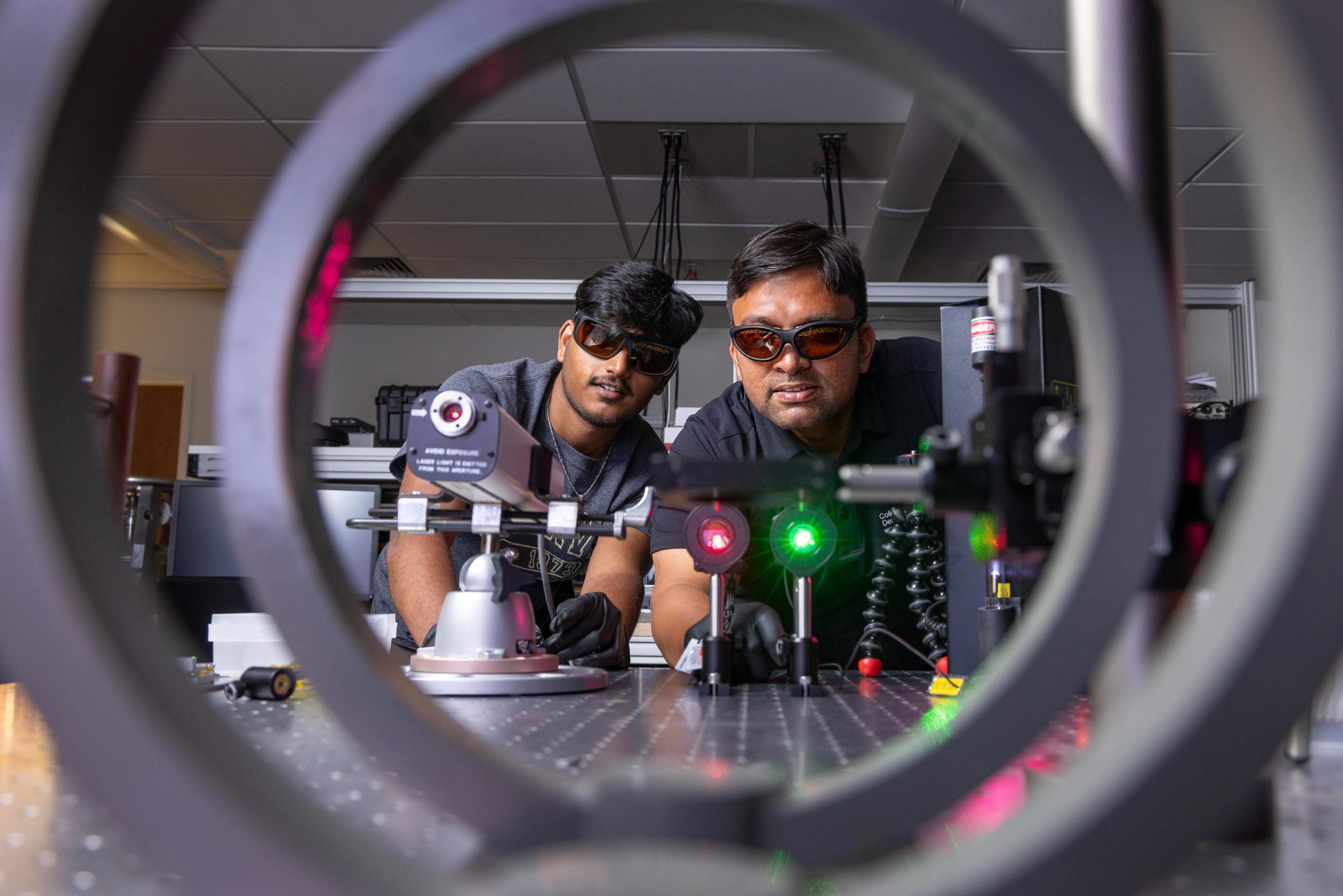
To overcome these limitations, Sahai created a silicon-based, chip-scale material that can endure the impact of high-energy particle beams.
This material efficiently channels the energy produced by the oscillating quantum electron gas and maintains structural stability by controlling the resulting heat. The rapid electron motion is what generates the electromagnetic fields. Sahai’s innovation allows researchers to observe high-energy field behavior in a device no larger than a thumb, presenting a potential path to reduce the scale of massive accelerators to a compact chip-based format.
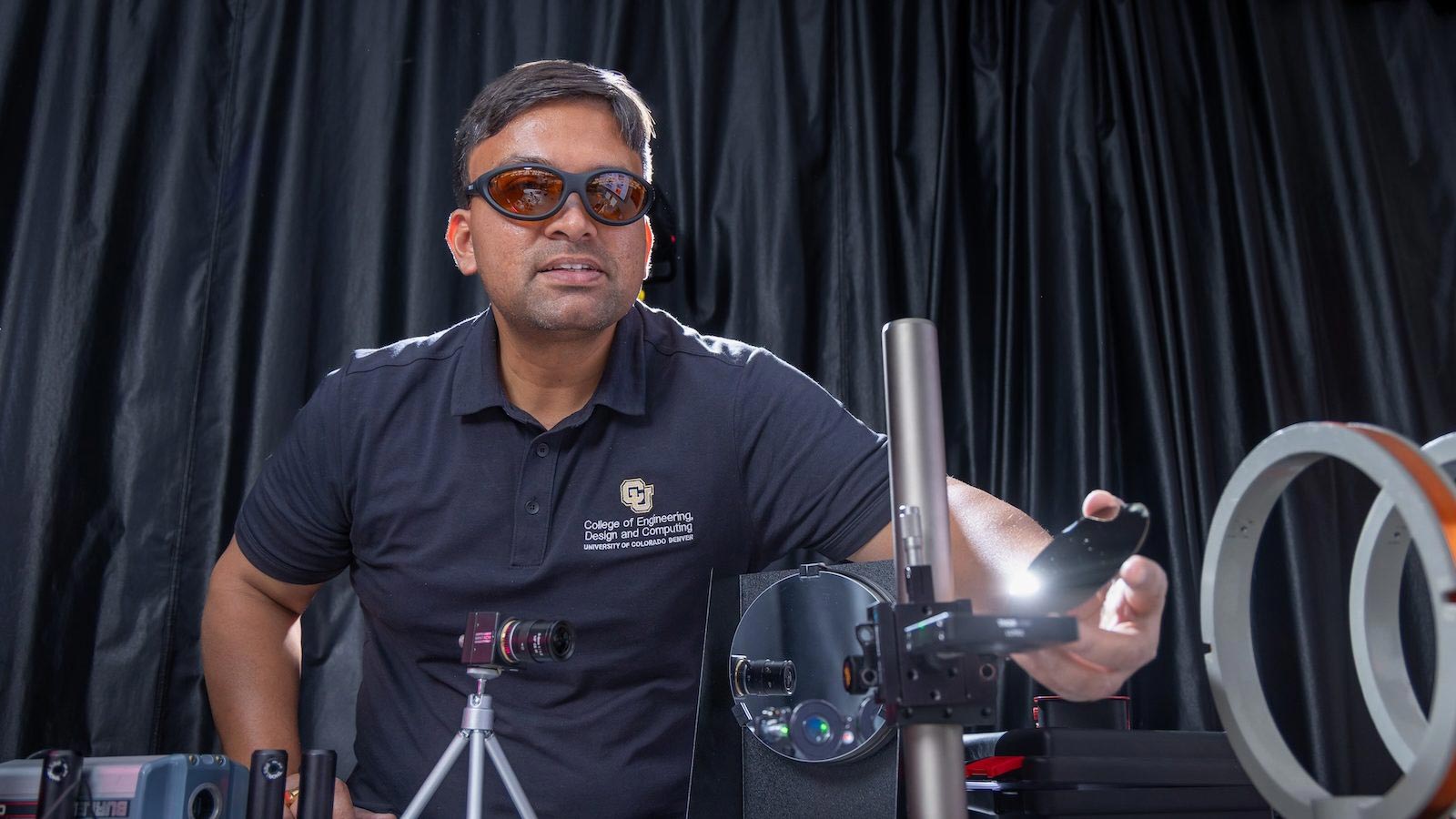
“Manipulating such high energy flow while preserving the underlying structure of the material is the breakthrough,” said Kalyan Tirumalasetty, a graduate student in Sahai’s lab working on the project. “This breakthrough in technology can make a real change in the world. It is about understanding how nature works and using that knowledge to make a positive impact on the world.”
The technology and method were designed at CU Denver and tested at SLAC National Accelerator Laboratory, a world-class facility operated by Stanford University and funded by the U.S. Department of Energy.
Applications of this Technology
CU Denver has already applied for and received provisional patents on the technology in the U.S. and internationally. While real-world, practical applications may be years away, the potential to better understand how the universe works, and to thereby improve lives, is what keeps Sahai and Tirumalasetty motivated to spend long hours in the lab and at SLAC.
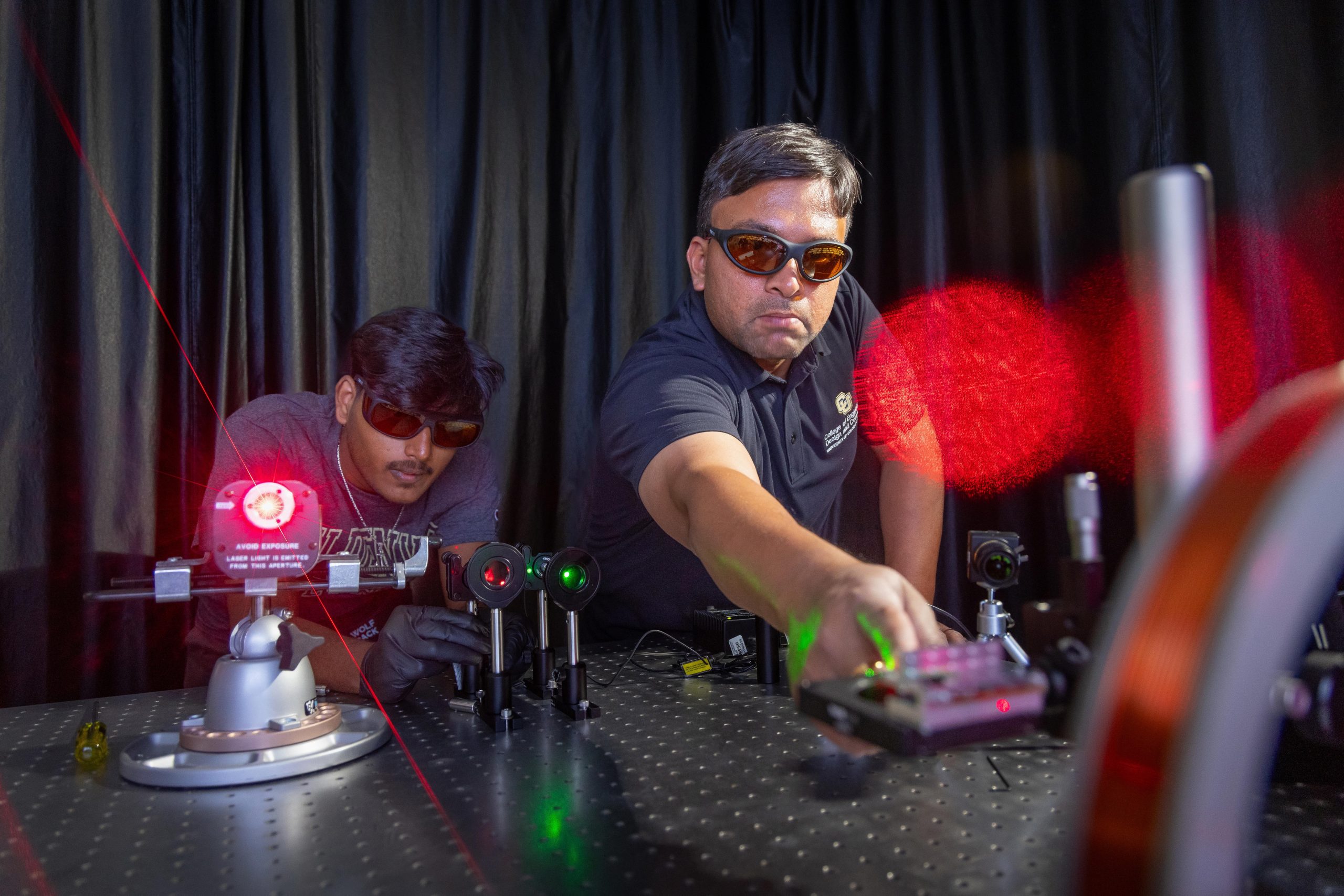
“Gamma ray lasers could become a reality,” Sahai said. “We could get imaging of tissue down to not just the nucleus of cells but down to the nucleus of the underlying atoms. That means scientists and doctors would be able to see what’s going on at the nuclear level and that could accelerate our understanding of immense forces that dominate at such small scales while also leading to better medical treatments and cures. Eventually, we could develop gamma ray lasers to modify the nucleus and remove cancer cells at the nano level.”
The extreme plasmon technique could also help test a wide range of theories about how our universe works—from the possibility of a multiverse to exploring the very fabric of our universe. These possibilities excite Tirumalasetty, who once thought of becoming a physicist. “To explore nature and how it works at its fundamental scale, that’s very important to me,” he said. “But engineers give scientists the tools to do more than understand. And that’s … that’s exhilarating.”
Next up for the duo is a return to SLAC this summer to keep refining the silicon-chip material and laser technique. Unlike in the movies, developing breakthrough technology can take decades. In fact, some of the foundational work that led to this pivotal moment began in 2018, when Sahai published his first research on antimatter accelerators. “It’s going to take a while, but within my lifetime, it is very probable,” Sahai said.
Reference: “Extreme Plasmons” by Aakash A. Sahai, 19 May 2025, Advanced Quantum Technologies.
DOI: 10.1002/qute.202500037
Never miss a breakthrough: Join the SciTechDaily newsletter.
Follow us on Google and Google News.
4 Comments
Note 2508061455_Source1.Reinterpretation【
Source 1.
https://scitechdaily.com/is-the-multiverse-real-new-quantum-tech-might-finally-tell-us/
1.
Is the Multiverse Real? A New Quantum Technology May Finally Tell Us
Author: Zenaida Kotala Gonzalez, University of Colorado Denver, August 2025
5 days
An engineer at the University of Colorado Denver’s campus has developed a groundbreaking quantum technology that can shrink a huge particle collider to the size of a microchip.
>>>>>><<<>>>>><<<>>>><<<^!^
^If it is a local point that forms a super strong magnetic field injected with dark energy, does it act as a large-scale particle accelerator of cern?
What if we have a strong gravitational field of force at qcell.pointer? My hypothesis that particles in the multiverse also appear is even more valid. Huh.
_This electromagnetic field arises from the fast oscillation and scattering of electrons in matter, and is at the heart of techniques ranging from microprocessors to powerful particle accelerators used in dark matter searches.
2-2.
Historically, generating such a powerful magnetic field required huge and complex infrastructure.
For example, the Large Hadron Collider (LHC) at CERN in Switzerland covers 16.7 miles (about 26.7 km) and uses advanced radio frequency systems and superconducting magnets to propel high-energy beams.
-Running a facility of this size requires significant funding and extensive infrastructure, and it also has inherent technical risks.
2-3.
-To overcome these limitations, Sahai has created a silicon-based chip-scale material that can withstand the impact of a high-energy particle beam.
-The material efficiently transfers energy generated by vibrating quantum electron gas and maintains structural stability by controlling the heat generated. Fast electron motion creates an electromagnetic field.
_Sahai's innovation allows researchers to observe the behavior of high energy fields on thumb-sized devices, suggesting a potential way to reduce the size of large accelerators to a small chip base.
3.
"Controlling this high energy flow while maintaining the basic structure of the material is a breakthrough," said Kalyan Tirumalasetti, a graduate student working on the project at Sahai Laboratory.
_"These technological innovations can bring real change to the world. Understanding the principles of nature and leveraging that knowledge to have a positive impact on the world is key."
_The technology and method were designed at CU Denver and tested at the SLAC National Accelerator Laboratory, a world-class facility run by Stanford University and funded by the U.S. Department of Energy.
Very good. Materials science knows no bounds.
Although developing breakthrough technology can take decades, the right theory may benefit researchers. The progress and innovation of physics require theoretical updates.
If researchers are interested in this, please visit https://zhuanlan.zhihu.com/p/1900140514277320438 (If the link is available).
This is a sensational PR piece for modeling and simulation work, not actual experimental results. Publish the experimental work (if it exists) in a major research journal, open access.
Advanced Quantum Technologies? The journal that published a paper describing alleged room-temperature superconductors? And a US patent is no proof of credibility either.