
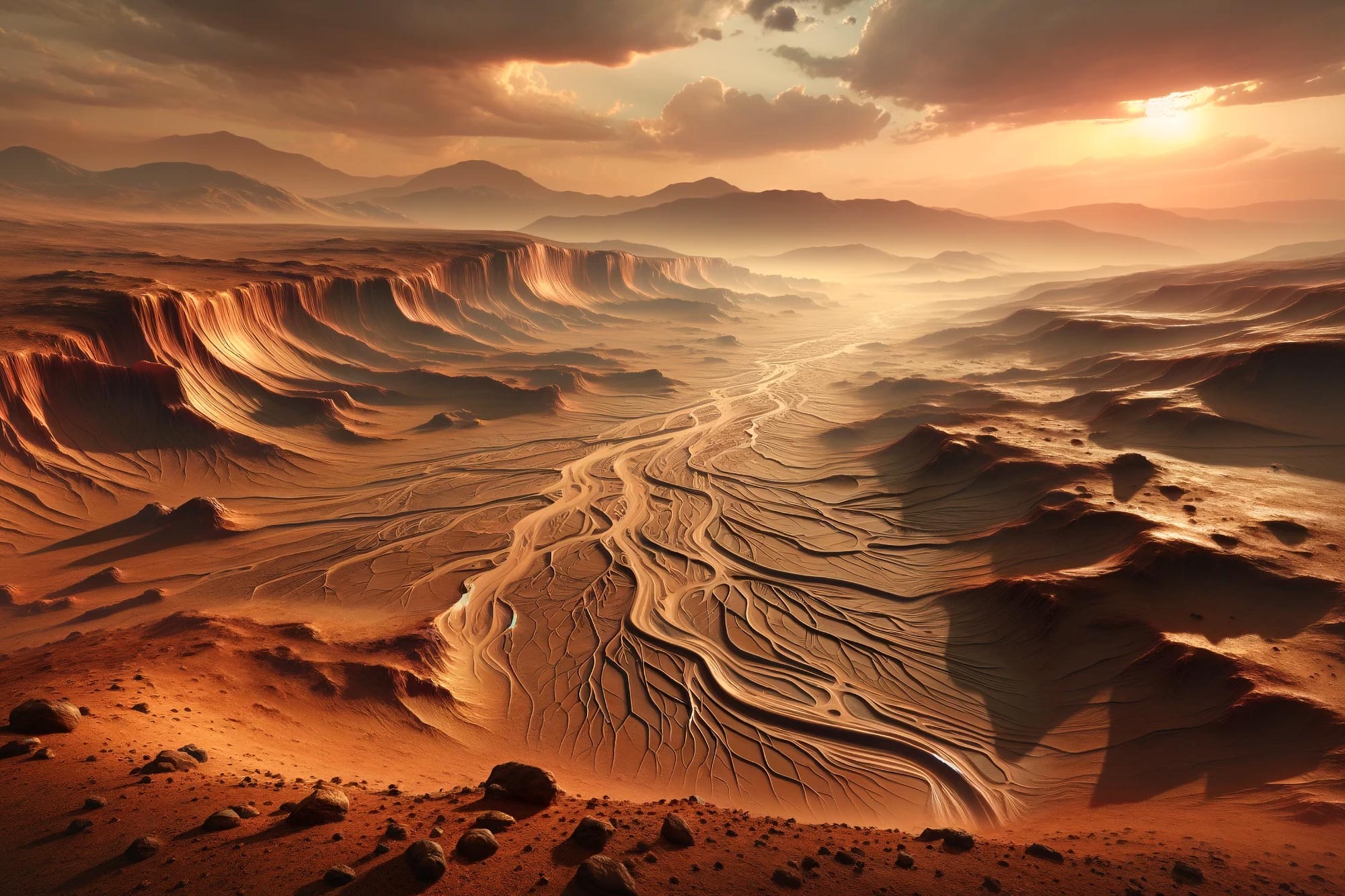
Mars’ ancient geological features suggest the presence of water in the past, and recent studies of sediments from Gale Crater reveal organic matter with unique isotopic compositions, pointing to atmospheric processes, not biological activity, as the source of this organic material.
Mars’ Geological Past
Although Mars presents a barren, dusty landscape with no signs of life so far, its geological features such as deltas, lakebeds, and river valleys strongly suggest a past where water once flowed abundantly on its surface. To explore this possibility, scientists examine sediments preserved near these formations. The composition of these sediments holds clues about the early environmental conditions, the processes that shaped the planet over time, and even potential signs of past life.
Insights From Gale Crater
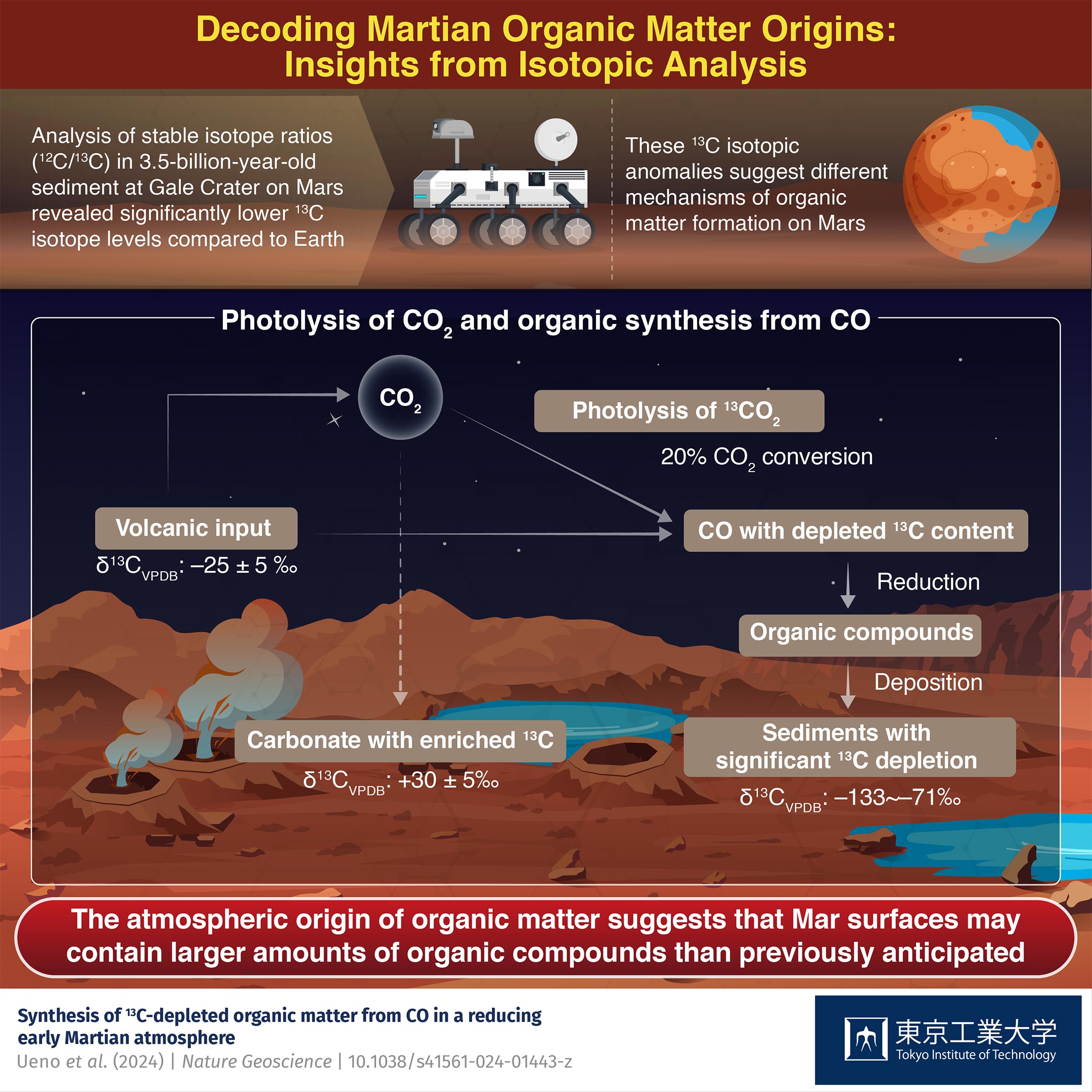
In one such analysis, sediments collected by the Curiosity rover from Gale Crater, believed to be an ancient lake formed approximately 3.8 billion years ago due to an asteroid impact, revealed organic matter. However, this organic matter had a significantly lower amount of the carbon-13 isotope (13C) relative to carbon-12 isotopes (12C) compared to what is found on Earth, suggesting different processes of organic matter formation on Mars.
New Research Findings
Now, a study elucidates this discrepancy, finding that the photodissociation of carbon dioxide (CO2) in the atmosphere to carbon monoxide (CO) and subsequent reduction result in organic matter with depleted 13C content. The research, led by Professor Yuichiro Ueno from Tokyo Institute of Technology and Professor Matthew Johnson from the University of Copenhagen, was published in the journal Nature Geoscience on May 9, 2024.
“On measuring the stable isotope ratio between 13C and 12C, the Martian organic matter has a 13C abundance of 0.92% to 0.99% of the carbon that makes it up. This is extremely low compared to Earth’s sedimentary organic matter, which is about 1.04%, and atmospheric CO2, around 1.07%, both of which are biological remnants, and are not similar to the organic matter in meteorites, which is about 1.05%,” explains Ueno.
Isotopic Fractionation on Mars
Early Mars had an atmosphere rich in CO2 containing both 13C and 12C isotopes. The researchers simulated different conditions of the Martian atmosphere’s composition and temperature in laboratory experiments. They found that when 12CO2 is exposed to solar ultraviolet (UV) light, it preferentially absorbs UV radiation, leading to its dissociation into CO depleted in 13C, leaving behind CO2 enriched in 13C.
This isotopic fractionation (separation of isotopes) is also observed in the upper atmospheres of Mars and Earth, where UV irradiation from the Sun causes CO2 to dissociate into CO with depleted 13C content. In a reducing Martian atmosphere, CO transforms into simple organic compounds such as formaldehyde and carboxylic acids. During the early Martian era, with surface temperatures close to the freezing point of water and not exceeding 300 K (27°C), these compounds may have dissolved in water and settled in sediments.
Implications for Martian Sediments
Using model calculations, the researchers found that in an atmosphere with a CO2 to CO ratio of 90:10, a 20% conversion of CO2 to CO would lead to sedimentary organic matter with δ13CVPDB values of -135‰. Also, the remaining CO2 would be enriched in 13C with δ13CVPDB values of +20‰. These values closely match those seen in sediments analyzed by the Curiosity rover and estimated from a Martian meteorite. This finding points to an atmospheric process rather than a biological one as the main source of organic matter formation on early Mars.
“If the estimation in this research is correct, there may be an unexpected amount of organic material present in Martian sediments. This suggests that future explorations of Mars might uncover large quantities of organic matter,” says Ueno.
Reference: “Synthesis of 13C-depleted organic matter from CO in a reducing early Martian atmosphere” by Yuichiro Ueno, Johan A. Schmidt, Matthew S. Johnson, Xiaofeng Zang, Alexis Gilbert, Hiroyuki Kurokawa, Tomohiro Usui and Shohei Aoki, 9 May 2024, Nature Geoscience.
DOI: 10.1038/s41561-024-01443-z
Never miss a breakthrough: Join the SciTechDaily newsletter.
Follow us on Google and Google News.
1 Comment
I love this today’s analysis of existing proof.
I appreciate your efforts