
Close Menu
    Facebook X (Twitter) Instagram
    SciTechDaily
    • Biology
    • Chemistry
    • Earth
    • Health
    • Physics
    • Science
    • Space
    • Technology
    Facebook X (Twitter) Pinterest YouTube RSS
    SciTechDaily
    Home»Science»Jawless Vertebrate Conodont Had Sharpest Yet Minuscule Teeth
    Science

    Jawless Vertebrate Conodont Had Sharpest Yet Minuscule Teeth

    By SciTechDailyMarch 14, 2012No Comments2 Mins Read
    Facebook Twitter Pinterest Telegram LinkedIn WhatsApp Email Reddit
    Share
    Facebook Twitter LinkedIn Pinterest Telegram Email Reddit
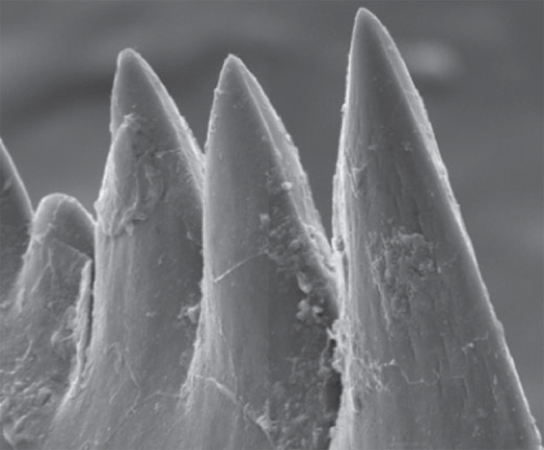
    conodont-fossil-teeth
    Cconodont fossil teeth

    The conodont, an extinct primitive marine vertebrate, had the sharpest teeth ever known, with tips just one-twentieth of the width of a human hair, and was able to apply pressures that were comparable with the ones made with human jaws.

    Conodonts had these razor-sharp teeth and they were jawless vertebrates that evolved 500 million years ago in the Neoproterozoic era of the Precambrian eon and went extinct during the Triassic period, about 200 million years ago. Conodonts roamed Earth for longer than any other vertebrates and they were the first creatures to evolve teeth.
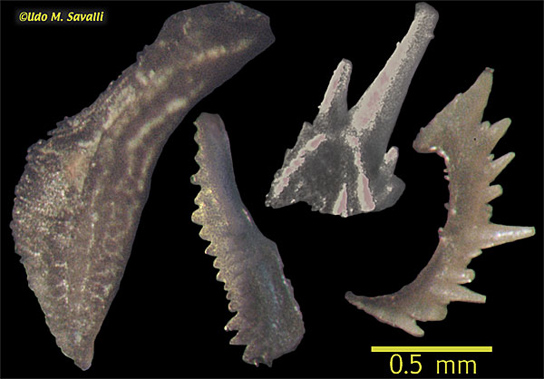
    conodont-teeth-udo-savalli

    Conodonts are chordates that resembled eels. The entire class of conodonts was wiped out by the Triassic-Jurassic extinction event, which occurred 200 million years ago.

    Researchers used X-rays to create computer models of the eight paired, food-processing structures from fossils of the Wurmiella excavata. The tips of the teeth are just 2 micrometers across. Using finite-element analysis, which uses numerical analysis to approximate the solutions of partial differential equations, the scientists compared conodont teeth with similar-sized bat molars. The findings were published in the journal Proceedings of The Royal Society B.

    Conodonts relied on minuscule forces that were concentrated because of the extreme sharpness of their teeth. They didn’t use muscular force as mammals do and conodont teeth sliced from left to right, instead of up and down. The sharpness would have made the teeth brittle, but conodonts may have been able to re-sharpen them, a quality that other vertebrates have failed to evolve.

    Reference: “The sharpest tools in the box? Quantitative analysis of conodont element functional morphology” by David Jones, Alistair R. Evans, Karen K. W. Siu, Emily J. Rayfield and Philip C. J. Donoghue, 14 March 2012, Proceedings of The Royal Society B.
    DOI: 10.1098/rspb.2012.0147

    Never miss a breakthrough: Join the SciTechDaily newsletter.
    Follow us on Google and Google News.

    Cambrian Dental Eels Evolution Jaws Paleobiology Paleontology Precambrian Rescue Teeth Triassic-jurassic Extinction Event
    Share. Facebook Twitter Pinterest LinkedIn Email Reddit

    Related Articles

    These Tiny Teeth Could Change What We Know About Human Origins

    Giant Ancient Shark Discovered in Australia Stuns Scientists

    500-Million-Year-Old Mystery Fossil Rewrites Early Animal Evolution

    “One-of-a-Kind” Fossil Discovery Could Solve the Mystery of Modern Bird Intelligence

    Scientists Discover New “Primitive Cousins of T. Rex” – Finding Sheds Light on the End of the Age of Dinosaurs in Africa

    A Hunt Gone Wrong! What Caused This Megalodon Shark’s Massive Toothache?

    Strange Animals That Lived Before the Dinosaurs Reveal the Evolutionary Origin of Tusks

    Fossil Dental Exams Reveal How Tusks Evolved – Originated in “Very Weird Animals” Called Dicynodonts

    Surprising Diversity of Cretaceous Reptiles at Argentina Fossil Site – Revealed by Discovery of Ancient Teeth

    Leave A Reply Cancel Reply

    • Facebook
    • Twitter
    • Pinterest
    • YouTube

    Don't Miss a Discovery

    Subscribe for the Latest in Science & Tech!

    Trending News

    Doctors May Need To Rethink Calcium and Vitamin D Recommendations After Major Review

    Scientists Discover a Hidden Cause of Cellular Aging That Can Be Reversed

    Archaeologists Have Found Something Unexpected Inside a 1,600-Year-Old Egyptian Mummy

    Scientists May Have Found a Completely New Way To Treat Depression

    New 7-Dimensional Theory May Finally Solve the Black Hole Information Paradox

    Scientists Made Older Mice Biologically Younger Using Gut Microbes

    Scientists Finally Uncover Why Ozempic Stops Working for Some People

    Wasp Colonies Explode Into Violence After Losing Their Queen

    Follow SciTechDaily
    • Facebook
    • Twitter
    • YouTube
    • Pinterest
    • Newsletter
    • RSS
    SciTech News
    • Biology News
    • Chemistry News
    • Earth News
    • Health News
    • Physics News
    • Science News
    • Space News
    • Technology News
    Recent Posts
    • Cambridge Scientists Just Reversed a Form of Nerve Damage Once Thought Permanent
    • A Surprising Discovery Inside Fish Could Change What We Know About the Ocean
    • Scientists May Have Finally Solved the Mystery of the Strange Hum Heard Around the World
    • Researchers Measured Alien Planet Spins and Discovered a Surprising Pattern
    • NASA’s Roman Telescope Will Search 100 Million Stars for New Worlds
    Copyright © 1998 - 2026 SciTechDaily. All Rights Reserved.
    • Science News
    • About
    • Contact
    • Editorial Board
    • Privacy Policy
    • Terms of Use

    Type above and press Enter to search. Press Esc to cancel.