
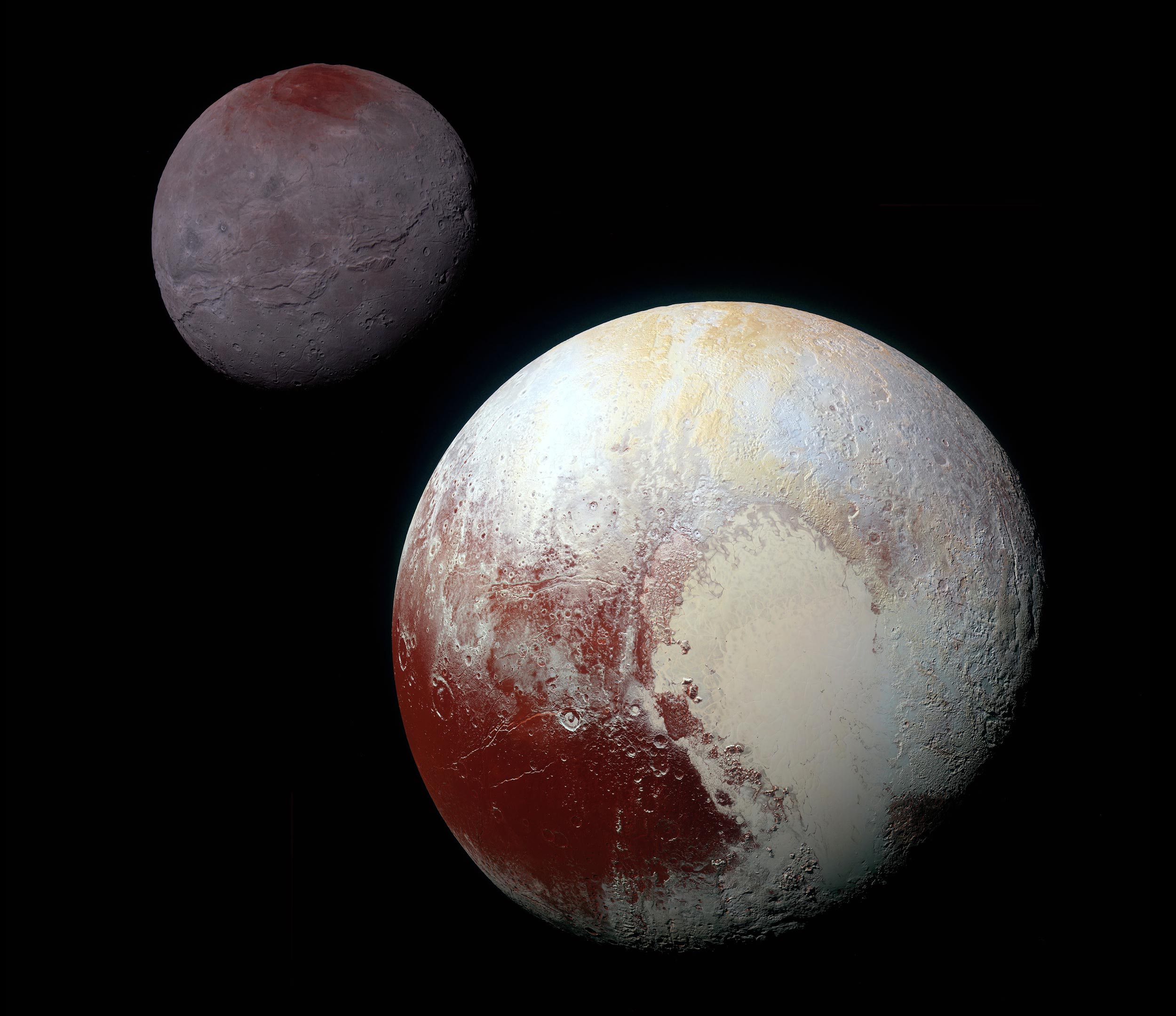
Pluto and Charon’s origin story has been rewritten by a recent study, revealing they formed from a unique “kiss and capture” collision that defies traditional scientific theories.
This discovery, emphasizing the structural integrity of icy worlds, may illuminate new pathways for understanding planetary formation and evolution.
Origins of Pluto and Charon
Billions of years ago, in the cold expanse of the outer solar system, two icy worlds collided. Instead of obliterating each other in a catastrophic impact, they briefly fused, spinning together like a celestial snowman. Eventually, they separated but remained forever bound in orbit. This dramatic encounter explains the origins of Pluto and its largest moon, Charon, according to a new study from the University of Arizona, which challenges long-held scientific theories.
Unveiling a New Cosmic Collision Model
Led by Adeene Denton, a NASA postdoctoral fellow at the University of Arizona’s Lunar and Planetary Laboratory, the study uncovers a surprising “kiss and capture” mechanism. This newly identified process sheds light on how planetary bodies form and evolve. By accounting for a critical but overlooked factor — the structural strength of icy worlds — the researchers have revealed an entirely novel type of cosmic collision.
The findings were published on January 6 in the journal Nature Geoscience.

Reevaluating The Formation of Planetary Bodies
For decades, scientists have theorized that Pluto’s unusually large moon Charon formed through a process similar to Earth’s moon – a massive collision followed by the stretching and deformation of fluid-like bodies, Denton said. This model worked well for the Earth-moon system, where the intense heat and larger masses involved meant the colliding bodies behaved more like fluids. However, when applied to the smaller, colder Pluto-Charon system, this approach overlooked a crucial factor: the structural integrity of rock and ice.
“Pluto and Charon are different – they’re smaller, colder, and made primarily of rock and ice. When we accounted for the actual strength of these materials, we discovered something completely unexpected,” Denton said.
Using advanced impact simulations on the U of A’s high-performance computing cluster, the research team found that instead of stretching like silly putty during the collision, Pluto and the proto-Charon actually became temporarily stuck together, rotating as a single snowman-shaped object before separating into the binary system we observe today. A binary system occurs when two celestial bodies orbit around a common center of mass, much like two figure skaters spinning while holding hands.
“Most planetary collision scenarios are classified as ‘hit and run’ or ‘graze and merge.’ What we’ve discovered is something entirely different – a ‘kiss and capture’ scenario where the bodies collide, stick together briefly and then separate while remaining gravitationally bound,” said Denton.
“The compelling thing about this study, is that the model parameters that work to capture Charon, end up putting it in the right orbit. You get two things right for the price of one,” said senior study author Erik Asphaug, a professor in the Lunar and Planetary Laboratory.
Implications and Future Research
The study also suggests that both Pluto and Charon remained largely intact during their collision, with much of their original composition preserved. This challenges previous models that suggested extensive deformation and mixing during the impact, Denton said. Additionally, the collision process, including tidal friction as the bodies separated, deposited considerable internal heat into both bodies, which may provide a mechanism for Pluto to develop a subsurface ocean without requiring formation in the more radioactive very early solar system – a timing constraint that has troubled planetary scientists.
The research team is already planning follow-up studies to explore several key areas. The team wants to investigate how tidal forces influenced Pluto and Charon’s early evolution when they were much closer together, analyze how this formation scenario aligns with Pluto’s current geological features, and examine whether similar processes could explain the formation of other binary systems.
“We’re particularly interested in understanding how this initial configuration affects Pluto’s geological evolution,” Denton said. “The heat from the impact and subsequent tidal forces could have played a crucial role in shaping the features we see on Pluto’s surface today.”
Reference: “Capture of an ancient Charon around Pluto” by C. Adeene Denton, Erik Asphaug, Alexandre Emsenhuber and Robert Melikyan, 6 January 2025, Nature Geoscience.
DOI: 10.1038/s41561-024-01612-0
Never miss a breakthrough: Join the SciTechDaily newsletter.
Follow us on Google and Google News.