
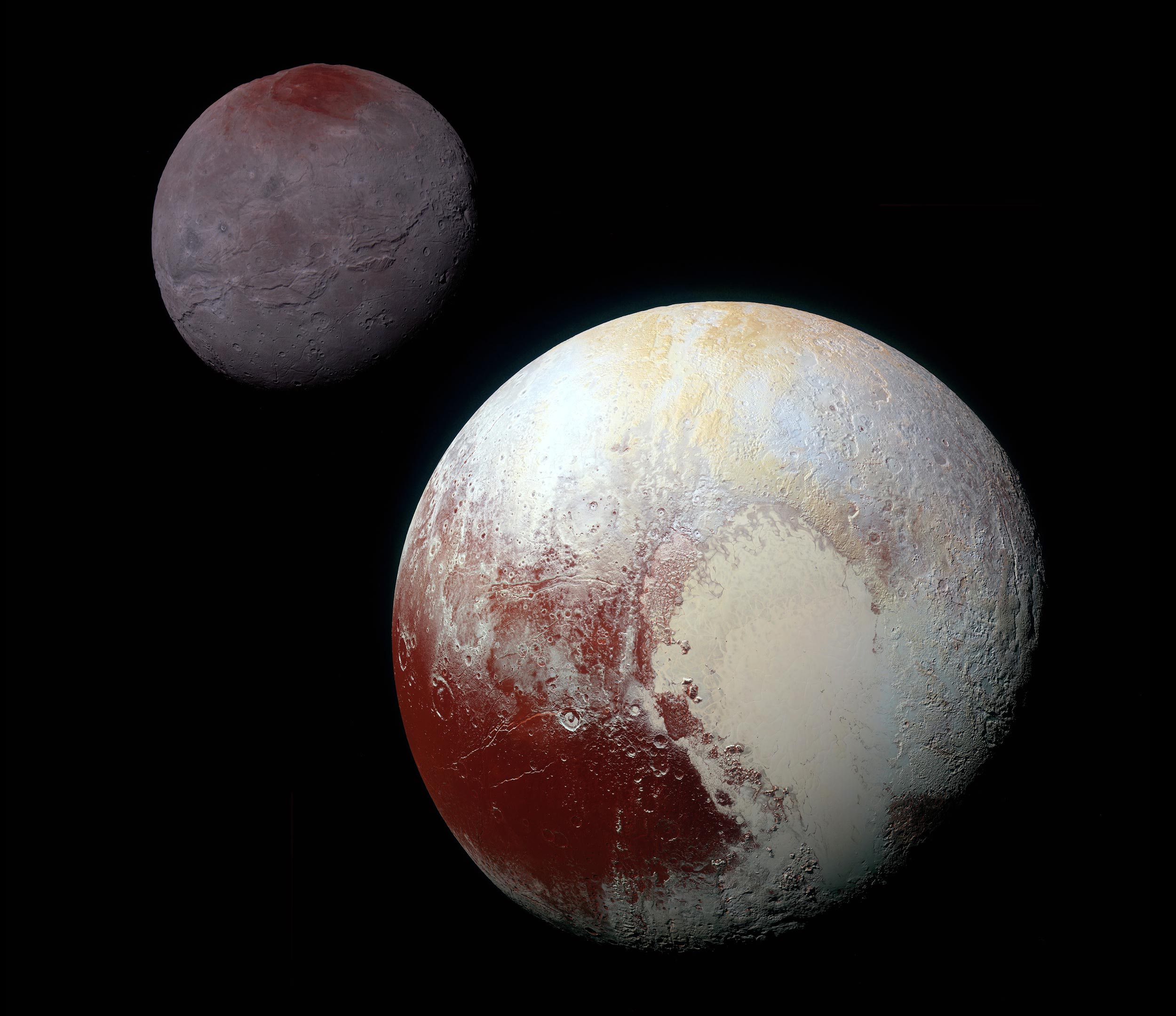
Recent simulations link the creation of Pluto and its moon Charon to a colossal impact, akin to the Earth-Moon origin, highlighting potential geologic activity and an ocean beneath Pluto’s icy façade.
A NASA postdoctoral researcher at Southwest Research Institute has developed advanced models suggesting that Pluto and its moon Charon may have formed in a way similar to the Earth-Moon system. In both cases, the moon is unusually large compared to its host body, a feature not commonly seen elsewhere in the solar system. This formation scenario also supports the possibility of Pluto having active geology and even a hidden subsurface ocean, despite its frigid location on the solar system’s edge.
Dr. Adeene Denton, who led the study published in Nature Geoscience, explained, “We think the Earth-Moon system initiated when a Mars-sized object hit the Earth and led to the formation of our large Moon sometime later. In comparison, Mars has two tiny moons that look like potatoes, while the moons of the giant planets make up a small fraction of their total systems.”

Advances in Cosmic Collision Simulations
In 2005, SwRI Vice President Dr. Robin Canup performed simulations that first demonstrated that the Pluto-Charon pair could have originated with a giant collision. However, those simplified early models treated the colliding material as a strengthless fluid. In the last five years, advancements in impact formation models have included material strength properties. Integrating this information into the simulation results in Pluto behaving like it has a rocky core covered in ice, which changes the outcome significantly.
“In previous models, when proto-Charon hit proto-Pluto, you have a massive shearing effect of fluids that looks like two blobs in a lava lamp that bend and swirl around each other,” she said. “Adding in structural properties allows friction to distribute the impact momentum, leading to a ‘kiss-and-capture’ regime.”

The Unique Mechanics of the Pluto-Charon Impact
When Pluto and Charon collide, they stick together in the shape of a snowman. They rotate as one body until Pluto pushes Charon out into a stable orbit.
“Most cosmic collisions are what we call a hit-and-run, when an impactor hits a planet and keeps going,” Denton continued. “Or an impactor hits a planet, and they merge, which is called a graze and merge. For the Pluto-Charon system, we have a new paradigm where the two bodies hit and then stick together but do not merge because they are behaving like rock and ice.”
Implications for Pluto’s Geology and Other Moons
Pluto and Charon likely exchanged some material between each other but didn’t lose a lot of material to the solar system. Pluto is bigger and started and ended up with much more rock than ice, while Charon is smaller and about 50% rock and 50% ice. The bodies maintain their structural integrity and eventually separate, likely preserving the ancient structures of both bodies, which initially formed in the Kuiper Belt. The interior structures could be quite ancient.
“And this collision scenario supports the formation of other moons, such as Pluto’s four other tiny, lumpy satellites,” she said.
This new model tells us how the impact may have happened but not when, which is significant, particularly because Pluto is thought to be geologically active and may have a liquid ocean beneath its icy surface.
“Even if Pluto starts out really cold, which makes more sense from a solar system evolution perspective, the giant impact and the subsequent tidal forces following the separation could result in an ocean down the line,” said Denton. “And that has pretty big implications for the Kuiper Belt as a whole, because eight of the 10 largest Kuiper Belt objects are similar to Pluto and Charon.”
For more on this research, see “Kiss and Capture:” The Icy Collision That Bound Pluto and Charon Forever.
Reference: “Capture of an ancient Charon around Pluto” by C. Adeene Denton, Erik Asphaug, Alexandre Emsenhuber and Robert Melikyan, 6 January 2025, Nature Geoscience.
DOI: 10.1038/s41561-024-01612-0
Never miss a breakthrough: Join the SciTechDaily newsletter.
Follow us on Google and Google News.