
Close Menu
    Facebook X (Twitter) Instagram
    SciTechDaily
    • Biology
    • Chemistry
    • Earth
    • Health
    • Physics
    • Science
    • Space
    • Technology
    Facebook X (Twitter) Pinterest YouTube RSS
    SciTechDaily
    Home»Space»Uranus Has a Tiny New Moon and It’s Only Six Miles Wide
    Space

    Uranus Has a Tiny New Moon and It’s Only Six Miles Wide

    By Southwest Research InstituteAugust 24, 20252 Comments4 Mins Read
    Facebook Twitter Pinterest Telegram LinkedIn WhatsApp Email Reddit
    Share
    Facebook Twitter LinkedIn Pinterest Telegram Email Reddit
    New Uranus Moon Discovered
    James Webb has revealed Uranus’ smallest moon yet, a six-mile-wide world hidden near its inner rings. This discovery pushes the planet’s moon count to 29 and shows how Webb can uncover secrets Voyager 2 never saw. Credit: NASA, ESA, CSA, STScI, M. El Moutamid (SwRI), M. Hedman (University of Idaho)

    The James Webb Space Telescope has spotted a tiny, hidden moon orbiting Uranus that even Voyager 2 missed during its 1986 flyby.

    The newfound satellite, only about six miles wide, becomes Uranus’ 29th known moon and orbits near the planet’s inner rings. Its discovery highlights Webb’s extraordinary ability to uncover small, faint objects in the outer solar system, while adding a new member to Uranus’ Shakespeare-inspired celestial family.

    Discovery of a New Uranian Moon

    Scientists from the Southwest Research Institute (SwRI) have used the James Webb Space Telescope (JWST) to identify a previously unknown moon orbiting Uranus. The discovery, made by a team led by Dr. Maryame El Moutamid, came from images captured on February 2, 2025. With this addition, Uranus is now known to have 29 moons.

    “As part of JWST’s guest observer program, we found a previously unknown satellite of the ice giant, which has been provisionally designated S/2025 U 1,” said El Moutamid, a lead scientist in SwRI’s Solar System Science and Exploration Division in Boulder, Colorado. “This object, by far the smallest object discovered to date, was detected in a series of 10 long exposures obtained by the Near-Infrared Camera.”
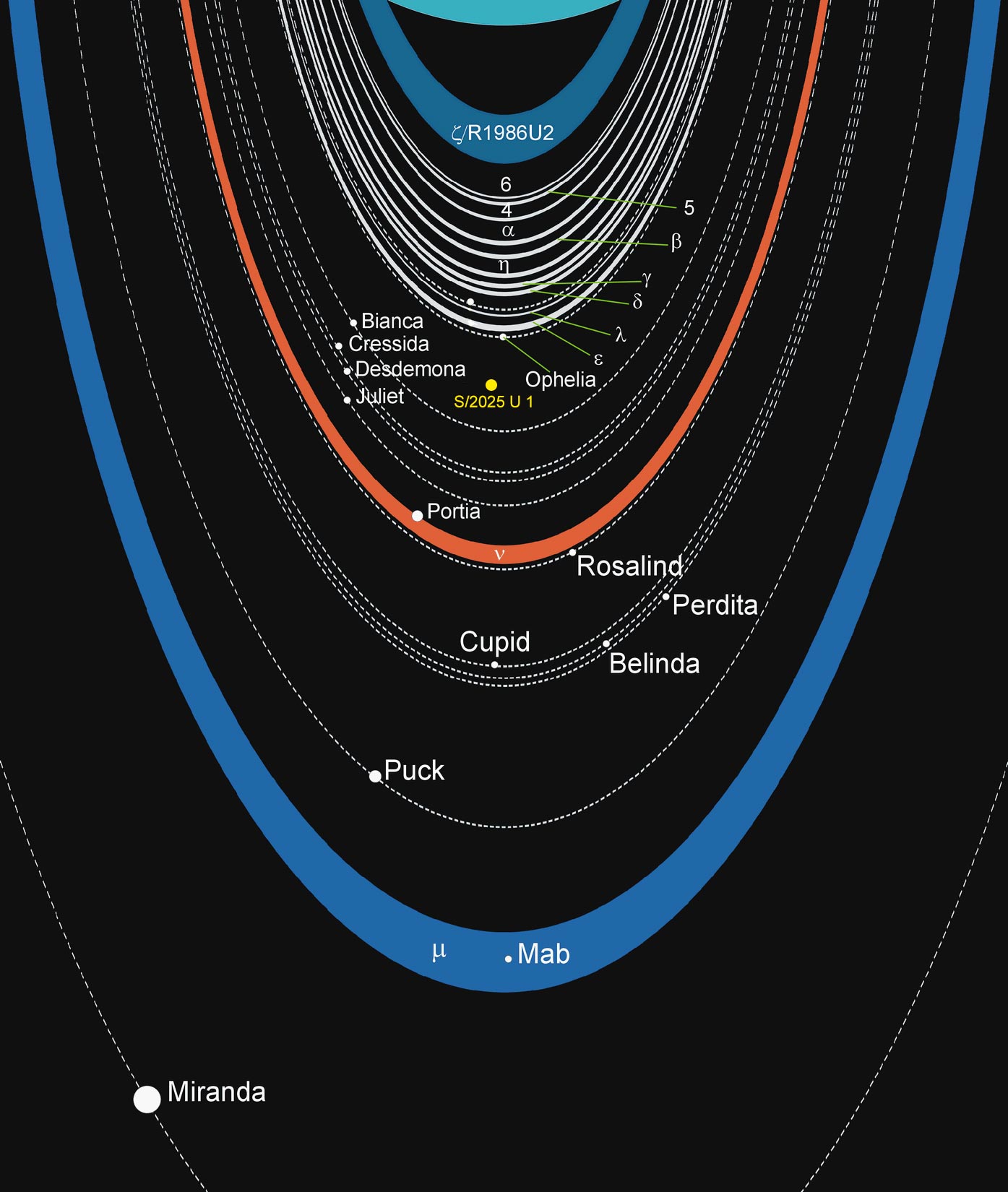
    Uranian Rings, Satellites, and New Moon
    A new SwRI-led JWST survey discovered S/2025 U 1 (approximate location indicated in yellow), a tiny moon orbiting Uranus between the satellites Bianca and Ophelia. If it has an albedo comparable to other nearby moons, this object is probably around six miles in diameter, by far the smallest moon in the Uranus system to date. The solid ellipses indicate rings, while the dotted lines show the orbits of many of the inner moons. Credit: Public Domain

    The Sideways Planet’s Unique Nature

    Uranus, the seventh planet from the Sun, lies in the distant reaches of the solar system. Often called “the sideways planet” because of its unusual tilt, Uranus is a cyan-colored ice giant with an atmosphere rich in hydrogen, helium, and methane. Researchers believe its larger moons are composed of roughly equal amounts of water ice and silicate rock.

    “Assuming that the new moon has an albedo comparable to other nearby satellites, this object is probably around six miles (10 km) in diameter,” El Moutamid said. “It is well below the detection threshold for the Voyager 2 cameras.”

    This timelapse animation shows the newly discovered moon of Uranus, designated S/2025 U1, as well as 13 of the 28 other known moons orbiting the planet.

    Voyager 2’s Historic Flyby

    The only spacecraft ever to visit Uranus is Voyager 2, which made its closest approach on January 24, 1986, passing within about 50,000 miles of the planet’s upper clouds. During its flyby, Voyager 2 gathered thousands of images that revealed Uranus’ ring system and uncovered several small moons, including 10 that were later given official names.

    Uranus’ 28 moons include five major moons — Titania, Oberon, Umbriel, Ariel, and Miranda — discovered between 1787 and 1948. Known as “the literary moons,” Uranus’s satellites are named for characters in Shakespeare and the works of Alexander Pope.
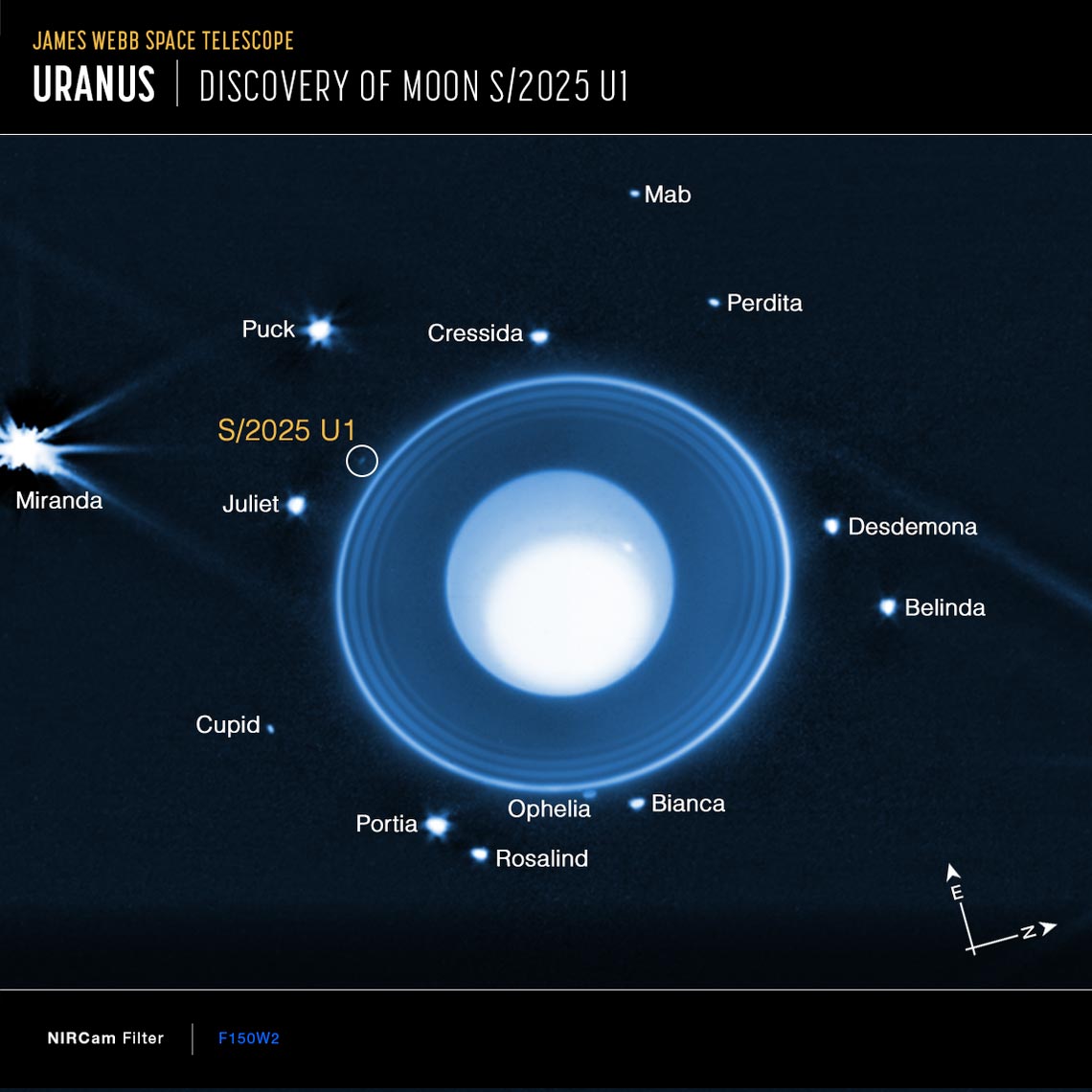
    New Uranus Moon Discovered Compass Image
    Southwest Research Institute led a James Webb Space Telescope (JWST) survey, discovering a previously unknown moon (circled) orbiting Uranus between its satellites Bianca and Ophelia. This image shows the tiny moon, designated S/2025 U1, as well as 13 of the 28 other known moons orbiting the planet. (The small moon Cordelia orbiting just inside the outermost ring is not visible here due to glare from the rings.) Due to the drastic differences in brightness levels, the image is a composite of three different treatments of the data, showing details about the planetary atmosphere, the surrounding rings, and the orbiting moons. Credit: NASA, ESA, CSA, STScI, M. El Moutamid (SwRI), M. Hedman (University of Idaho)

    Orbit and Neighboring Moons

    The new moon is at the edge of Uranus’ inner rings. It is located about 35,000 miles (56,250 km) from its center in the planet’s equatorial plane, between the orbits of Ophelia and Bianca. Ophelia is about 13 miles (43 km) in diameter, while Bianca is an elongated object around 40 by 29 miles (64 by 46 km) in dimension.

    “With so many of Uranus’ moons named for Shakespearean characters, our team is getting a lot of culture trying to figure out what to name our new discovery,” El Moutamid said.

    Never miss a breakthrough: Join the SciTechDaily newsletter.
    Follow us on Google and Google News.

    Astronomy James Webb Space Telescope Moons Planets Popular Southwest Research Institute Uranus
    Share. Facebook Twitter Pinterest LinkedIn Email Reddit

    Related Articles

    Exploring Alien Oceans: NASA’s Bold Mission to Uranus’ Moons

    Infrared Insights: Webb’s Revolutionary View of Uranus’s Hidden Rings

    Dazzling Rings and Dynamic Atmosphere Stun in Webb’s Spectacular New View of Ice Giant Uranus

    NASA’s Webb Space Telescope Primed To Reveal Secrets of Galaxy’s Most Mysterious Planets

    Possible Signs of Alien Life? Methane in the Plumes of Saturn’s Moon Enceladus

    Two Strange Planets: Unsolved Magnetic Mystery on Uranus and Neptune

    First Detection of X-rays From Uranus

    Worlds With Underground Oceans – Like Europa, Titan, and Enceladus – May Be More Conducive to Supporting Life Than Earth

    Two Scientists Have Figured Out What Caused Saturn’s Tilt

    2 Comments

    1. Vanessa Nowitzky on August 30, 2025 4:00 am

      they should name it Saint-Exupéry
      after the author of The Little Prince <3

      Reply
    2. alec carr on August 31, 2025 2:02 pm

      I think you should name it Dingleberry.

      Reply
    Leave A Reply Cancel Reply

    • Facebook
    • Twitter
    • Pinterest
    • YouTube

    Don't Miss a Discovery

    Subscribe for the Latest in Science & Tech!

    Trending News

    Beyond Pain Relief: Scientists Discover a Protein That Could Stop Osteoarthritis in Its Tracks

    Scientists Discover Why Alcohol Prevents the Liver From Healing, Even After You Quit

    Scientists Stunned As Volcano Removes Methane From the Air

    Scientists Discover Signs Africa May Be Splitting Apart Beneath Zambia

    Common Blood Pressure Drug Supercharges Cancer Treatment in Surprising New Study

    540-Million-Year-Old Fossils Reveal a Huge Surprise About Early Life on Earth

    Scientists Reverse Stroke Damage Using Stem Cells in Breakthrough Study

    Eating One Egg a Day Could Cut Alzheimer’s Risk by 27%

    Follow SciTechDaily
    • Facebook
    • Twitter
    • YouTube
    • Pinterest
    • Newsletter
    • RSS
    SciTech News
    • Biology News
    • Chemistry News
    • Earth News
    • Health News
    • Physics News
    • Science News
    • Space News
    • Technology News
    Recent Posts
    • Too Much Sleep May Age Your Body Faster, New Study Warns
    • Scientists Uncover Promising New Strategy To Stop Parkinson’s in Its Tracks
    • New Study Reveals How Vitamin D Could Calm Gut Inflammation
    • Experts Reveal the Surprising Cancer Link Behind a Common Vitamin
    • NASA’s Roman Space Telescope Could Finally Find the Milky Way’s Missing Neutron Stars
    Copyright © 1998 - 2026 SciTechDaily. All Rights Reserved.
    • Science News
    • About
    • Contact
    • Editorial Board
    • Privacy Policy
    • Terms of Use

    Type above and press Enter to search. Press Esc to cancel.