

Nearly 40 years after Voyager 2’s journey, NASA plans to revisit Uranus to explore its moons for hidden liquid water oceans, using a new computer model.
This model analyzes the moons’ rotational wobbles to infer the presence and size of subsurface oceans. The findings could significantly influence our understanding of life’s potential in the galaxy, as ice giants and their moons might be prevalent habitats.
Voyager’s Historic Encounter and Future Plans
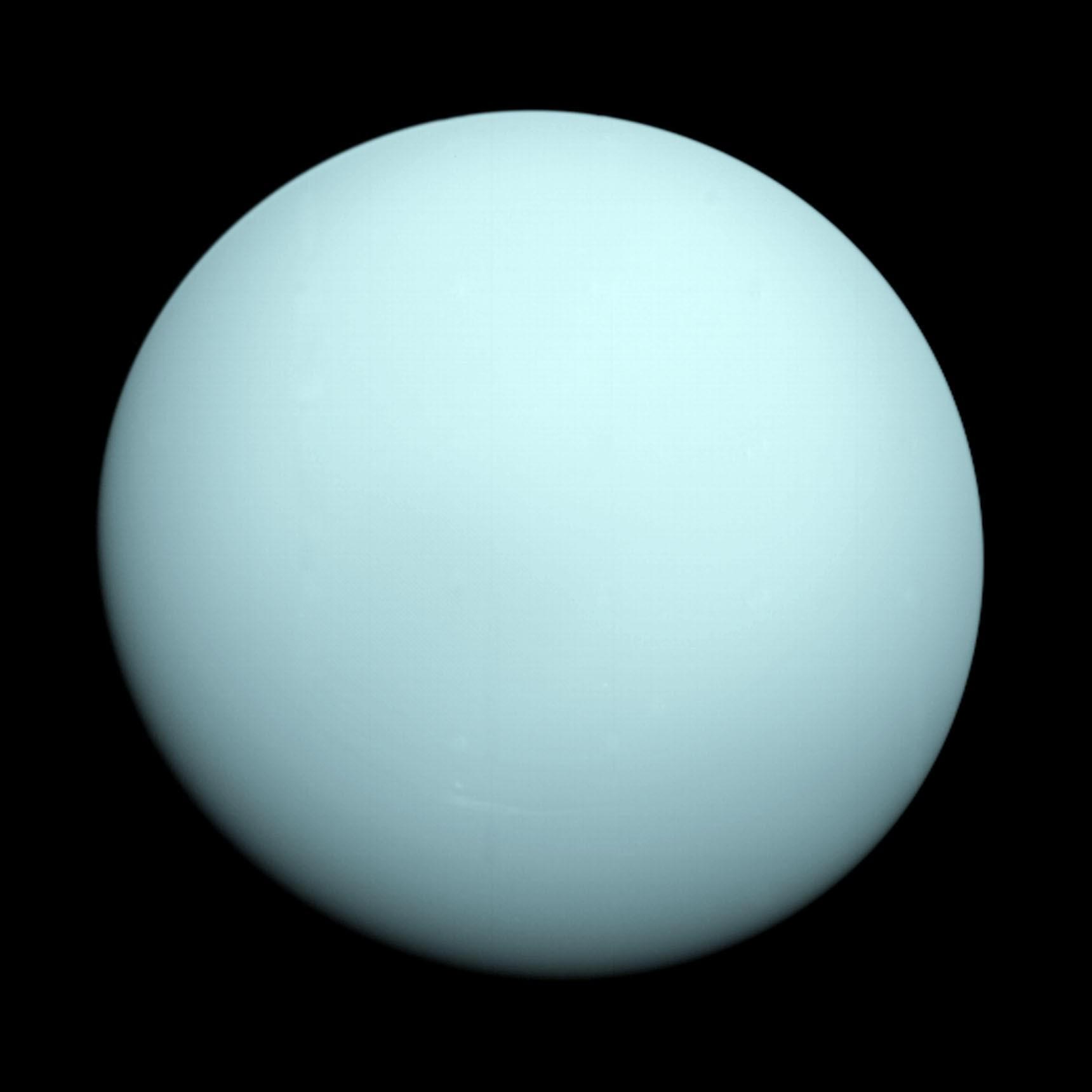
In 1986, NASA’s Voyager 2 flew past Uranus, capturing grainy images of its large, ice-covered moons. Nearly 40 years later, NASA is planning a new mission to the distant planet, this time equipped to determine if those icy moons conceal liquid water oceans beneath their surfaces.
Though the mission is still in its early planning stages, researchers at the University of Texas Institute for Geophysics (UTIG) are already developing a computer model designed to detect these hidden oceans using only the spacecraft’s cameras.
This research is crucial because scientists are unsure which techniques will be most effective for finding oceans on Uranus. Confirming the presence of liquid water is a priority, as it is a fundamental ingredient for life.
The new computer model works by analyzing small oscillations — or wobbles — in the way a moon spins as it orbits its parent planet. From there it can calculate how much water, ice and rock there is inside. Less wobble means a moon is mostly solid, while a large wobble means the icy surface is floating on a liquid water ocean. When combined with gravity data, the model computes the ocean’s depth as well as the thickness of the overlying ice.
Understanding Ice Giants and Life Potential
Uranus, along with Neptune, is in a class of planets called ice giants. Astronomers have detected more ice giant-sized bodies outside of our solar system than any other kind of exoplanet. If Uranus’s moons are found to have interior oceans, that could mean there are vast numbers of potentially life-harboring worlds throughout the galaxy, said UTIG planetary scientist Doug Hemingway, who developed the model.
“Discovering liquid water oceans inside the moons of Uranus would transform our thinking about the range of possibilities for where life could exist,” he said.
The UTIG research, which was published in the journal Geophysical Research Letters, will help mission scientists and engineers improve their chances of detecting oceans. UTIG is a research unit of the Jackson School of Geosciences at The University of Texas at Austin.

Mechanics of Moons’ Oscillations
All large moons in the solar system, including Uranus’s, are tidally locked. This means that gravity has matched their spin so that the same side always faces their parent planet while they orbit. This doesn’t mean their spin is completely fixed, however, and all tidally locked moons oscillate back and forth as they orbit. Determining the extent of the wobbles will be key to knowing if Uranus’s moons contain oceans, and if so, how large they might be.
Moons with a liquid water ocean sloshing about on the inside will wobble more than those that are solid all the way through. However, even the largest oceans will generate only a slight wobble: A moon’s rotation might deviate only a few hundred feet as it travels through its orbit.
That’s still enough for passing spacecraft to detect. In fact, the technique was previously used to confirm that Saturn’s moon Enceladus has an interior global ocean.
An animation demonstrating how Uranus’s moon Ariel might wobble with an interior ocean (right) versus being solid through to the core (left). The depicted wobbles are exaggerated. A UTIG-developed computer model can calculate the thickness of the ocean and overlying ice (lighter-colored layer) by analyzing the wobble and combining it with other measurements. Credit: Doug Hemingway
Expanding Ocean Detection Techniques
To find out if the same technique would work at Uranus, Hemingway made theoretical calculations for five of its moons and came up with a range of plausible scenarios. For example, if Uranus’s moon Ariel wobbles 300 feet, then it’s likely to have an ocean 100 miles deep surrounded by a 20-mile-thick ice shell.
Detecting smaller oceans will mean a spacecraft will have to get closer or pack extra powerful cameras. But the model gives mission designers a slide rule to know what will work, said UTIG Research Associate Professor Krista Soderlund.
“It could be the difference between discovering an ocean or finding we don’t have that capability when we arrive,” said Soderlund, who was not involved in the current research.
Soderlund has worked with NASA on Uranus mission concepts. She is also part of the science team for NASA’s Europa Clipper mission, which recently launched and carries an ice-penetrating radar imager developed by UTIG.
The next step, Hemingway said, is to extend the model to include measurements by other instruments to see how they improve the picture of the moons’ interiors.
Reference: “Looking for Subsurface Oceans Within the Moons of Uranus Using Librations and Gravity” by D. J. Hemingway and F. Nimmo, 15 September 2024, Geophysical Research Letters.
DOI: 10.1029/2024GL110409
The journal article was coauthored by Francis Nimmo at the University of California, Santa Cruz. The research was funded by UTIG.
Never miss a breakthrough: Join the SciTechDaily newsletter.
Follow us on Google and Google News.
1 Comment
Cool stuff
I really hope to see a mission yo Uranus in the not too distant future.