
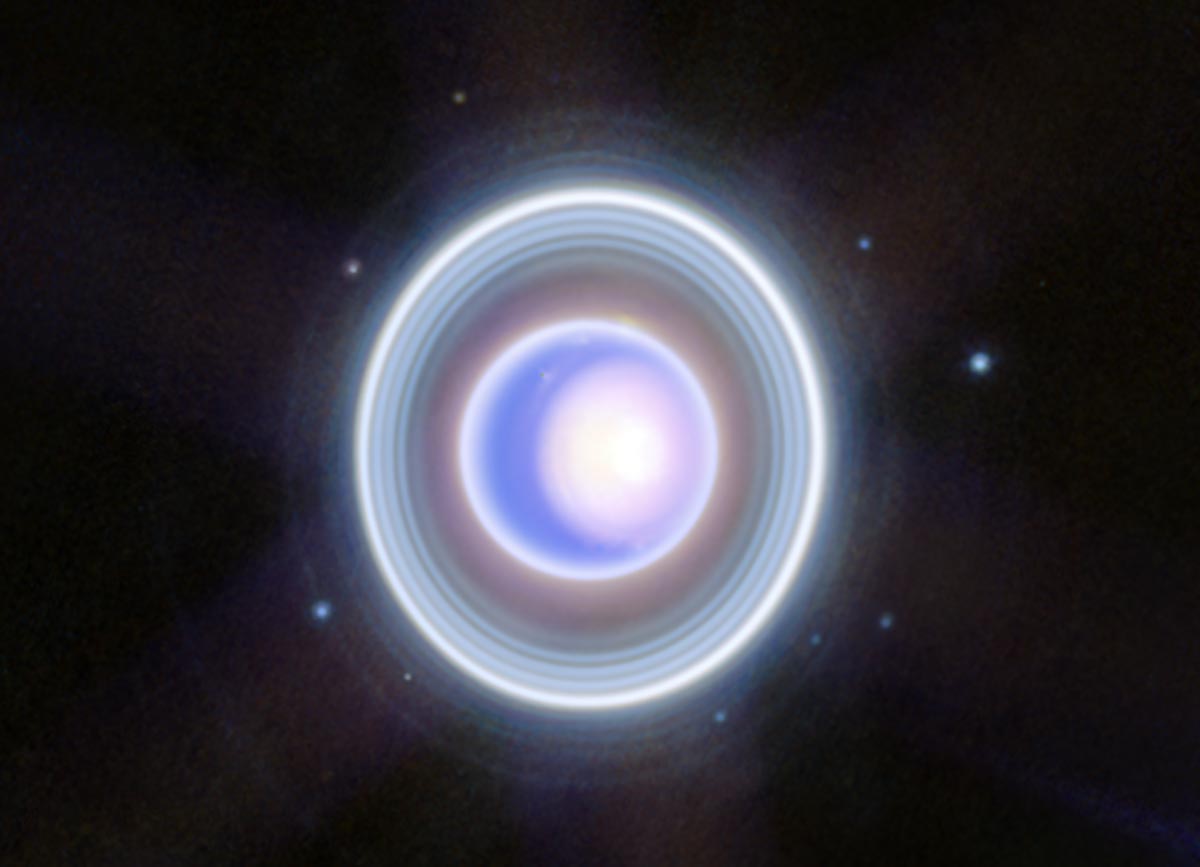
A rare celestial alignment in April 2025 gave NASA scientists the chance to study Uranus in exceptional detail as it passed in front of a distant star.
This stellar occultation, visible only from parts of western North America, allowed researchers to measure changes in Uranus’ atmosphere that haven’t been studied this thoroughly in decades.
Rare Uranus Event Offers a Glimpse Into Its Atmosphere
On April 7, Uranus moved perfectly between Earth and a distant star, creating a rare cosmic event known as a stellar occultation. But for NASA scientists, this wasn’t just a beautiful alignment. It was a golden opportunity to study the mysterious ice giant in ways we haven’t been able to in over 30 years.
By watching how the star’s light dimmed and brightened as it passed behind Uranus, scientists were able to measure key features of the planet’s atmosphere, like its temperature, pressure, and density, in incredible detail. This flickering of starlight creates something called a light curve, and it’s a powerful tool for unlocking secrets hidden high in the planet’s skies.

A Light Curve Unlocks Atmospheric Secrets
“Uranus passed in front of a star that is about 400 light years from Earth,” said William Saunders, planetary scientist at NASA’s Langley Research Center in Hampton, Virginia, and science principal investigator and analysis lead, for what NASA’s team calls the Uranus Stellar Occultation Campaign 2025. “As Uranus began to occult the star, the planet’s atmosphere refracted the starlight, causing the star to appear to gradually dim before being blocked completely. The reverse happened at the end of the occultation, making what we call a light curve. By observing the occultation from many large telescopes, we are able to measure the light curve and determine Uranus’ atmospheric properties at many altitude layers.”
“We are able to measure the light curve and determine Uranus’ atmospheric properties at many altitude layers.”
William Saunders, Planetary Scientist at NASA’s Langley Research Center
This detailed data from Uranus’ stratosphere, the middle layer of its atmosphere, will help scientists understand how the planet’s climate works today, how it’s changed over decades, and what to expect for future missions to this distant, icy world.
This rendering demonstrates what is happening during a stellar occultation and illustrates an example of the light curve data graph recorded by scientists that enables them to gather atmospheric measurements, like temperature and pressure, from Uranus as the amount of starlight changes when the planet eclipses the star. Credit: NASA/Langley Research Center Advanced Concepts Laboratory
A Coordinated Global Effort to Observe Uranus
To observe the rare event, which lasted about an hour and was only visible from Western North America, planetary scientists at NASA Langley led an international team of over 30 astronomers using 18 professional observatories.
“This was the first time we have collaborated on this scale for an occultation,” said Saunders. “I am extremely grateful to each member of the team and each observatory for taking part in this extraordinary event. NASA will use the observations of Uranus to determine how energy moves around the atmosphere and what causes the upper layers to be inexplicably hot. Others will use the data to measure Uranus’ rings, its atmospheric turbulence, and its precise orbit around the Sun.”

Unraveling Uranus’ Orbit and Ring Mysteries
Knowing the location and orbit of Uranus is not as simple as it sounds. In 1986, NASA’s Voyager 2 spacecraft became the first and only spacecraft to fly past the planet, 10 years before the last bright stellar occultation occurred in 1996. And, Uranus’ exact position in space is only accurate to within about 100 miles, which makes analyzing this new atmospheric data crucial to future NASA exploration of the ice giant.
These investigations were possible because the large number of partners provided many unique views of the stellar occultation from many different instruments.
NASA’s Infrared Telescope Facility Joins the Effort
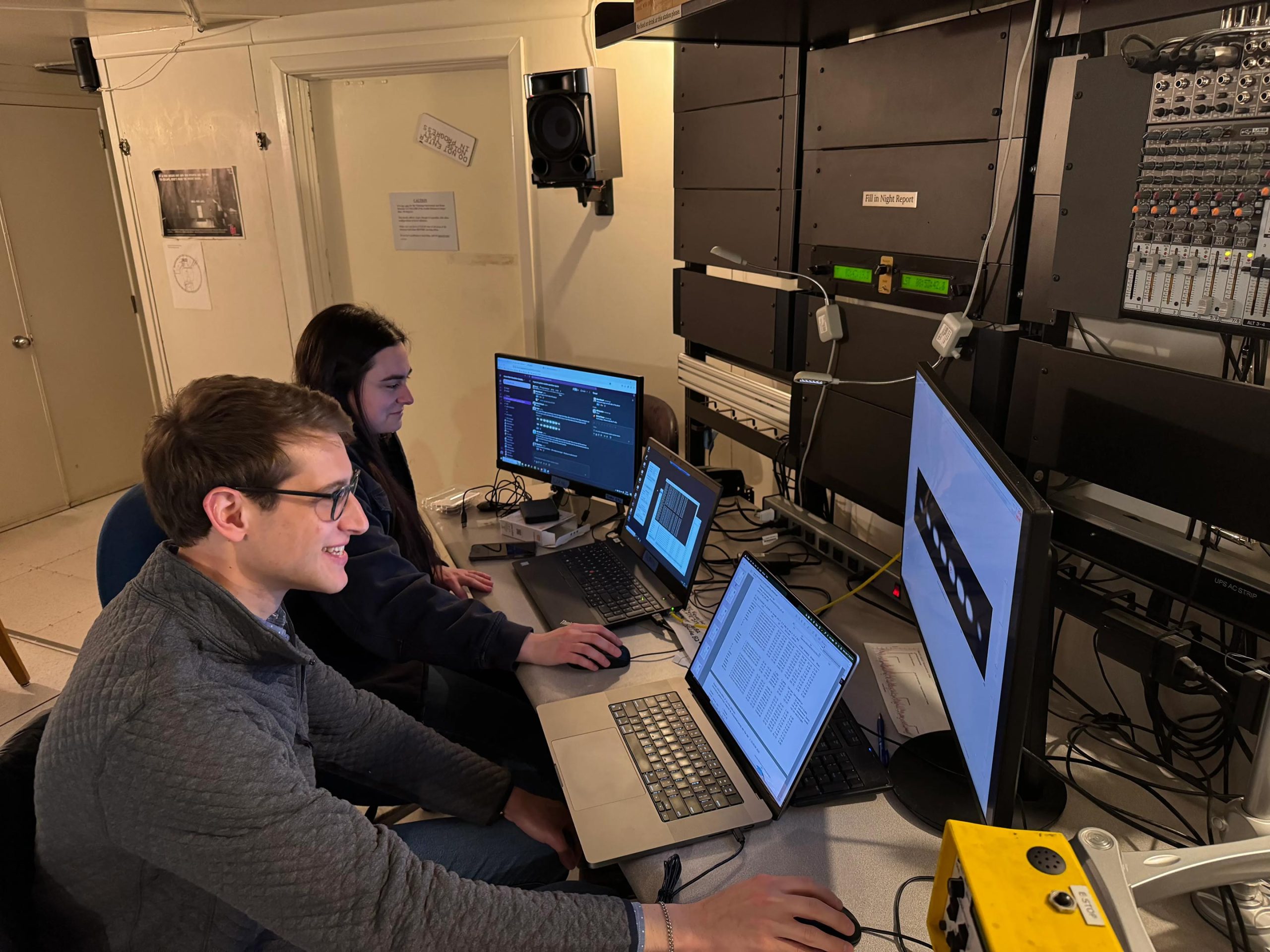
Emma Dahl, a postdoctoral scholar at Caltech in Pasadena, California, assisted in gathering observations from NASA’s Infrared Telescope Facility (IRTF) on the summit of Mauna Kea in Hawaii – an observatory first built to support NASA’s Voyager missions.
“As scientists, we do our best work when we collaborate. This was a team effort between NASA scientists, academic researchers, and amateur astronomers,” said Dahl. “The atmospheres of the gas and ice giant planets [Jupiter, Saturn, Uranus, and Neptune] are exceptional atmospheric laboratories because they don’t have solid surfaces. This allows us to study cloud formation, storms, and wind patterns without the extra variables and effects a surface produces, which can complicate simulations very quickly.”
Test Run Over Asia Sharpens April Predictions
On November 12, 2024, NASA Langley researchers and collaborators were able to do a test run to prepare for the April occultation. Langley coordinated two telescopes in Japan and one in Thailand to observe a dimmer Uranus stellar occultation only visible from Asia. As a result, these observers learned how to calibrate their instruments to observe stellar occultations, and NASA was able to test its theory that multiple observatories working together could capture Uranus’ big event in April.
Researchers from the Paris Observatory and Space Science Institute, in contact with NASA, also coordinated observations of the November 2024 occultation from two telescopes in India. These observations of Uranus and its rings allowed the researchers, who were also members of the April 7 occultation team, to improve the predictions about the timing on April 7 down to the second and also improved modeling to update Uranus’ expected location during the occultation by 125 miles.
What Makes Uranus an Ice Giant
Uranus is almost 2 billion miles away from Earth and has an atmosphere composed primarily of hydrogen and helium. It does not have a solid surface, but rather a soft surface made of water, ammonia, and methane. It’s called an ice giant because its interior contains an abundance of these swirling fluids that have relatively low freezing points. And, while Saturn is the most well-known planet for having rings, Uranus has 13 known rings composed of ice and dust.
Looking Ahead: A Brighter Occultation in 2031
Over the next six years, Uranus will occult several dimmer stars. NASA hopes to gather airborne and possibly space-based measurements of the next bright Uranus occultation in 2031, which will be of an even brighter star than the one observed in April.
Never miss a breakthrough: Join the SciTechDaily newsletter.
Follow us on Google and Google News.
43 Comments
I’m sorry but this must be done.
I sure hope they saw my prostate was good if their going to look at my anus
That’s funny…I knew this was coming …lol
I wonder if they saw my teeth.
Whose A did they observe?
Frickin’ NASA…. I didn’t ask for a rectal exam or a colonoscopy!! Did they put me asleep? The REALLY scary part is I don’t recall a #∆£@# thing about this.
Awesome stuff thank you so much. Is it true that Neptune planet if drifting away and out of our solar system. 5 years ago its Luminosity was 7.7 Now its 7.9 after drifting back from its opposition around the sun.. Can i see Planet Neptune with the right size binoculers and Telescope . Currently i have a pair of 15-70 ASTRONZ Binoculars. Astronomy is one of my biggest hobbies . . so clear nights here in new zealand are enjoyable educational stuff.
this wouldn’t be so weird if I wasn’t a rabbit eastern zodiac trying to open a nightclub called the lucky rabbit hole and hadn’t seen a card that said please enjoy this bunny’s butt after buying a sign with a rabbit butt saying every bunny welcome and made a joke sign with a bunny butt saying abandon all hope all ye who enter here and also known for leaking nudes of various precarious activity’s including a bizare concept where i had various lights coming out of my anus… literally making a red light blue light matrix rabbit hole joke…
I am jealous of your clear night skies.
I don’t have a telescope myself (dusty skies, you see) – but I have access to some of the luggable ones. With those, Saturn is a smudge with a hint of a ring. So, I am guessing (just a guess – others may have better information), you won’t be able to see Neptune beyond a dot in most household telescopes.
Do you have access to better telescopes at universities? That’s the place to start.
Yeah. They might have seen the laser treatment on my hemorrhoids to boot.
Darkness
It better be a rare occasion I didn’t consent to that!
Distance in light years always baffled me . If s star moves behind Neptune, which is 400 light years away, the light and date we receive on earth, is already 400 plus years old!!!. How can we know what actually happened to the light travelling 400 years before passing through Neptune’s atmosphere?
Excellent question,food for thought I don’t know the answer.
Yeesh – the title is a bit… odd – all jokes aside
HAHAHAHAHA…. Nice headline… An interplanetary colonoscopy ????
The name of the star is _________ The name of the dimmer star seen in April is _________
What a load of arse hole wipe!
valuable Knowledge & experience…
Well I understand that scientist’s were able to learn a multitude of information about the ice giant thanks to this event but yall haven’t really told us nothing except just that. They learned a lot. Well what did they learn
Exactly, i was waiting and it is probably still being analysed.
What I am asking as well!!
IS NASA keeping up with China in the new space race.
Do the gas giants have life build on ammonia.
Unfortunately no … at least the normal organic matter we are used to here on earth … organic chemical reactions are not possible there …
I wouldnt look “normal” to be honest.
As a fellow Aquarian, I’ve longed to see inside Uranus.
Using the “Just the Tip” technique, NASA discovers what’s in Uranus.
You’ve been watching porn again, haven’t you.
Why would NASA be doing that?! Looking inside our private parts is not cool. I will report this! It’s called sexual harassment!
I know you know what you did with that headline…
It is so common for our nature, to almost see what it would feel like ,being away from home, first it’s an order seem to be relying on our planet for God knows how far from our saviour, two and well last , to be away and see how we can change but stay in our mind ,it’s simply illistrated in just visuals spice is a form of behavior away from home. To what extent, one can only imagine the power we can’t live through. It sure is there but the reason we just cant ideal it’s too powerfull ,yes we thank you nasa and our brave astronomers courageous astronauts, only we have to see this and realize we are going around at a pace these other planets don’t seem to mind, I say that because they are far but the sun is closed to us, so whats the spectrum through our chances of survival and what if we can adapt to these living cycles, or perhaps would be offered to do so, seems.like we live here but who lives there? Why not ask, it’s gastly but we just disintegrate and gas out when gone, and why is saturn so big and well why do diamonds have encrpted names of some zephania as to say of , just a question?
this reads as if you smoked a full planet of…something…..
I was half expecting a picture of a gerbil.
Basically:
“Uranus Is Full Of Gas”
Everybody likes a good Uranus joke. If only we had one.
I told my office assistant. She said “The hell they are!”
No, they didn’t!!!
I truly, honestly, with all my heart don’t want to know what Uranus’ atmosphere would smell like… let alone “measure changes” of it!
That’s a clean A
4to7
This was the best option for an article title?!
This was the best article title option?!
Let me guess: decomposing organic material.