
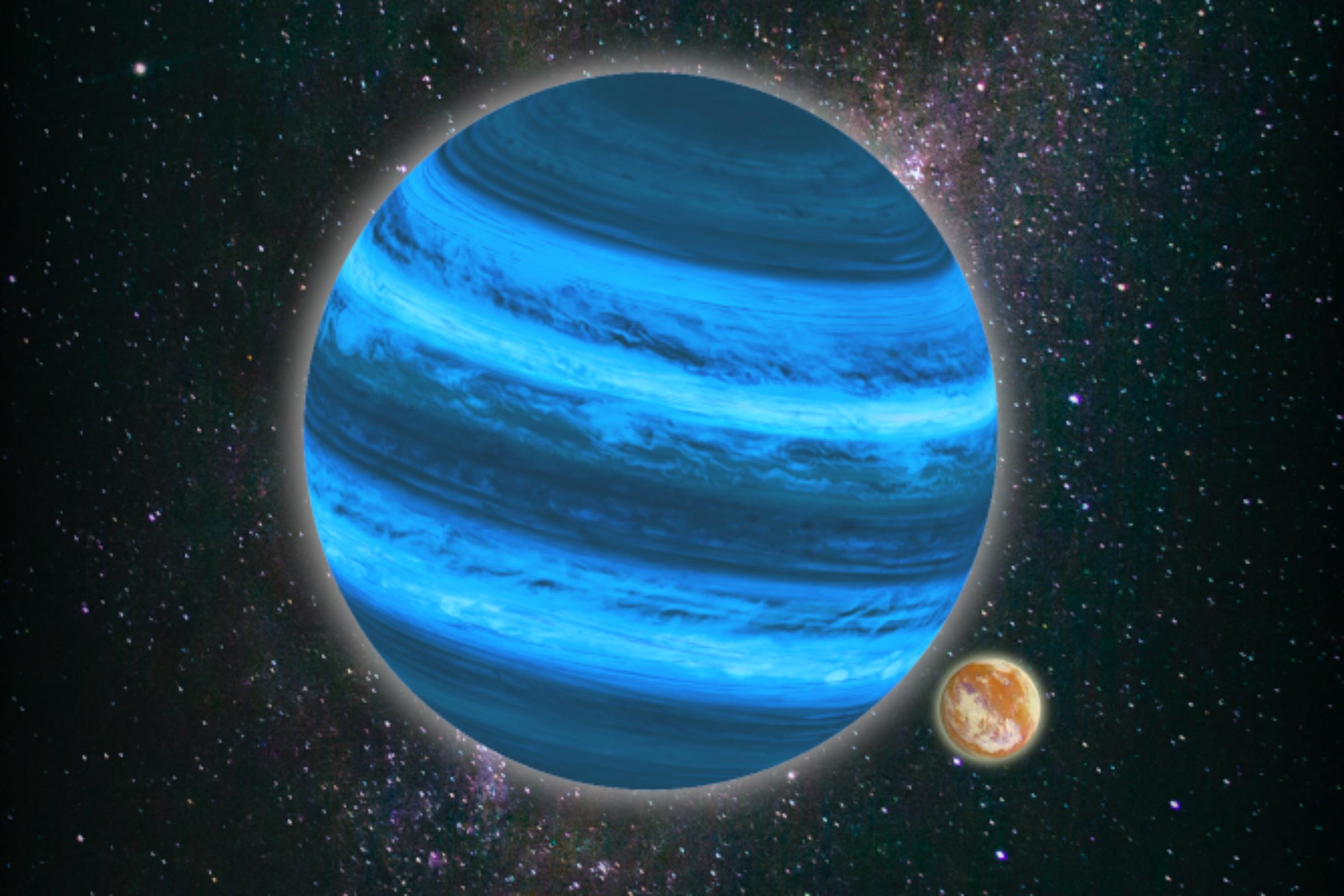
The moons of planets that have no parent star can possess an atmosphere and retain liquid water. Astrophysicists at LMU have calculated that such systems could harbor sufficient water to make life possible – and sustain it.
Water – in liquid form – is the elixir of life. It made life possible on Earth and is indispensable for the continuing existence of living systems on the planet. This explains why scientists are constantly on the lookout for evidence of water on other solid bodies in the Universe. Up to now, however, the existence of liquid water on planets other than Earth has not been directly proven. However, there are indications that several moons in the outer reaches of our own solar system – more specifically, Saturn’s Enceladus and three of Jupiter’s moons (Ganymede, Callisto, and Europa) may possess subterranean oceans. What then are the prospects for the detection of water on the moons of planets beyond our solar system?
In cooperation with colleagues at the University of Concepción in Chile, LMU physicists Prof. Barbara Ercolano and Dr. Tommaso Grassi (both of whom are members of ORIGINS, a Cluster of Excellence) have now used mathematical methods to model the atmosphere and gas-phase chemistry of a moon in orbit around a free-floating planet (FFP). An FFP is a planet that is not associated with a star.
More Than 100 Billion Planetary Nomads
FFPs are of interest mainly because the evidence indicates that there are plenty of them out there. Conservative estimates suggest that our own galaxy hosts at least as many Jupiter-sized orphan planets as there are stars – and the Milky Way itself is home to well over 100 billion stars.
Ercolano and Grassi made use of a computer model to simulate the thermal structure of the atmosphere of an exomoon of the same size as the Earth in orbit around an FFP. Their results suggest that the amount of water present on the moon’s surface would be about 10,000 times smaller than the total volume of our planet’s oceans, but 100 times larger than that found in Earth’s atmosphere. This would be enough to enable life to evolve and thrive.
The model from which this estimate was derived consists of an Earth-sized moon and a Jupiter-sized FFP. Such a system, which has no stellar companion nearby, is expected to be dark and cold. Unlike our solar system, there is no central star that can serve as a reliable source of energy to drive chemical reactions.
Rather, in the researchers’ model, cosmic rays provide the chemical drive necessary to convert molecular hydrogen and carbon dioxide into water and other products. To keep the system stirred up, the authors invoke the tidal forces exerted by the planet on its moon as a source of heat – and assuming that carbon dioxide accounts for 90% of the moon’s atmosphere, the resulting greenhouse effect would effectively retain a large part of the heat generated on the moon. Together, these energy sources would suffice to keep water in the liquid state.
Reference: “Presence of water on exomoons orbiting free-floating planets: a case study” by Patricio Javier Ávila, Tommaso Grassi, Stefano Bovino, Andrea Chiavassa, Barbara Ercolano, Sebastian Oscar Danielache and Eugenio Simoncini, 8 June 2021, International Journal of Astrobiology.
DOI: 10.1017/S1473550421000173
Never miss a breakthrough: Join the SciTechDaily newsletter.
Follow us on Google and Google News.
3 Comments
It’s fun to speculate this kind of thing, and we need to look in all places, but there are so many current science problems with this. The radiation scenario is just not conducive. Such a planet would be lambasted with too much cosmic radiation for significant life, if any. Would the planet have a magnetic field? (And yes, even an electric field–at a habitable level?) Without them even our earth would be lifeless. Plus, where would it get its heavy elements? Yes, nearby supernovae could help, but chances of the right mix are slim. It took multiple nearby supernovae (very early on of different types) to have our solar system have the right elements for advanced life at least. Would rotation rate be right? What about having to also be in the perfect UV habitable zone? (Of the 4,777 exoplanets we know about, we can’t even find one where the water and UV habitable zone intersect.) Or effects of stellar magnetic wind? Over time there could be tidal locking which is a limiting aspect. And, I’m not convinced the math supports the idea that tidal effects render enough energy. Not even close. Photosynthesis can’t work with cosmic radiation (and no light from a star). How thick is the atmosphere — probably too thick. The list goes on. Anything is possible. But, even with a high number of FFPs, the math just works strongly against it. Thanks for the article, but it seems a little afield of normative and well-established astronomy.
That makes me see C02 in a whole other light: darkness. I wonder if organisms on dark planets have viable methods to acquire vitamin D or if they evolved in such a way that there’s no need for it.
There is another problem, think of how Jupiter & Saturn first formed, they are born as rocky planets at the start that went on to draw in the lighter gasses. Say Jupiter starts with a rocky core of 10 earths before it eventually becomes 100s times bigger as a gas giant. How could an earth size rocky planet even form in such close proximity to that while still getting its own right ingredients to support future life. Also I would think that water, ammonia, and methane would be in similar abundance based of C,N,O abundance, good for making the gas giants, not so much for forming earth type planets.