
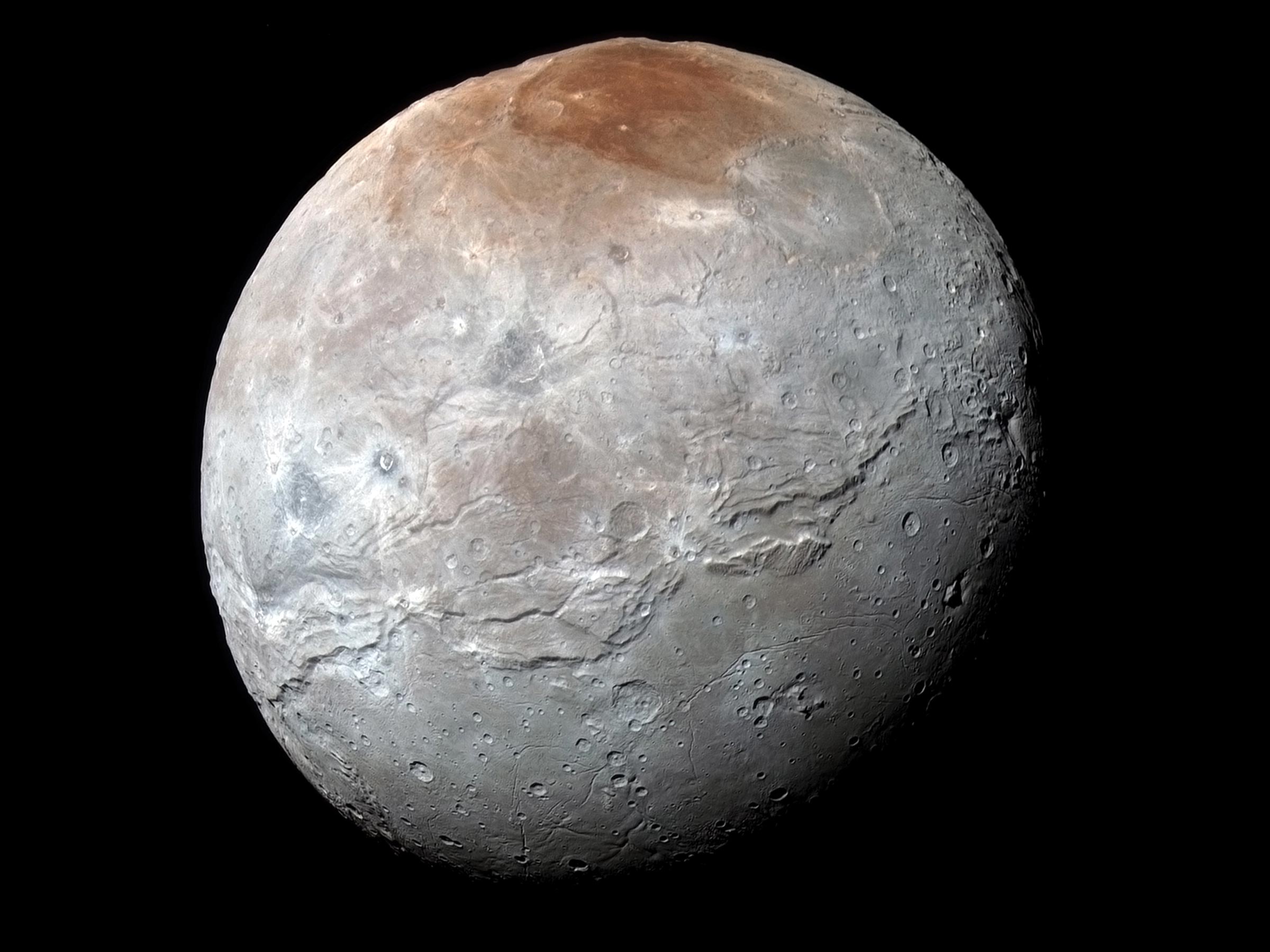
Research combined spacecraft data with new lab experiments and models of Pluto’s largest moon.
Southwest Research Institute (SwRI) scientists combined data from NASA’s New Horizons mission with cutting-edge laboratory experiments and exospheric modeling to reveal the likely composition of the red cap on Pluto’s moon Charon and how it may have formed. This first-ever description of Charon’s dynamic methane atmosphere using new experimental data provides a fascinating glimpse into the origins of this moon’s red spot as described in two recent papers.
Charon is the largest of Pluto’s moons. At half the size of Pluto, it is the largest known satellite relative to its parent body. Charon orbits Pluto every 6.4 Earth days. James Christy and Robert Harrington discovered Charon in 1978 at the U.S. Naval Observatory in Flagstaff, Arizona.
“Prior to New Horizons, the best Hubble images of Pluto revealed only a fuzzy blob of reflected light,” said SwRI’s Randy Gladstone, a member of the New Horizons science team. “In addition to all the fascinating features discovered on Pluto’s surface, the flyby revealed an unusual feature on Charon, a surprising red cap centered on its north pole.”
Formation of Charon’s Red Cap
Soon after the 2015 encounter, New Horizons scientists proposed that a reddish “tholin-like” material at Charon’s pole could be synthesized by ultraviolet light breaking down methane molecules. These are captured after escaping from Pluto and then frozen onto the moon’s polar regions during their long winter nights. Tholins are sticky organic residues formed by chemical reactions powered by light, in this case the Lyman-alpha ultraviolet glow scattered by interplanetary hydrogen atoms.
“Our findings indicate that drastic seasonal surges in Charon’s thin atmosphere, as well as light breaking down the condensing methane frost, are key to understanding the origins of Charon’s red polar zone,” said SwRI’s Dr. Ujjwal Raut, lead author of a paper titled “Charon’s Refractory Factory” in the journal Science Advances. “This is one of the most illustrative and stark examples of surface-atmospheric interactions so far observed at a planetary body.”
The team realistically replicated Charon surface conditions at SwRI’s new Center for Laboratory Astrophysics and Space Science Experiments (CLASSE) to measure the composition and color of hydrocarbons produced on Charon’s winter hemisphere as methane freezes beneath the Lyman-alpha glow. The team fed the measurements into a new atmospheric model of Charon to show methane breaking down into residue on Charon’s north polar spot.
“Our team’s novel ‘dynamic photolysis’ experiments provided new limits on the contribution of interplanetary Lyman-alpha to the synthesis of Charon’s red material,” Raut said. “Our experiment condensed methane in an ultra-high vacuum chamber under exposure to Lyman-alpha photons to replicate with high fidelity the conditions at Charon’s poles.”
SwRI scientists also developed a new computer simulation to model Charon’s thin methane atmosphere.
“The model points to ‘explosive’ seasonal pulsations in Charon’s atmosphere due to extreme shifts in conditions over Pluto’s long journey around the Sun,” said Dr. Ben Teolis, lead author of a related paper titled “Extreme Exospheric Dynamics at Charon: Implications for the Red Spot” in the journal Geophysical Research Letters.
Solar Wind and Red Material Formation
The team input the results from SwRI’s ultra-realistic experiments into the atmospheric model to estimate the distribution of complex hydrocarbons emerging from methane decomposition under the influence of ultraviolet light. The model has polar zones primarily generating ethane, a colorless material that does not contribute to a reddish color.
“We think ionizing radiation from the solar wind decomposes the Lyman-alpha-cooked polar frost to synthesize increasingly complex, redder materials responsible for the unique albedo on this enigmatic moon,” Raut said. “Ethane is less volatile than methane and stays frozen to Charon’s surface long after spring sunrise. Exposure to the solar wind may convert ethane into persistent reddish surface deposits contributing to Charon’s red cap.”
“The team is set to investigate the role of solar wind in the formation of the red pole,” said SwRI’s Dr. Josh Kammer, who secured continued support from NASA’s New Frontier Data Analysis Program.
Reference: “Extreme Exospheric Dynamics at Charon: Implications for the Red Spot” by Ben Teolis, Ujjwal Raut, Joshua A. Kammer, Caleb J. Gimar, Carly J. A. Howett, G. Randall Gladstone and Kurt D. Retherford, 15 April 2022, Geophysical Research Letters.
DOI: 10.1029/2021GL097580
Never miss a breakthrough: Join the SciTechDaily newsletter.
Follow us on Google and Google News.