
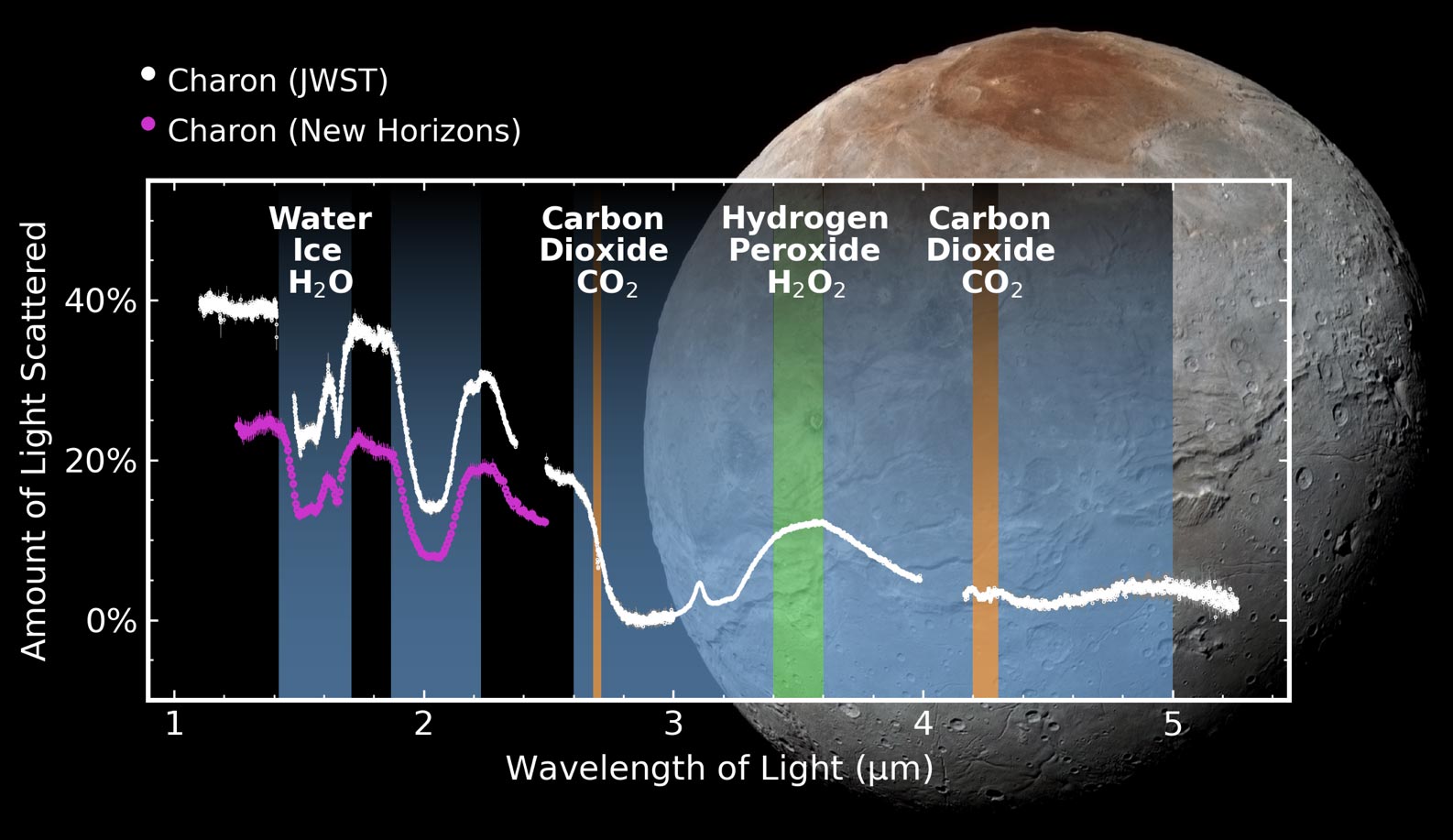
Scientists have detected carbon dioxide and hydrogen peroxide on the frozen surface of Pluto’s largest moon, Charon, using data from the James Webb Space Telescope.
This marks the first discovery of these chemicals on Charon and expands its known chemical inventory, which previously included water ice, ammonia compounds, and the organic materials responsible for its gray and red hues, identified through both ground- and space-based observations.
Groundbreaking Discoveries on Charon
A team led by Southwest Research Institute (SwRI) has detected carbon dioxide and hydrogen peroxide on the frozen surface of Pluto’s largest moon, Charon, using data from the James Webb Space Telescope. This marks the first discovery of these chemicals on Charon and expands its known chemical inventory, which previously included water ice, ammonia compounds, and the organic materials responsible for its gray and red hues, identified through both ground- and space-based observations.
“Charon is the only midsized Kuiper Belt object, in the range of 300 to 1,000 miles in diameter, that has been geologically mapped, thanks to the SwRI-led New Horizons mission, which flew by the Pluto system in 2015,” said Dr. Silvia Protopapa of SwRI, lead author of a new study in Nature Communications and co-investigator of the New Horizons mission that mapped the Pluto system in 2015. “Unlike many of the larger objects in the Kuiper Belt, the surface of Charon is not obscured by highly volatile ices such as methane and therefore provides valuable insights into how processes like sunlight exposure and cratering affect these distant bodies.”
An SwRI-led team detected carbon dioxide and hydrogen peroxide spectral signatures on Pluto’s largest moon Charon using Webb telescope observations (white), which extend the wavelength coverage of previous New Horizons flyby measurements (pink). The JWST and New Horizons data are consistent in the spectral shape and the strength of the absorption bands at short wavelengths of light; the offset in the absolute amount of scattered light can largely be attributed to differences in viewing geometries. These findings offer clues about the formation and evolution of Charon, shown in the background as imaged by New Horizons. Credit: S. Protopapa/SwRI/NASA/ESA/CSA/STSci/JHUAPL
Webb Telescope’s Role in Exploring Charon
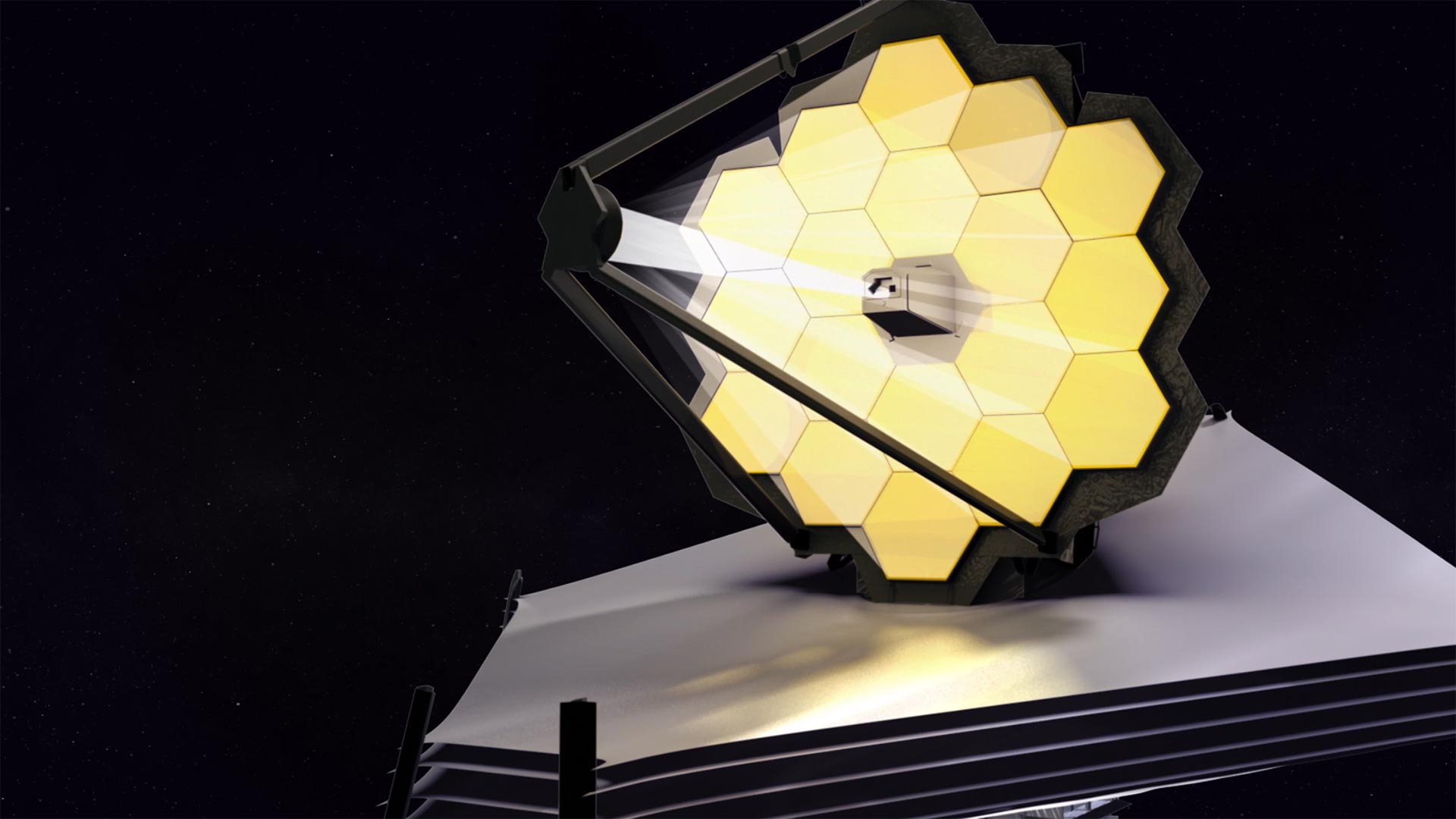
The James Webb Space Telescope is ideally suited for exploring Charon and other icy bodies beyond Neptune. In 2022 and 2023, the team used Webb’s Near-Infrared Spectrograph to make four observations of the Pluto-Charon system, with different viewing angles providing comprehensive coverage of Charon’s northern hemisphere.
“The advanced observational capabilities of Webb enabled our team to explore the light scattered from Charon’s surface at longer wavelengths than what was previously possible, expanding our understanding of the complexity of this fascinating object,” said Dr. Ian Wong, a staff scientist at the Space Telescope Science Institute and co-author of the paper.
Chemical Insights From Spectral Analysis
The extended wavelength coverage of Charon’s Webb measurements reveals signatures of carbon dioxide. The team compared the spectroscopic observations with laboratory measurements and detailed spectral models of the surface, concluding that carbon dioxide is present primarily as a surface veneer on a water ice-rich subsurface.
“Our preferred interpretation is that the upper layer of carbon dioxide originates from the interior and has been exposed to the surface through cratering events. Carbon dioxide is known to be present in regions of the protoplanetary disk from which the Pluto system formed,” Protopapa said.
The Impact of Solar Forces on Charon
The presence of hydrogen peroxide on the surface of Charon clearly indicates that the water ice-rich surface is altered by solar ultraviolet light and energetic particles from the solar wind and galactic cosmic rays. Hydrogen peroxide forms from oxygen and hydrogen atoms originating from the breakup of water ice due to incoming ions, electrons or photons.
“Laboratory experiments conducted at SwRI’s CLASSE (Center for Laboratory Astrophysics and Space Science Experiments) facility were instrumental in demonstrating that hydrogen peroxide can form even in mixtures of carbon dioxide and water ice under conditions analogous to those at Charon,” said SwRI’s Dr. Ujjwal Raut, leader of CLASSE lab and second author of the paper.
Synthesis of Observational and Experimental Research
The team’s research showcases the Webb telescope’s unparalleled capability to uncover complex surface signatures shaped by impacts and irradiation processes.
“The new insights were made possible by the synergy between Webb observations, spectral modeling and laboratory experiments and are possibly applicable to other similar midsized objects beyond Neptune,” said Protopapa.
Reference: “Detection of carbon dioxide and hydrogen peroxide on the stratified surface of Charon with JWST” by Silvia Protopapa, Ujjwal Raut, Ian Wong, John Stansberry, Geronimo L. Villanueva, Jason Cook, Bryan Holler, William M. Grundy, Rosario Brunetto, Richard J. Cartwright, Bereket Mamo, Joshua P. Emery, Alex H. Parker, Aurelie Guilbert-Lepoutre, Noemi Pinilla-Alonso, Stefanie N. Milam and Heidi B. Hammel, 1 October 2024, Nature Communications.
DOI: 10.1038/s41467-024-51826-4
See also the ‘Behind the Paper’ post from lead author Dr. Silvia Protopapa on the Springer Nature Research Communities webpage.
The data used in this work were acquired with the JWST/NIRSpec instrument through Program 1191 (PI: J. Stansberry).
Never miss a breakthrough: Join the SciTechDaily newsletter.
Follow us on Google and Google News.