
Close Menu
    Facebook X (Twitter) Instagram
    SciTechDaily
    • Biology
    • Chemistry
    • Earth
    • Health
    • Physics
    • Science
    • Space
    • Technology
    Facebook X (Twitter) Pinterest YouTube RSS
    SciTechDaily
    Home»Space»False Color Images Show the Complexity of Pluto and Charon
    Space

    False Color Images Show the Complexity of Pluto and Charon

    By NASAJuly 15, 2015No Comments4 Mins Read
    Facebook Twitter Pinterest Telegram LinkedIn WhatsApp Email Reddit
    Share
    Facebook Twitter LinkedIn Pinterest Telegram Email Reddit
    Pluto and Charon Shine in False Color Image
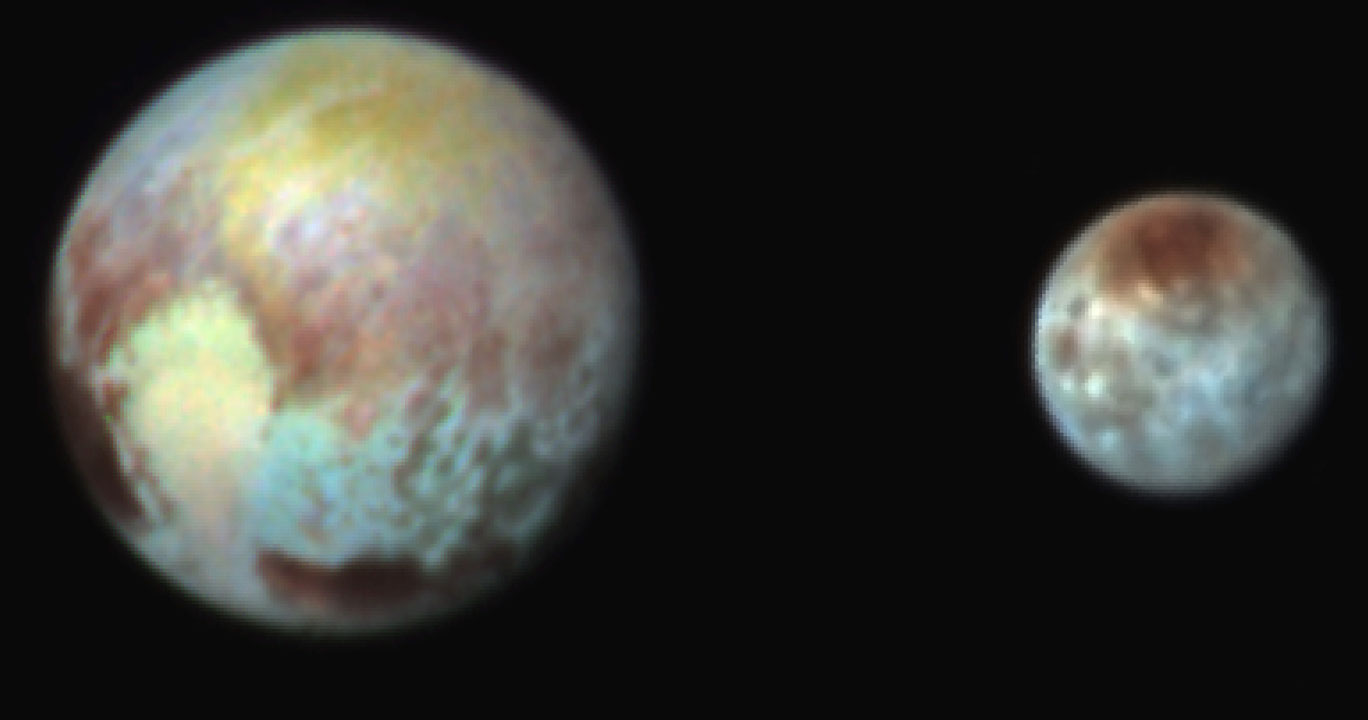
    This July 13, 2015, image of Pluto and Charon is presented in false colors to make differences in surface material and features easy to see. It was obtained by the Ralph instrument on NASA’s New Horizons spacecraft, using three filters to obtain color information, which is exaggerated in the image. These are not the actual colors of Pluto and Charon, and the apparent distance between the two bodies has been reduced for this side-by-side view. The image reveals that the bright heart-shaped region of Pluto includes areas that differ in color characteristics. The western lobe, shaped like an ice cream cone, appears peach color in this image. A mottled area on the right (east) appears bluish. Even within Pluto’s northern polar cap, in the upper part of the image, various shades of yellow-orange indicate subtle compositional differences. The surface of Charon is viewed using the same exaggerated color. The red on the dark northern polar cap of Charon is attributed to hydrocarbon materials including a class of chemical compounds called tholins. The mottled colors at lower latitudes point to the diversity of terrains on Charon. This image was taken at 3:38 a.m. EDT on July 13, one day before New Horizons’ closest approach to Pluto. Credit: NASA/APL/SwRI

    These new false color images from the New Horizons Spacecraft reveal that Pluto and Charon are truly complex worlds.

    New Horizons has obtained impressive new images of Pluto and its large moon Charon that highlight their compositional diversity. These are not actual color images of Pluto and Charon—they are shown here in exaggerated colors that make it easy to note the differences in surface material and features on each planetary body.

    The images were obtained using three of the color filters of the “Ralph” instrument on July 13 at 3:38 am EDT. New Horizons has seven science instruments on board the spacecraft—including “Ralph” and “Alice”, whose names are a throwback to the “Honeymooners,” a popular 1950s sitcom.

    “These images show that Pluto and Charon are truly complex worlds. There’s a whole lot going on here,” said New Horizons co-investigator Will Grundy, Lowell Observatory, Flagstaff, Arizona. “Our surface composition team is working as fast as we can to identify the substances in different regions on Pluto and unravel the processes that put them where they are.”

    The color data helps scientists understand the molecular make-up of ices on the surfaces of Pluto and Charon, as well as the age of geologic features such as craters. They can also tell us about surface changes caused by space “weather,” such as radiation.

    The new color images reveal that the “heart” of Pluto actually consists of two remarkably different-colored regions. In the false-color image, the heart consists of a western lobe shaped like an ice cream cone that appears peach color in this image. A mottled area on the right (east) side looks bluish. A mid-latitude band appears in shades ranging from pale blue to red. Even within the northern polar cap, in the upper part of the image, various shades of yellow-orange indicate subtle compositional differences. This image was obtained using three of the color filters of the Ralph instrument on July 13 at 3:38 am EDT and received on the ground on at 12:25 pm.

    Charon is Just as Colorful

    The surface of Charon is viewed using the same exaggerated color. The red on the dark northern polar cap of Charon is attributed to hydrocarbon and other molecules, a class of chemical compounds called tholins. The mottled colors at lower latitudes point to the diversity of terrains on Charon. This image was obtained using three of the color filters of the Ralph instrument on July 13 at 3:38 am EDT and received on the ground at 12:25 pm.

    “We make these color images to highlight the variety of surface environments present in the Pluto system,” said Dennis Reuter, co-investigator with the New Horizons Composition Team. “They show us in an intuitive way that there is much still to learn from the data coming down.”

    Due to the three-billion-mile distance to Pluto, data takes 4 ½ hours to come to Earth, even at the speed of light. It will take 16 months for all of New Horizons’ science data to be received, and the treasure trove from this mission will be studied for decades to come.

    Never miss a breakthrough: Join the SciTechDaily newsletter.
    Follow us on Google and Google News.

    Charon NASA New Horizons Planetary Science Pluto Popular
    Share. Facebook Twitter Pinterest LinkedIn Email Reddit

    Related Articles

    New Horizons Reveals Charon’s Colorful and Violent History

    Data from NASA’s New Horizons Hints at Underground Ocean on Pluto

    New Horizons Reveals Flowing Ices, Exotic Surface Chemistry, Mountains, and Haze on Pluto

    Latest New Horizons Portrait of Pluto and Charon

    New Horizons Reveals a Dense Region of Atmospheric Ions Behind Pluto

    New Horizons Measures Size of Pluto, Settles Decades-Long Debate

    NASA’s New Horizons Spacecraft Reaches Historic Encounter with Pluto

    New Horizons Reveals Signs of Pluto’s Geology

    Dwarf Planet Pluto: The ‘Other’ Red Planet

    Leave A Reply Cancel Reply

    • Facebook
    • Twitter
    • Pinterest
    • YouTube

    Don't Miss a Discovery

    Subscribe for the Latest in Science & Tech!

    Trending News

    Your Blood Pressure Reading Could Be Wrong Because of One Simple Mistake

    Astronomers Stunned by Ancient Galaxy With No Spin

    Physicists May Be on the Verge of Discovering “New Physics” at CERN

    Scientists Solve 320-Million-Year Mystery of Reptile Skin Armor

    Scientists Say This Daily Walking Habit May Be the Secret to Keeping Weight Off After Dieting

    New Therapy Rewires the Brain To Restore Joy in Depression Patients

    Giant Squid Detected off Western Australia in Stunning Deep-Sea Discovery

    Popular Sugar-Free Sweetener Linked to Liver Disease, Study Warns

    Follow SciTechDaily
    • Facebook
    • Twitter
    • YouTube
    • Pinterest
    • Newsletter
    • RSS
    SciTech News
    • Biology News
    • Chemistry News
    • Earth News
    • Health News
    • Physics News
    • Science News
    • Space News
    • Technology News
    Recent Posts
    • Hidden Warm Water Beneath Antarctica Could Rapidly Raise Global Sea Levels
    • Scientists Revive Ancient Chemistry Trick To Engineer Next-Generation Glass
    • Scientists Use AI To Supercharge Ultrafast Laser Simulations by More Than 250x
    • Scientists Just Found a Surprising Way To Destroy “Forever Chemicals”
    • Popular Supplement Ingredient Linked to Shorter Lifespan in Men
    Copyright © 1998 - 2026 SciTechDaily. All Rights Reserved.
    • Science News
    • About
    • Contact
    • Editorial Board
    • Privacy Policy
    • Terms of Use

    Type above and press Enter to search. Press Esc to cancel.