
Close Menu
    Facebook X (Twitter) Instagram
    SciTechDaily
    • Biology
    • Chemistry
    • Earth
    • Health
    • Physics
    • Science
    • Space
    • Technology
    Facebook X (Twitter) Pinterest YouTube RSS
    SciTechDaily
    Home»Space»KPS-1b: First Transiting Exoplanet Discovered Using Amateur Data
    Space

    KPS-1b: First Transiting Exoplanet Discovered Using Amateur Data

    By Inna Mikhaydarova, Ural Federal UniversityMay 17, 2018No Comments2 Mins Read
    Facebook Twitter Pinterest Telegram LinkedIn WhatsApp Email Reddit
    Share
    Facebook Twitter LinkedIn Pinterest Telegram Email Reddit
    First Transiting Exoplanet Discovered Using an Amateur Astronomer's Wide field CCD Data
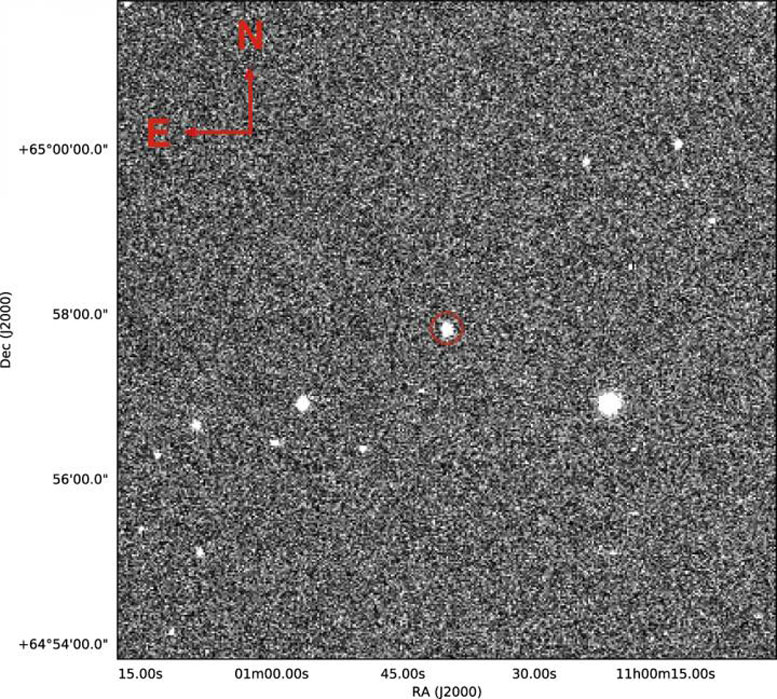
    Finding chart including KPS-1 host star as obtained with the MTM-500 telescope in V band. Kourovka Planet Search project

    One of the candidates previously found by the Kourovka Planet Search (KPS) project turned out to be the so-called hot Jupiter. The exoplanet, known as KPS-1b, orbits a star similar to the Sun with a period of 40 hours. The mass and size of the exoplanet KPS-1b are close to the characteristics of Jupiter, but it is located very close to its parent star. Due to such proximity to the star, the temperature of the atmosphere KPS-1b is much higher than that of Jupiter.

    Software for analyzing data and searching exoplanet candidates was developed in UrFU. Subsequent observations of exoplanets candidates were conducted in a number of observatories around the world including the Special Astrophysical Observatory of the Russian Academy of Sciences. Spectral observations, which allowed calculating the mass of the exoplanet, were conducted at Haute-Provence Observatory (France).

    According to the researchers, the current discovery is unique due to the fact that signs of exoplanet existence (exoplanetary transits) were found in the data gathered by an amateur astronomer using readily available and relatively affordable equipment. The discovery was made in collaboration with astronomers from Belgium, USA, England, France, the Netherlands, Turkey, Portugal, Lithuania, Italy, and Canada. The search for new exoplanets, as well as detailed studies of already known extrasolar planets, allow scientists to come closer to understanding how our solar system was formed and evolved.

    Reference: “KPS-1b: The First Transiting Exoplanet Discovered Using an Amateur Astronomer’s Wide-field CCD Data” by Artem Burdanov, Paul Benni, Eugene Sokov, Vadim Krushinsky, Alexander Popov, Laetitia Delrez, Michael Gillon, Guillaume Hébrard, Magali Deleui, Paul A. Wilson, Olivier Demangeon, Özgür Baştürk, Erika Pakštiene, Iraida Sokova, Sergei A. Rusov, Vladimir V. Dyachenko, Denis A. Rastegaev, Anatoliy Beskakotov, Alessandro Marchini1, Marc Bretton, Stan Shadick1 and Kirill Ivanov, 16 March 2018, PASP.
    DOI: 10.1088/1538-3873/aabde2

    Never miss a breakthrough: Join the SciTechDaily newsletter.
    Follow us on Google and Google News.

    Astronomy Exoplanet Planetary Science Ural Federal University
    Share. Facebook Twitter Pinterest LinkedIn Email Reddit

    Related Articles

    Mysterious “Soot Planets” May Be Hiding in Plain Sight Among the Stars

    Planetary Collisions Could Hold the Key to Alien Habitability

    This Earth-Sized Exoplanet Is Racing Toward Its Own Destruction

    Astronomers Discover Potentially Habitable Earth-Like Planet Just 35 Light-Years Away

    Cosmic Death Spiral: Astronomers Catch Planet in Final Orbit Before Destruction

    A Super-Earth Stripped Bare: Astronomers Uncover One of the Densest Planets Ever Found

    “Truly Remarkable” – Scientists Discover Record-Breaking Super-Earth That Is As Dense as Lead

    Astronomers Uncover Vast Array of Strange Alien Worlds

    International Planet Hunters Discover Dozens of Strange New Worlds

    Leave A Reply Cancel Reply

    • Facebook
    • Twitter
    • Pinterest
    • YouTube

    Don't Miss a Discovery

    Subscribe for the Latest in Science & Tech!

    Trending News

    The Strange “Spacetime Crystal” That Can Suddenly Turn Into a Black Hole

    The Surprising Way Asteroids May Have Helped Life Begin on Earth

    Vast Hidden Structure Discovered Under Miles of Ice in East Antarctica

    A Surprising Discovery Suggests Autism Is Not One Condition

    New Alzheimer’s Discovery Could Change How Scientists Fight the Disease

    Yale Discovery Overturns Long-Held “Evolutionary Dead End” Theory

    UCLA Scientists Uncover a “Hidden Weakness” in Some of the World’s Deadliest Cancers

    Humpback Whale Stuns Scientists With 15,000 Kilometer Journey Across Oceans

    Follow SciTechDaily
    • Facebook
    • Twitter
    • YouTube
    • Pinterest
    • Newsletter
    • RSS
    SciTech News
    • Biology News
    • Chemistry News
    • Earth News
    • Health News
    • Physics News
    • Science News
    • Space News
    • Technology News
    Recent Posts
    • Food Waste Becomes a Powerful Carbon Trap in Climate Breakthrough
    • Battery-Free Artificial Photosynthesis Turns Sunlight, Water, and CO2 Into Fuel
    • How Ancient People Moved a 6-Ton Stone 700 Kilometers to Stonehenge
    • Scientists Finally See How Antibodies Really Attack Viruses
    • The Unexpected Gut Health Risk of Cutting Out Sugar
    Copyright © 1998 - 2026 SciTechDaily. All Rights Reserved.
    • Science News
    • About
    • Contact
    • Editorial Board
    • Privacy Policy
    • Terms of Use

    Type above and press Enter to search. Press Esc to cancel.