
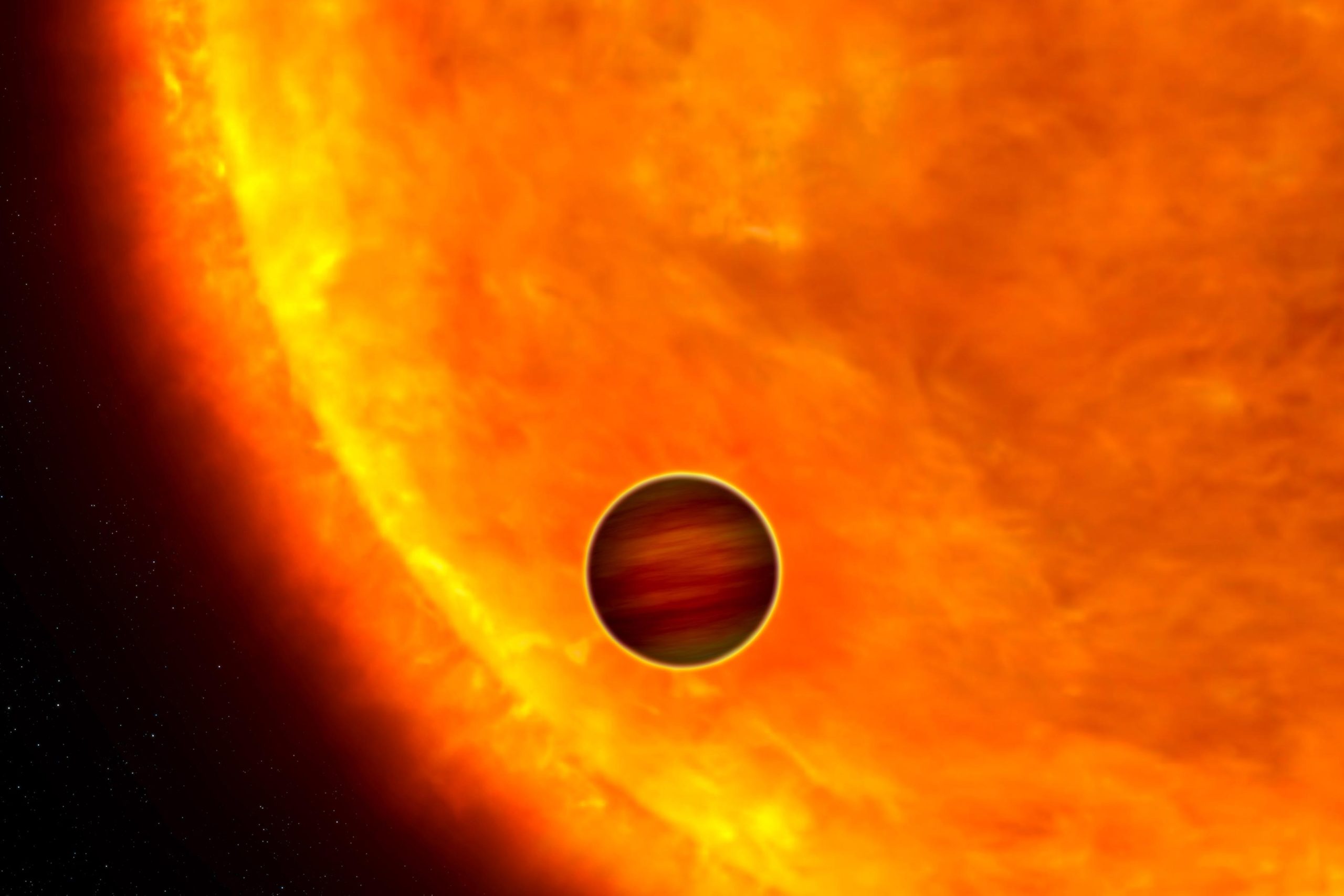
TOI-2109b is an ultrahot Jupiter located 855 light-years away, orbiting its star in just 16 hours—the shortest orbit ever measured for a gas giant.
Mercury is the speed champion in our Solar System. It orbits the Sun every 88 days, and its average speed is 47 km/s. Its average distance from the Sun is 58 million km (36 million miles), and it’s so fast it’s named after Mercury, the wing-footed God.
But what if instead of Mercury, Jupiter was closest to the Sun? And what if Jupiter was even closer to the Sun than Mercury and far hotter?
In a remote solar system about 855 light-years away, there’s a planet that makes Mercury seem like a slow, chilled, distant neighbor of the Sun. This planet orbits its star in only 16 hours, giving it one of the shortest orbits ever measured. At that distance and speed, and with the planet’s extremely high surface temperatures, it’s one of the most exotic planets ever found.
The planet’s name is TOI-2109b, and it’s what astronomers call an “Ultrahot Jupiter.” Hot Jupiters are gas giants that orbit extraordinarily close to their stars and have extremely high surface temperatures. Ultrahot Jupiters are even more extreme. Their surface temperatures are greater than 2200 Kelvin (1900 C, 3500 F). Astronomers estimate that TOI-2109 b’s dayside temperature is greater than 3500 K (3225 C, 5840 F), as hot as some small stars.
A new paper published in The Astronomical Journal presented the discovery. The paper’s title is “TOI-2109: An Ultrahot Gas Giant on a 16 hr Orbit.” The lead author is Ian Wong, currently at NASA’s Goddard Space Flight Center, but a postdoc at MIT during this research.
How Astronomers Found This Extreme World
NASA’s TESS (Transiting Exoplanet Survey Satellite) found the planet in May 2020. TESS started observing it on May 13th and kept watching for almost a month. Over the next year, multiple ground-based observatories performed follow-up observations in different wavelengths. All those observations confirmed that TOI-2109b is a rare and unusual planet.
“Everything was consistent with it being a planet, and we realized we had something very interesting and relatively rare,” said study co-author Avi Shporer from MIT’s Kavli Institute for Astrophysics and Space Research.
TOI-2109 b’s 16-hour orbital period is the shortest ever measured for a gas giant. (The previous record-holder has an 18-hour orbit.) The planet is about five times more massive than our own Jupiter, and it orbits an F-type star about 1.5 times more massive than our Sun. It’s difficult to imagine what this arrangement would look like to any observer in the same system.
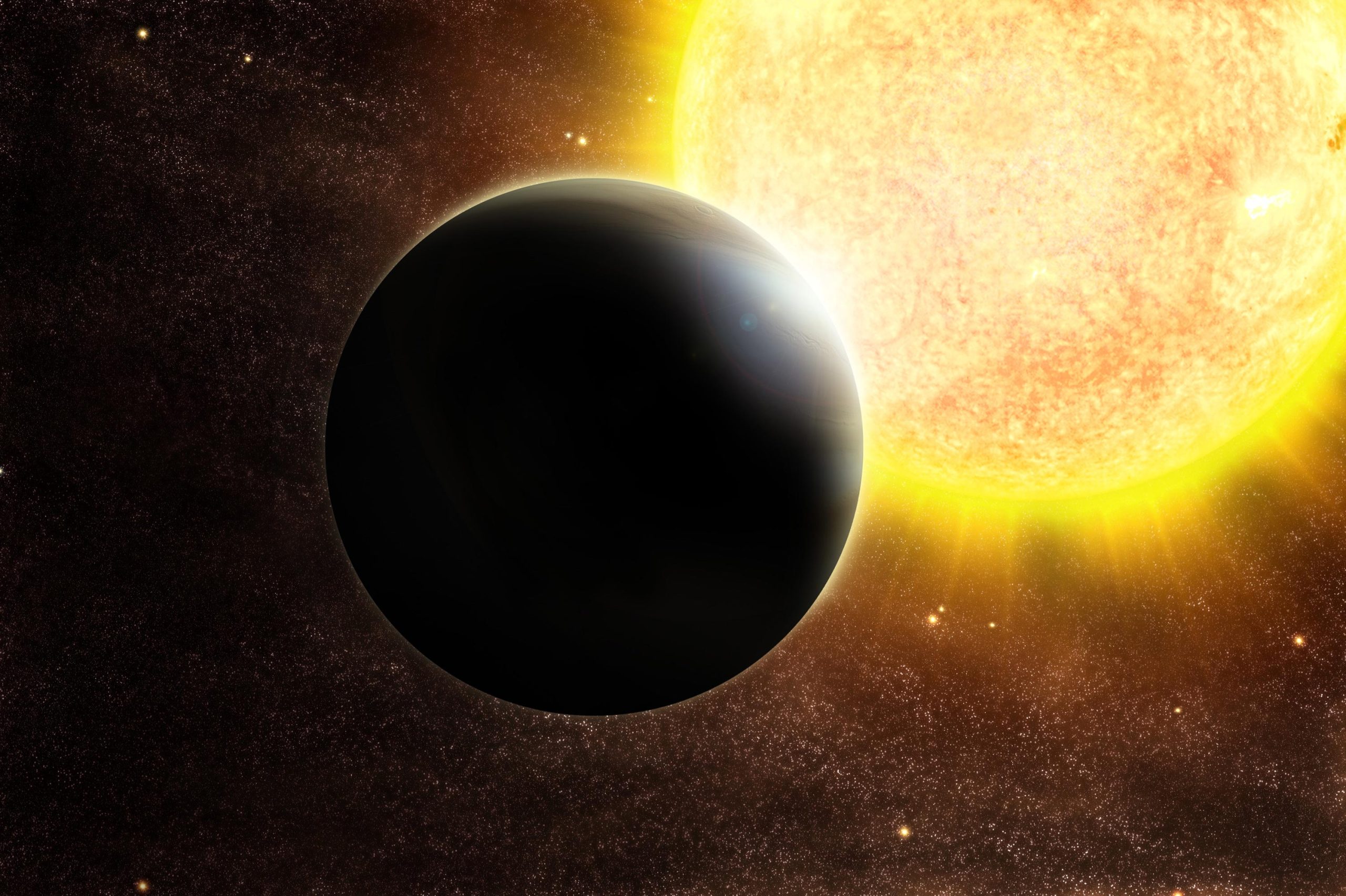
The planet is so hot because it’s an average of only 2.4 million km (1.5 million mi) from its star. It’s probably tidally locked to its star like other Hot Jupiters and Ultrahot Jupiters. The extremely high dayside temperature can tear molecules apart into their constituent atoms. Theoretical modeling shows that this can happen to molecular hydrogen. If the night side is significantly cooler, the hydrogen can combine into molecules again.
A month of TESS observations meant that the team could observe the planet as it orbited its star. They watched the secondary eclipse—when a planet passes behind its star—in multiple wavelengths. That helped them determine that the daytime temperature likely exceeds 3500 K. But the researchers aren’t sure what happens on the nightside because TESS isn’t sensitive enough. If it’s true that molecular hydrogen is torn apart on the dayside and recombines on the nightside, then that could contribute to more efficient temperature mixing in the atmosphere and could mean the temperature isn’t as extreme.
“Meanwhile, the planet’s night side brightness is below the sensitivity of the TESS data, which raises questions about what is really happening there,” said Shporer. “Is the temperature there very cold, or does the planet somehow take heat on the day side and transfer it to the night side? We’re at the beginning of trying to answer this question for these ultrahot Jupiters.”
Spiraling Toward Destruction
The researchers found that TOI-2109b is slowly spiraling into the star at about 10 to 750 milliseconds per year. Astronomers have found other Hot Jupiters whose orbital decay draws them into their stars, but nothing as fast as this.
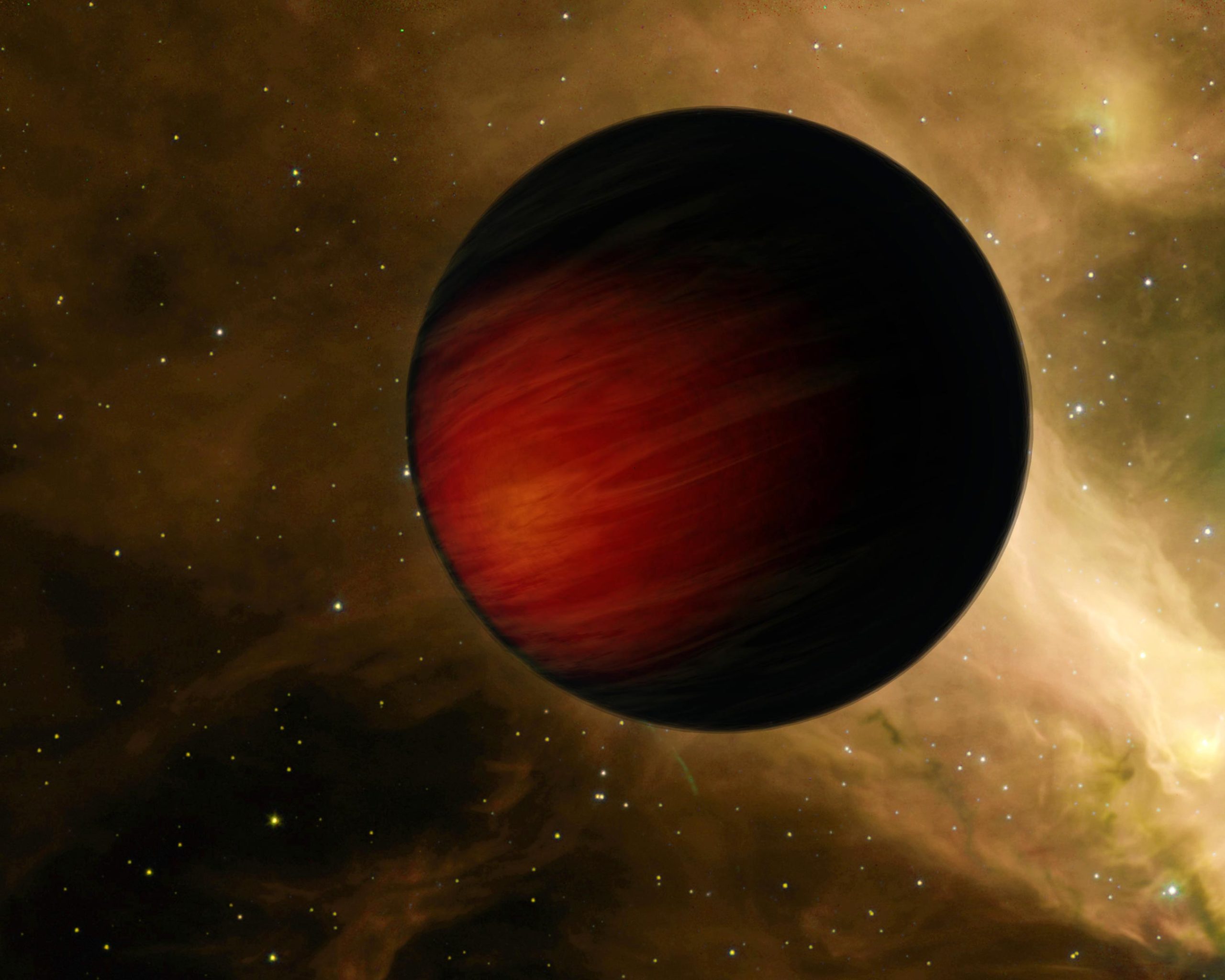
TOI-210 b’s extreme nature helps confirm the status of Ultrahot and Hot Jupiters as one of the most extreme types of exoplanets. More powerful telescopes will reveal more of the planet’s nature, and the team hopes that the Hubble will be able to study it, along with the soon-to-be-launched James Webb Space Telescope. Watching what happens as the planet gets closer and closer to the star is especially interesting to astronomers.
“Ultrahot Jupiters such as TOI-2109b constitute the most extreme subclass of exoplanet,” Wong says. “We have only just started to understand some of the unique physical and chemical processes that occur in their atmospheres — processes that have no analogs in our own solar system.”
Clues to Planetary Migration
Future observations of TOI-2109b may also reveal clues to how such dizzying systems come to be in the first place. “From the beginning of exoplanetary science, hot Jupiters have been seen as oddball,” Shporer says. “How does a planet as massive and large as Jupiter reach an orbit that is only a few days long? We don’t have anything like this in our Solar System, and we see this as an opportunity to study them and help explain their existence.”
In the distant past, Jupiter may have migrated to within 1.5 AU of the Sun before reversing course to the orbital path it follows now. That’s called the Grand Tack Hypothesis. That would’ve been something for human eyes to behold.
How Rare Are Ultrahot Jupiters?
Finding extreme and unusual exoplanets teaches us a lot about the range of planet types out there. Exoplanet surveys find lots of Hot Jupiters and Ultrahot Jupiters because they’re huge and close to their stars. But they’re actually scarce.
The authors point out that only about 0.5% of Sun-like stars host these extreme planets. But even though their numbers are few, they make a massive contribution to our understanding of exoplanets overall. “Their large size in relation to their host stars and high temperatures enable a broad range of intensive studies that extend far beyond the rudimentary measurements of planet mass and radius,” the authors explain.
“Over the past two decades, a wide arsenal of observational techniques has been leveraged to probe the atmospheric properties of hot Jupiters in ever-increasing detail,” they write in their paper. Things like temperature distribution, chemical composition, condensate clouds, photochemical hazes, and heat transport mechanisms are becoming easier to study.
Astronomers are learning that Ultrahot Jupiters are “… characterized by a number of distinct physical and dynamical properties that set them apart from the rest of the hot gas-giant population.”
No article on exoplanets can be complete without looking ahead to the James Webb Space Telescope. The JWST will have the power to probe exoplanet atmospheres more rigorously than any other tool currently at astronomers’ disposal.
Part of the search for and study of exoplanets is centred around finding Earth-like planets in habitable zones. But Ultrahot Jupiters like TOI-2109b can teach us a lot about planets at their most extreme and about planet-star interactions that we can’t study in our Solar System. And the JWST will make a considerable contribution to our knowledge.
“While future advances in telescope capabilities will allow for comparably in-depth explorations of smaller and cooler exoplanets, ultrahot Jupiters will continue to be among the most fruitful candidates for impactful efforts at characterization, providing crucial insights into the nature of planets at their most extreme,” the authors write.
Adapted from an article originally published on Universe Today.
For more on this discovery, read Newly Discovered Extreme “Ultrahot Jupiter” Blitzes Around Its Star – One Year Is Just 16 Hours Long.
Reference: “TOI-2109: An Ultrahot Gas Giant on a 16 hr Orbit” by Ian Wong, Avi Shporer, George Zhou, Daniel Kitzmann, Thaddeus D. Komacek, Xianyu Tan, René Tronsgaard, Lars A. Buchhave, Shreyas Vissapragada, Michael Greklek-McKeon, Joseph E. Rodriguez, John P. Ahlers, Samuel N. Quinn, Elise Furlan, Steve B. Howell, Allyson Bieryla, Kevin Heng, Heather A. Knutson, Karen A. Collins, Kim K. McLeod, Perry Berlind, Peyton Brown, Michael L. Calkins, Jerome P. de Leon, Emma Esparza-Borges, Gilbert A. Esquerdo, Akihiko Fukui, Tianjun Gan, Eric Girardin, Crystal L. Gnilka, Masahiro Ikoma, Eric L. N. Jensen, John Kielkopf, Takanori Kodama, Seiya Kurita, Kathryn V. Lester, Pablo Lewin, Giuseppe Marino, Felipe Murgas, Norio Narita, Enric Pallé, Richard P. Schwarz, Keivan G. Stassun, Motohide Tamura, Noriharu Watanabe, Björn Benneke, George R. Ricker, David W. Latham, Roland Vanderspek, Sara Seager, Joshua N. Winn, Jon M. Jenkins, Douglas A. Caldwell, William Fong, Chelsea X. Huang, Ismael Mireles, Joshua E. Schlieder, Bernie Shiao and Jesus Noel Villaseñor, 23 November 2021, Astronomical Journal.
DOI: 10.3847/1538-3881/ac26bd
Never miss a breakthrough: Join the SciTechDaily newsletter.
Follow us on Google and Google News.