
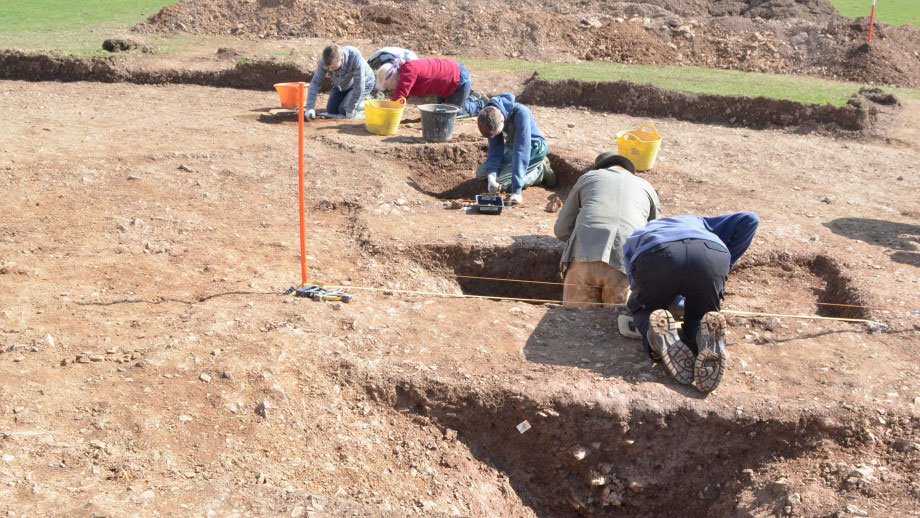
An ANU archaeologist has hailed her excavation of a Bronze Age burial mound in southwest England a huge success with the discovery of an intact 4,000-year-old human cremation as well as evidence of unaccountable activity from the medieval period on the same site.
Dr. Catherine Frieman recently excavated an untouched ancient barrow near the town of Looe in South East Cornwall. Her 14-day-dig over Easter was the first time such a site in the area has been excavated to modern archaeological standards.
She said when digging began, local farmers told her they’d plowed the field in their childhood, so she didn’t expect the site to be so well preserved.
“We were so excited to find such a lot of archaeology on the site despite scores of generations of plowing, but to find an intact clay urn buried 4,000 years ago just 25 centimeters beneath the surface is nothing short of a miracle,” said Dr. Frieman.
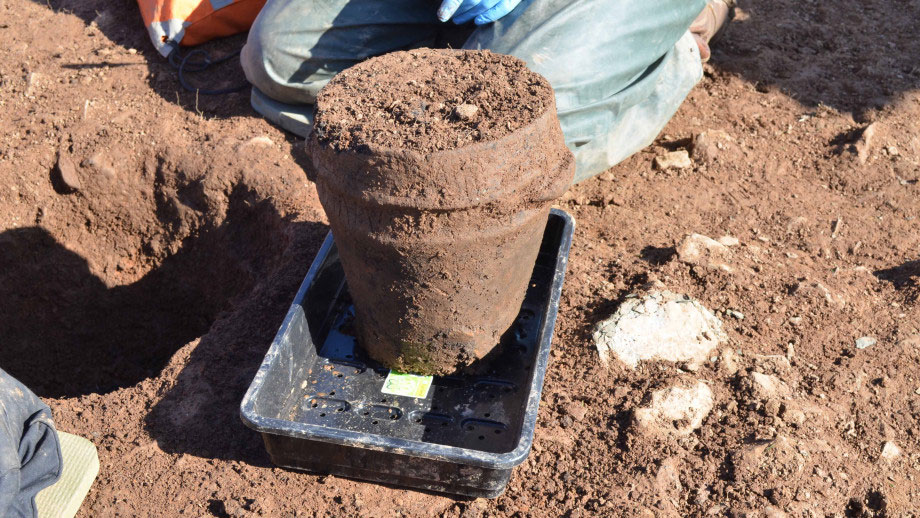
This and other evidence from the site have led her to conclude there was most likely a large mound over the burial which existed from prehistory well into the middle ages protecting the center of the barrow.
“This is a sealed, intact cremation so it has the potential to tell us a lot about the cremation rite as it was practiced 4,000 years ago. We also appear to have some identifiable fragments of bone among the cremated remains so we’ll potentially be able to tell a lot about the individual themselves,” she said.
“We’ll be able to say what gender they were, possibly their age, or an age range, and depending on the bone preservation we can conduct analyses to examine where they were from, what their diet was like, where this food was coming from and what they ate and drank as a child when their teeth were forming. This is a very beautiful, very complete burial, and we’re very excited,” she said.
Other items found include various examples of Cornish Bronze Age pottery, flint tools, and two high-quality hammer stones, used to make flint tools. However, what has puzzled Dr. Frieman and her team was the discovery of medieval activity on the same site.
“The site has thrown up a big mystery for us because we found what we believe is an entire — albeit crushed — medieval pot from the 12th or 13th century AD, carefully placed under a couple of layers of flat stones. It had some cooked food remains adhering to it and we don’t know what it’s doing there or why.”
“Hundreds of years after the barrow was built, someone from the 12th or 13th century came back to this site and dug into it to bury this pot.
“At that stage there were two local monasteries in view of this site, as Looe Island was a satellite monastery of the Glastonbury Abbey, so it would be very strange to have non-Christian activity on this site. The evidence looks quite ritualistic, but what the ritual was, we don’t know,” she said.
The team also excavated a round house — an ancient dwelling or land marker nearby, possibly from 500 BC and are trying to deduce possible reasons for the location of the barrow.
“This was a traversed place and regularly visited over the millennia, it affords a sweeping view of the south coast of England and we know that there are a series of Bronze Age shipwrecks off this coast, so this was an important shipping highway in prehistory.”
The analysis of soil, pollen, flint, and other samples is underway but it will probably be a year before a comprehensive story of the find is possible.
Dr. Frieman said the dig would not have been possible without the help of a team of enthusiastic and skilled volunteers from the Cornwall Archaeological Society, the tenant farmers, John and Vanessa Hutchings, and the strong support of the National Trust who own and manage the site and their Regional Archaeologist James Parry.
The excavation was funded through a Discovery Early Career Researcher Award (DECRA) and a contribution from the ANU College of Archaeology and Anthropology.
Never miss a breakthrough: Join the SciTechDaily newsletter.
Follow us on Google and Google News.
2 Comments
Fantastic , brill , wow., what more can one say , olny bloody well done to all ! Mr. Alan
THIS ARTICLE IS ABSOLUTELY AMAZING. THANK YOU FOR SHARING THIS WITH US.