
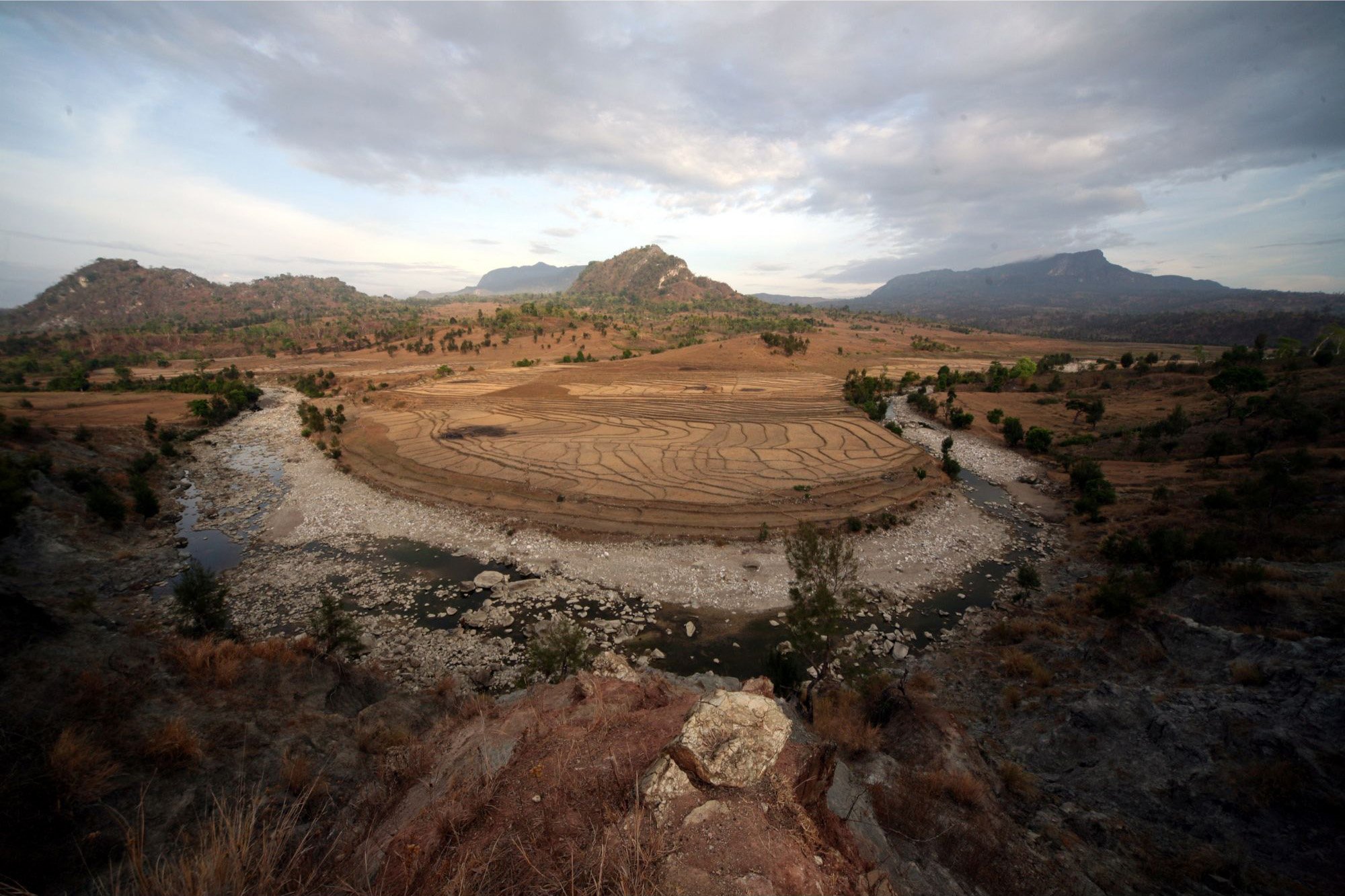
Archaeological discoveries on Timor Island suggest early humans used New Guinea, not Timor, as a stepping stone to Australia, challenging previous migration theories and highlighting advanced maritime skills.
Archaeologists are reevaluating the path early humans took to reach Australia following the discovery of thousands of stone artifacts and animal bones in a deep cave on Timor Island.
Researchers from The Australian National University (ANU), Flinders University, University College London (UCL), and the ARC Centre of Excellence for Australian Biodiversity and Heritage dated and analyzed the artifacts and sediment at the Laili rock shelter in central-north Timor-Leste, north of Australia, to pinpoint the arrival of the colonists.
They detected a human “arrival signature” from about 44,000 years ago, suggesting there were no humans on the island prior to this time.
“Unlike other sites in the region, the Laili rock shelter preserved deep sediments dating between 59,000 and 54,000 years ago which showed no clear signs of human occupation,” Dr. Shimona Kealy, from the ANU College of Asia and the Pacific, said. “When we analyze and compare markers of human occupation from other sites across Timor-Leste and nearby Flores Island, we can confidently say humans were also absent throughout the wider region of the southern Wallacean islands. This is significant as these islands were most likely a gateway crossing for ancient humans making the crossing to Australia.”
Reassessing Migration Theories
Study co-author Professor Sue O’Connor, also from ANU, said Timor Island has long been considered a stepping stone island for the first human migration between mainland Southeast Asia and into Australia and New Guinea. But the new findings challenge this theory.
“The absence of humans on Timor Island earlier than at least 50,000 years ago is significant as it indicates that these early humans arrived on the island later than previously believed,” she said.
“This provides further evidence to suggest early humans were making the crossing to Australia using the stepping stone island of New Guinea, rather than Timor Island as researchers had previously suggested. In addition to prompting a re-evaluation of the route and timing of earliest human migration through Wallacea and into Sahul, our findings highlight the fact that migration into the islands was ongoing with occupation of the southern islands occurring thousands of years after the initial settlement of Australia.”

Analysis of Sediments and Artifacts
The sediment from the site was analyzed at the Flinders Microarchaeology Laboratory by co-author Associate Professor Mike Morley.
“The shift from pre-occupation to intensive human activity at the site was very clear in the sediments,” Associate Professor Morley, from Flinders University, said. “As soon as people arrived on the scene, their use of the cave was very intensive, with clear evidence of burning and trampling of the shelter floor underfoot.”
The research team unearthed many small stone tools during the excavation, as well as charred fish bones.
“We know these people specialized in making tiny stone tools, but we’re not 100 percent sure what they were used for,” Dr. Kealy said. “Because a lot of their diet was either shellfish or small animals, you don’t really need big knives to gather that sort of food. But having small, fine tools is useful for things like stripping leaves to then weave into baskets, but also for creating wooden tools.”
Based on the sheer number of artifacts unearthed at the site, the researchers say the migration to Timor Island was a “major” one. According to the researchers, these ancient humans likely made the crossing to Timor from nearby Flores Island and mainland Southeast Asia.
“The traditional view held by researchers is that early humans who were making these significant water crossings were stumbling upon these islands by mistake, largely because it was so long ago,” Dr. Kealy said. “Their arrival on Timor was no accident. This was a major colonization effort, evident through the sheer number of people who were making the journey. It’s a testament to these peoples’ level of maritime technology and the boats they created, but also their confidence and competence in braving maritime crossings.”
Reference: “Abrupt onset of intensive human occupation 44,000 years ago on the threshold of Sahul” by Ceri Shipton, Mike W. Morley, Shimona Kealy, Kasih Norman, Clara Boulanger, Stuart Hawkins, Mirani Litster, Caitlin Withnell and Sue O’Connor, 22 May 2024, Nature Communications.
DOI: 10.1038/s41467-024-48395-x
Never miss a breakthrough: Join the SciTechDaily newsletter.
Follow us on Google and Google News.