
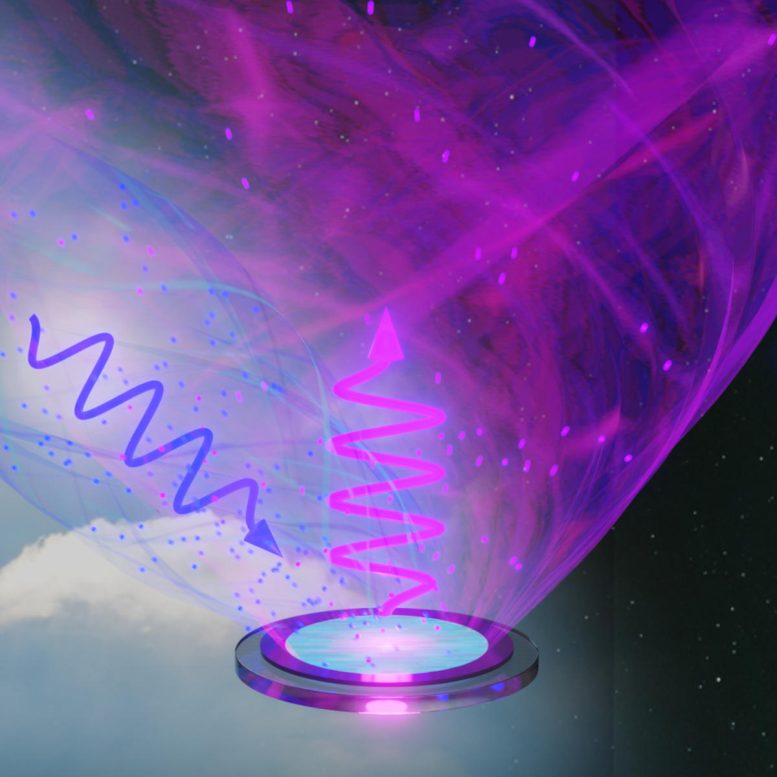
Tokyo Tech researchers create a durable photon UC film to upconvert visible light into UV, opening sustainable applications for solar and LED sources.
Solar power is becoming increasingly important as a renewable energy source. The high-energy UV light with a wavelength shorter than 400 nm found in sunlight can be utilized in a variety of ways, such as photopolymerization and activating photocatalysts to produce green hydrogen or useful hydrocarbons through a process known as “artificial photosynthesis.
The ability of UV light to efficiently kill viruses and bacteria through photocatalytic reactions is another important application. However, only a small portion of sunlight falls within the UV range, leaving much of the spectrum unused for this purpose.
Photon upconversion (UC) could be the key to solving this problem. It is the process of converting long-wavelength, low-energy photons (such as those present in visible light) to short-wavelength, high-energy photons (such as those present in UV light) via a process called “triplet-triplet annihilation” (TTA).
Previous works in this field have reported visible-to-UV UC using organic solvent solutions that required the solution to be deoxygenated first and then sealed in an airtight container to prevent exposure to oxygen that deactivated and degraded TTA-based photon UC samples. These materials not only lacked photostability in the presence of oxygen but also failed to perform effectively with sunlight-intensity incident light. These issues presented roadblocks in the practical applications of photon UC.
A Breakthrough Solid Film for Visible-to-UV Photon Upconversion
Now, two scientists at Tokyo Tech—Prof. Yoichi Murakami and his graduate student Mr. Riku Enomoto—have come up with a resolution to these problems—a revolutionary solid film that can perform visible-to-UV photon UC for weak incident light while remaining photostable for an unprecedented amount of time in the air. They describe this breakthrough invention in their paper published in the Journal of Materials Chemistry C.
Prof. Murakami explains the novelty of their research: “Our invention will enable the practical utilization of the visible part of low-intensity light, such as sunlight and LED room light, for applications that are effectively done with UV light. And its photostability—demonstrated to be at least over 100 hours, even in the presence of air—is the highest ever reported in any TTA-based photon UC material, regardless of the material form, as long as we could survey.”
In addition to this record photostability, these films had an ultralow excitation threshold (only 0.3x the Sun’s intensity) and a high UC quantum yield of 4.3% (normalized UC emission efficiency of 8.6%) —both in the presence of air—making this material one of a kind, since most materials of this class lose their photon UC ability when exposed to air.
Innovative Technique for Advanced Photon UC Films
To prepare this material, the researchers melted together a sensitizer (i.e., molecular chromophore that can absorb longer-wavelength photons) with a much larger quantity of an annihilator (i.e., organic molecule that received the triplet excited energy from the sensitizer and then caused the TTA process); the combination of the sensitizer and annihilator was selected by the researchers. This bi-component melt was then cooled over a temperature gradient-controlled surface to form a solid-state visible-to-UV photon UC thin film.
This novel technique—temperature gradient solidification—is highly controllable and reproducible, which means that it is compatible with realistic industrial processes. Prof. Murakami tells us, “We believe that the temperature-controlled solidification can provide a solid groundwork for developing advanced photon UC films, that too on a solid substrate without using organic solvents, as demonstrated for the first time by this work.”
Finally, to demonstrate the visible-to-UV photon UC of the thin film, the researchers used it with a 1-Sun-intensity simulated sunlight consisting only of visible light to successfully cure and solidify a resin that would otherwise require UV light for the same process.
This study presented, for the very first time, a novel class of UC solids with unprecedented photostability that can be realistically used for the upconversion of low-intensity visible light photons into UV light photons in the presence of air. “Our research will not only expand the exploration of a new class of UV-light-generating materials but will also help in substantially broadening the utility of the abundant weak visible light towards applications that are driven by UV light,” concludes Prof. Murakami.
Reference: “Solvent-free temperature gradient melt formation of efficient visible-to-UV photon upconversion organic films with subsolar threshold and over 100 h photostability in air” by Riku Enomoto and Yoichi Murakami, 20 December 2022, Journal of Materials Chemistry C.
DOI: 10.1039/D2TC04578H
The study was funded by the Japan Society for the Promotion of Science.
Never miss a breakthrough: Join the SciTechDaily newsletter.
Follow us on Google and Google News.