
Using dual lasers and an advanced gas injection system, researchers at the Berkeley Lab Laser Accelerator Center (BELLA) accelerated a high-quality electron beam to 10 billion electronvolts (10 GeV) over a distance of just 30 centimeters.
Laser-plasma accelerators have the potential to dramatically shrink the size and cost of particle accelerators, benefiting fields such as high-energy physics, medicine, and materials science. Key achievements from BELLA’s recent experiment include:
- Record Energy and Beam Quality: Researchers used a petawatt laser to accelerate a 10-GeV electron beam, marking a major improvement in both energy output and beam quality.
- Advanced Experimental Setup: The new system features precise plasma control, allowing scientists to observe how the laser plasma evolves throughout the process.
- Dark Current-Free Acceleration: By eliminating background electrons that can sap laser energy, the setup efficiently channels power into the intended electron beam.

Breakthrough in Laser-Plasma Acceleration
Scientists have successfully accelerated electrons to extremely high energies using a pair of lasers and a supersonic sheet of gas, achieving this feat within a distance of less than a foot. This breakthrough advances laser-plasma acceleration, a promising technology that could lead to compact, high-energy particle accelerators with applications in particle physics, medicine, and materials science.
In a new study published today (December 18) in Physical Review Letters, researchers accelerated high-quality electron beams to more than 10 billion electronvolts (10 gigaelectronvolts, or GeV) within 30 centimeters. The work was led by the Department of Energy’s Lawrence Berkeley National Laboratory (Berkeley Lab) in collaboration with the University of Maryland. Conducted at the Berkeley Lab Laser Accelerator Center (BELLA), the experiment surpasses the lab’s previous 2019 world record of producing 8-GeV electron beams in 20 centimeters. This new achievement not only boosts beam energy but also delivers high-quality electron beams at this energy level for the first time, marking a crucial step toward future high-efficiency particle accelerators.
“We’ve jumped from 8 GeV to 10 GeV, but we’ve also significantly improved the quality and energy efficiency by changing the technology we use,” said Alex Picksley, lead author of the study and a research scientist in Berkeley Lab’s Accelerator Technology & Applied Physics Division (ATAP). “This is a milestone step on the path to a future plasma-based collider.”

Enhancing Electron Acceleration with Dual-Laser System
Laser-plasma accelerators (LPAs) use plasma, a gaseous soup of charged particles that includes electrons. By giving the plasma an intense jolt of energy over a few quadrillionths of a second, researchers can create a powerful wave. Electrons ride the crest of this plasma wave, gathering energy like a surfer on a wave in the ocean.
The new result used a dual-laser system made possible by the completion of a second beamline at BELLA in 2022. In this system, the first laser acts like a drill, heating the plasma and forming a channel that guides the following “drive” laser pulse, which accelerates the electrons. The plasma channel directs the laser energy much like a fiber-optic cable guides light, keeping the laser pulse focused over longer distances.

Advancements in Plasma Channel Technology
In the past, researchers shaped the plasma using fixed-length glass or sapphire tubes called “capillaries.” But in the new result, the team turned to a system that uses a series of gas jets, lined up like the jets in a gas fireplace. The jets create a sheet of gas traveling at supersonic speeds, which the lasers pass through to form a plasma channel. The setup allows researchers to finely tune their plasma and change its length, letting them study the process at different stages with unmatched precision.
“Before, the plasma was essentially a black box,” said Carlo Benedetti, an ATAP staff scientist at BELLA who works on the theory and modeling of laser-plasma accelerators. “You knew what you put in and what came out at the end. This is the first time we can capture what’s happening inside the accelerator at each point, showing how the laser and plasma wave evolve, at high power, frame by frame.”
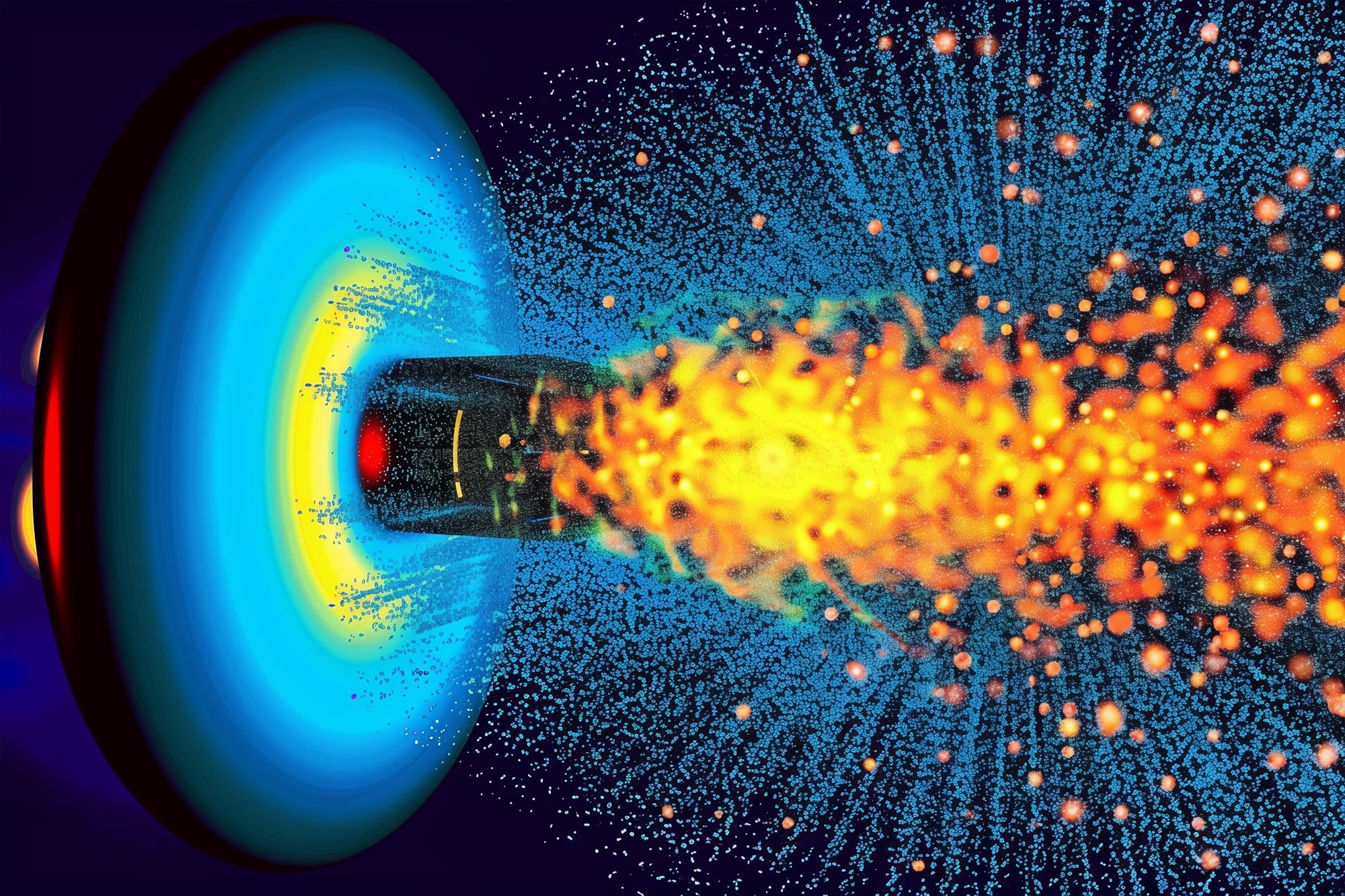
In this simulation of the laser-plasma acceleration process generated with the INF&RNO code, a laser driver (orange) propagates to the right through a plasma (blue), generating a plasma wave. The simulation window moves at the speed of light following the laser and the plasma wave, making them appear stationary. Laser-ionized electrons (yellow) are trapped and accelerated (yellow bunch) to energies of up to 10 GeV by the strong electromagnetic fields in the plasma, after a propagation distance of 30 cm. Credit: Carlo Benedetti/Berkeley Lab
Precise Monitoring and Simulation of Plasma
That knowledge allows researchers to compare their models and experiments, giving them confidence that they understand the physics at work and tools to tune the accelerator. To simulate the laser-plasma interaction, experts use a code called INF&RNO that was developed at BELLA. The complex computations are run at the National Energy Research Scientific Computing Center (NERSC) at Berkeley Lab. The new findings help validate the code used in these simulations, further strengthening the models.
The gas jet system has another benefit: resilience. Because the sheet of gas has no parts to break, the technology can scale to very high repetition rates, which the lab is working toward for future particle colliders and applications.
Researchers also showed that their approach made a beam that was “dark current free,” meaning background electrons in the plasma were not unintentionally accelerated.
“If you have dark currents, they’re sucking up the laser energy instead of accelerating your electron beam,” said Jeroen van Tilborg, an ATAP staff scientist and deputy director in charge of BELLA’s experimental program. “We’ve gotten to a point where we can control our accelerator and suppress unwanted effects, so we are making a high-quality beam without wasting energy. That’s essential as we think about the ideal laser accelerator of the future.”
Potential Applications and Future Prospects
The technology has a wide range of potential applications. For example, it could be used to produce particle beams for cancer treatments. Or it could power free-electron lasers that act like atomic microscopes, helping to create advanced materials and gain insight into chemical and biological processes.
“We’ve taken a big step towards enabling applications of these compact accelerators,” said Anthony Gonsalves, an ATAP staff scientist who leads accelerator work at BELLA. “For me, the beauty of this result is we’ve taken away restrictions on the plasma shape that limited efficiency and beam quality. We have built a platform from which we can make big improvements, and are poised to realize the amazing potential of laser-plasma accelerators.”
Toward High-Energy Particle Colliders
Scaled up to higher energies, laser-plasma accelerators could have applications in fundamental physics and beyond. In the near-term, LPAs could be used to produce beams of muons that help image difficult-to-explore areas, including architectural structures like ancient pyramids, geologic features like volcanoes or mineral deposits, or the interior of nuclear reactors. On a longer scale, the technology could power higher-energy particle colliders that smash charged particles together, searching for new particles and deeper insights into the forces underlying our universe. Researchers at BELLA are now working on developing these very high energy machines by connecting the building blocks together in a staged accelerator system.
A Pathway to Advanced Accelerator Systems
“Coupling stages together gives us a realistic path to generate electrons between 10 and 100 GeV, and to build toward future particle colliders that can reach 10 TeV [teraelectronvolts],” said Eric Esarey, director of the BELLA Center. “Once the laser energy from one stage is depleted, we send in a new laser pulse, boosting the electron energy from stage to stage in series.”
To create staged systems, it’s essential that researchers have good diagnostics. This lets them understand how the plasma, laser, and electron beam are behaving, and gives them precision control over the timing and synchronization of steps happening in the barest fraction of a second.
“With this study, we’ve advanced the particle energy of high-quality beams in very short distances, and the efficiency with which we can make them, by using precision diagnostics that give us great laser-plasma control,” said Cameron Geddes, director of Berkeley Lab’s ATAP Division. “Advancing laser-plasma accelerator technology has been identified as an important goal by both the U.S. Particle Physics Project Prioritization Panel (P5) and the Department of Energy’s Advanced Accelerator Development Strategy. This result is a milestone on our way to staged accelerators that are going to change the way we do our science.”
Reference: “Matched guiding and controlled injection in dark-current-free, 10-GeV-class, channel-guided laser-plasma accelerators” by A. Picksley, J. Stackhouse, C. Benedetti, K. Nakamura, H. E. Tsai, R. Li, B. Miao, J. E. Shrock, E. Rockafellow, H. M. Milchberg, C. B. Schroeder, J. van Tilborg, E. Esarey, C. G. R. Geddes and A. J. Gonsalves, 18 December 2024, Physical Review Letters.
DOI: 10.1103/PhysRevLett.133.255001
This work was supported by the Department of Energy’s Office of Science, Office of High Energy Physics, and the Defense Advanced Research Projects Agency, and used the National Energy Research Scientific Computing Center (NERSC), a DOE Office of Science user facility.
Never miss a breakthrough: Join the SciTechDaily newsletter.
Follow us on Google and Google News.
1 Comment
Advancing laser-plasma accelerator technology has been identified as an important goal by both the U.S. Particle Physics Project Prioritization Panel (P5) and the Department of Energy’s Advanced Accelerator Development Strategy. This result is a milestone on our way to staged accelerators that are going to change the way we do our science.
VERY GOOD!
Spin direction, energy gap, and plane should also be considered. Topological spins create everything, topological spins shape the world.
If anyone is interested in science, they can browse https://zhuanlan.zhihu.com/p/4659236468.