
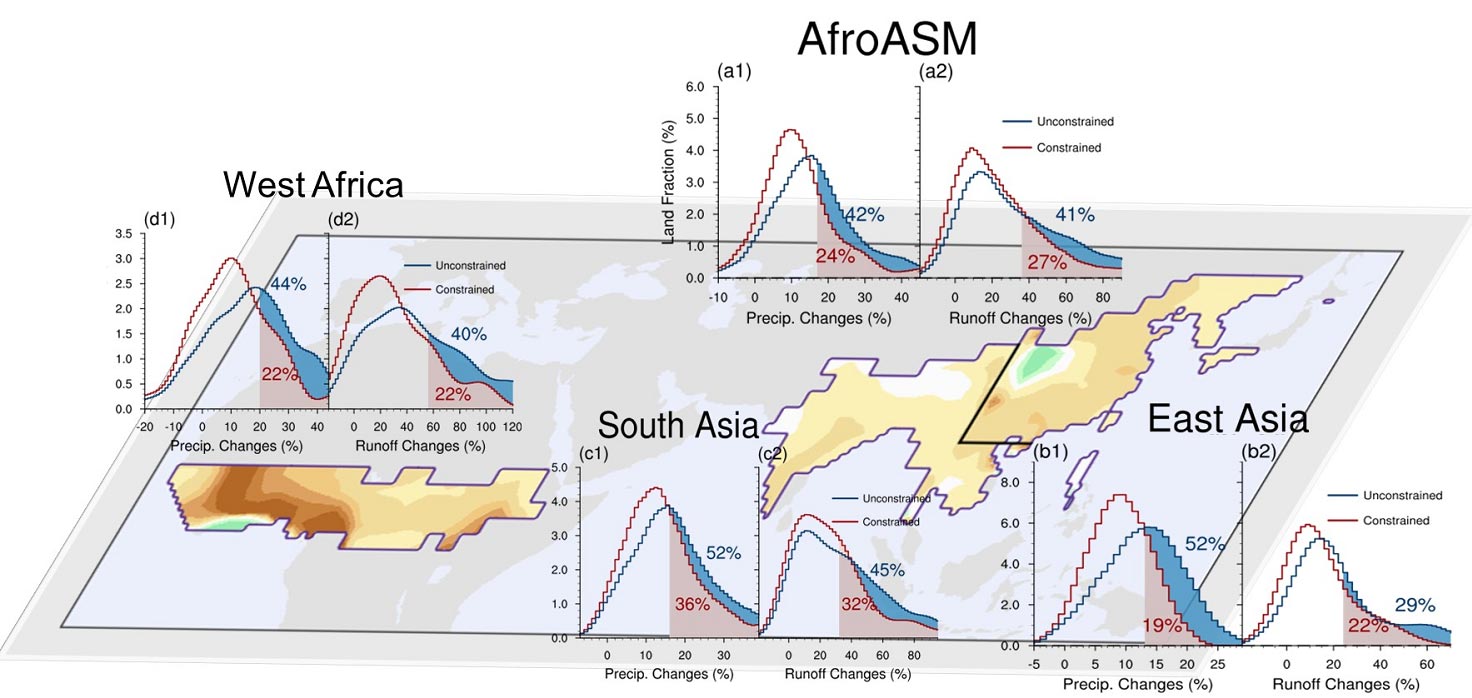
Researchers corrected CMIP6 climate model biases that overestimated Afro-Asian monsoon rainfall, reducing projected rainfall by 70%.
Climate projections are critical for adaptation and mitigation planning. The output of the latest round of the Coupled Model Intercomparison Project, phase 6 (CMIP6) has been widely used in climate projections.
However, a subset of CMIP6 models is “too hot” and the projected warming as a result of greenhouse gases is excessive. It was previously unclear how to address the “hot model” problem at the regional scale.
The latest CMIP6 climate models tend to overestimate future Afro-Asian summer monsoon (AfroASM) rainfall and runoff due to present-day biases in warming patterns, according to a research team from the Chinese Academy of Sciences’ Institute of Atmospheric Physics (IAP). By constraining biases, however, the rainfall increase is 70% of the raw projection.
The study will be published today (May 10, 2022) in the journal Nature Communications.
The AfroASM includes the West African monsoon, South Asian monsoon, and East Asian monsoon.
Emergent Constraint Technique for Correcting Bias
The research team identified the leading mode of variability among CMIP6 models in projecting future changes in AfroASM rainfall. They found that projection uncertainty was related to the bias in present-day interhemispheric thermal contrast (ITC). Since large-scale monsoon circulation is driven by ITC due to moist static energy gradients, models with a larger ITC trend over the past thirty years tend to project more precipitation increases.
Since most CMIP6 models tend to overestimate present-day ITC trends, the team corrected the raw projection by designing an emergent constraint technique. The increase in precipitation in the constrained projection is ~70% of the ensemble mean of the CMIP6 models. The area of land with a significant increase in precipitation is ~57% of the raw projection.
The research team further extended its analysis to runoff, which is a mirror of potential water availability. In the constrained projection, ~27% of land area in the AfroASM region will witness a significant increase in potential water availability, which is ~66% of the raw projection. Regionally, the impact of the observational constraint is most pronounced in the West African monsoon region where the fraction of land area with increased water availability is ~55% of the raw projection.
This study provides a solution for tackling the “hot model” problem at regional scales. The emergent constraint technique reported in the study is based on the physical link between a modeled but observable variable in the present day and a projected variable in the future climate system.
“This technique is useful for correcting the bias of CMIP6 models and finally increase the reliability of rainfall projection in the Afro-Asian summer monsoon region. The underlying physical mechanism is the impact of equilibrium climate sensitivity on the interhemispheric thermal contrast in both the historical and future periods,” said Dr. ZHOU Tianjun from IAP, corresponding author of the study.
Implications for Water Management and Flooding Risks
“Smaller increases in precipitation and runoff will likely reduce flooding risk, while also posing a challenge to future water resource management,” said CHEN Ziming, a Ph.D. student at the University of the Chinese Academy of Sciences, first author of the study.
Reference: “Observationally constrained projection of Afro-Asian monsoon precipitation” by Ziming Chen, Tianjun Zhou, Xiaolong Chen, Wenxia Zhang, Lixia Zhang, Mingna Wu and Liwei Zou, 10 May 2022, Nature Communications.
DOI: 10.1038/s41467-022-30106-z
The study was supported by the National Key Research and Development Program of China and the National Natural Science Foundation of China.
Never miss a breakthrough: Join the SciTechDaily newsletter.
Follow us on Google and Google News.
1 Comment
The models have been running warm for years and those responsible for them have not only been unwilling to address the problem, but CMIP6 is even hotter. The Russian models seem to be the only ones that are consistently reasonable. What is probably even worse is that the models have a reputation for having inconsistent results for regional precipitation, sometimes leading to contradictions of droughts versus flooding.
This ‘correction’ wouldn’t have been necessary if the fundamental problem had been addressed years ago.