
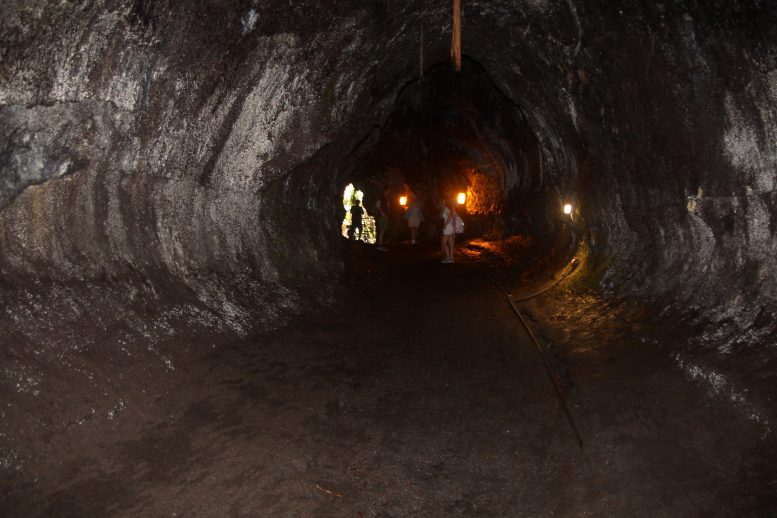
The international journal Earth-Science Reviews published a paper offering an overview of the lava tubes (pyroducts) on Earth, eventually providing an estimate of the (greater) size of their lunar and Martian counterparts.
This study involved the Universities of Bologna and Padua and its coordinators are Francesco Sauro and Riccardo Pozzobon. Francesco Sauro is a speleologist and head of the ESA programs CAVES and PANGAEA, he is also a professor at the Department of Biological, Geological, and Environmental Sciences at the University of Bologna. Riccardo Pozzobon is a planetary geologist at the Department of Geosciences of the University of Padua.
“We can find lava tubes on planet Earth, but also on the subsurface of the Moon and Mars according to the high-resolution pictures of lava tubes’ skylights taken by interplanetary probes. Evidence of lava tubes was often inferred by observing linear cavities and sinuous collapse chains where the galleries cracked,” explains Francesco Sauro. “These collapse chains represent ideal gateways or windows for subsurface exploration. The morphological surface expression of lava tubes on Mars and the Moon is similar to their terrestrial counterpart. Speleologists thoroughly studied lava tubes on Earth in Hawaii, Canary Islands, Australia, and Iceland.”
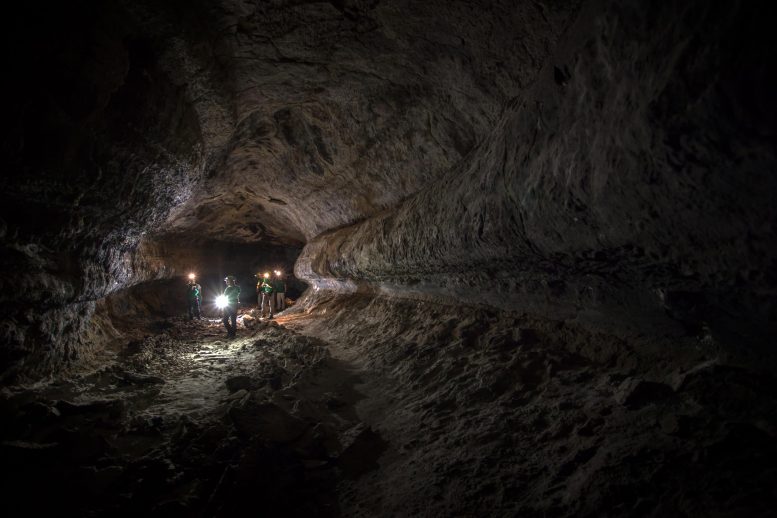
“We measured the size and gathered the morphology of lunar and Martian collapse chains (collapsed lava tubes), using digital terrain models (DTMs), which we obtained through satellite stereoscopic images and laser altimetry taken by interplanetary probes,” reminds Riccardo Pozzobon. “We then compared these data to topographic studies about similar collapse chains on the Earth’s surface and to laser scans of the inside of lava tubes in Lanzarote and the Galapagos. These data allowed to establish a restriction to the relationship between collapse chains and subsurface cavities that are still intact.”
Researchers found that Martian and lunar tubes are respectively 100 and 1,000 times wider than those on Earth, which typically have a diameter of 10 to 30 meters (33 to 98 meters). Lower gravity and its effect on volcanism explain these outstanding dimensions (with total volumes exceeding 1 billion cubic meters on the Moon).
Riccardo Pozzobon adds: “Tubes as wide as these can be longer than 40 kilometers (25 miles), making the Moon an extraordinary target for subsurface exploration and potential settlement in the wide protected and stable environments of lava tubes. The latter are so big they can contain Padua’s entire city center.”
“What is most important is that, despite the impressive dimension of the lunar tubes, they remain well within the roof stability threshold because of a lower gravitational attraction,” explains Matteo Massironi, who is professor of Structural and Planetary Geology at the Department of Geosciences of the University of Padua. “This means that the majority of lava tubes underneath the maria smooth plains are intact. The collapse chains we observed might have been caused by asteroids piercing the tube walls. This is what the collapse chains in Marius Hills seem to suggest. From the latter, we can get access to these huge underground cavities.”
Francesco Sauro concludes: “Lava tubes could provide stable shields from cosmic and solar radiation and micrometeorite impacts which are often happening on the surfaces of planetary bodies. Moreover, they have great potential for providing an environment in which temperatures do not vary from day- to night-time. Space agencies are now interested in planetary caves and lava tubes, as they represent a first step towards future explorations of the lunar surface (see also NASA’s project Artemis) and towards finding life (past or present) in Mars subsurface.”
Researchers also point out how this study opens up a completely new perspective in planetary exploration, which is increasingly focusing on the subsurface of Mars and the Moon.
“In autumn 2019, ESA called up universities and industries with a campaign seeking ideas for developing technologies for lunar caves exploration. They are specifically looking for systems that would land on the lunar surface to operate missions exploring lunar tubes,” clarifies Unibo professor Jo De Waele, who is one of the authors of the study and a speleologist. “Since 2012, in collaboration with some European universities including Bologna and Padua, ESA has been carrying out two training programs for astronauts focusing on the exploration of underground systems (CAVES) and planetary geology (PANGAEA). These programs include lava tubes on the island of Lanzarote. So far, 36 astronauts from five space agencies have received training in cave hiking; moreover, six astronauts and four mission and operation specialists have received geological field training.”
Reference: “Lava tubes on Earth, Moon and Mars: A review on their size and morphology revealed by comparative planetology” by Francesco Sauro, Riccardo Pozzobon,
Matteo Massironi, Pierluigi De Berardinis, Tommaso Santagata and Jo De Waele, 20 July 2020, Earth-Science Reviews.
DOI: 10.1016/j.earscirev.2020.103288
The title of this study is “Lava tubes on Earth, Moon and Mars: A review on their size and morphology revealed by comparative planetology” and it was published in the journal Earth-Science Reviews. The authors are: Francesco Sauro, Jo De Waele and Pierluigi De Berardinis (Department of Biological, Geological and Environmental Sciences of the University of Bologna); Riccardo Pozzobon and Matteo Massironi (Department of Geosciences of the University of Padua); Tommaso Santagata (VIGEA – Virtual Geographic Agency in Reggio Emilia).
Never miss a breakthrough: Join the SciTechDaily newsletter.
Follow us on Google and Google News.
5 Comments
if the tubes are permeable they could be coated on the inside with silicone.
I think it is more likely that the walls of the lava tubes will be coated with aluminum or titanium or some other alloy that is in abundance on the Moon.
I believe Japan is looking to explore Marius Hills in 2022. I think one of the first things that needs to be done is to set up seismic monitors to check for “Moon Quakes’. I think whoever finds the most optimal lunar lava tube may well found the capital of the Moon.
We also need to address the 1967 Outer Space Treaty. I don’t think it is worth the paper it was written on now. The World needs to come together and figure out a new treaty. No nation will invest ten’s of billions of dollars, perhaps hundreds of billions of dollars, if they do not own the lunar land they are developing.
There will be a lunar land grab in the next twenty years. Let the race begin!
Many years ago when we almost moved to Hawaii instead of Florida from our Kansas Roots, I read numerous stories about lava tubes because we were fascinated with Hawaii. One idea I still read about now is a construction method utilizing lava tubes that’s extremely fast. They essentially sprayed a type of adhesive on the wall and then I rolled a very long and heavy duty rubber tube that could then be inflated,much like clown balloons they make animals out of, and it would instantly line the lava tube and stick to the walls creating a perfectly air tight enclosure that fit any shaped lava tube. Then you install air locks, ventilation, etc and you can create a livable area in one day. I never more modern technique was sending robotic 3D printers that use the existing soil as the construction medium, and the robots build structures like that. It’s going to be exciting to see what they come up with.
Just what humanity needs. Lava tubes on the moon as astronaut towns. It would be easier to colonize the bottom of the ocean or Antarctica than to put people on the moon. Any science, beyond the self-referential science of space physiology, can be carried out with less expense and more precision using robotics.