
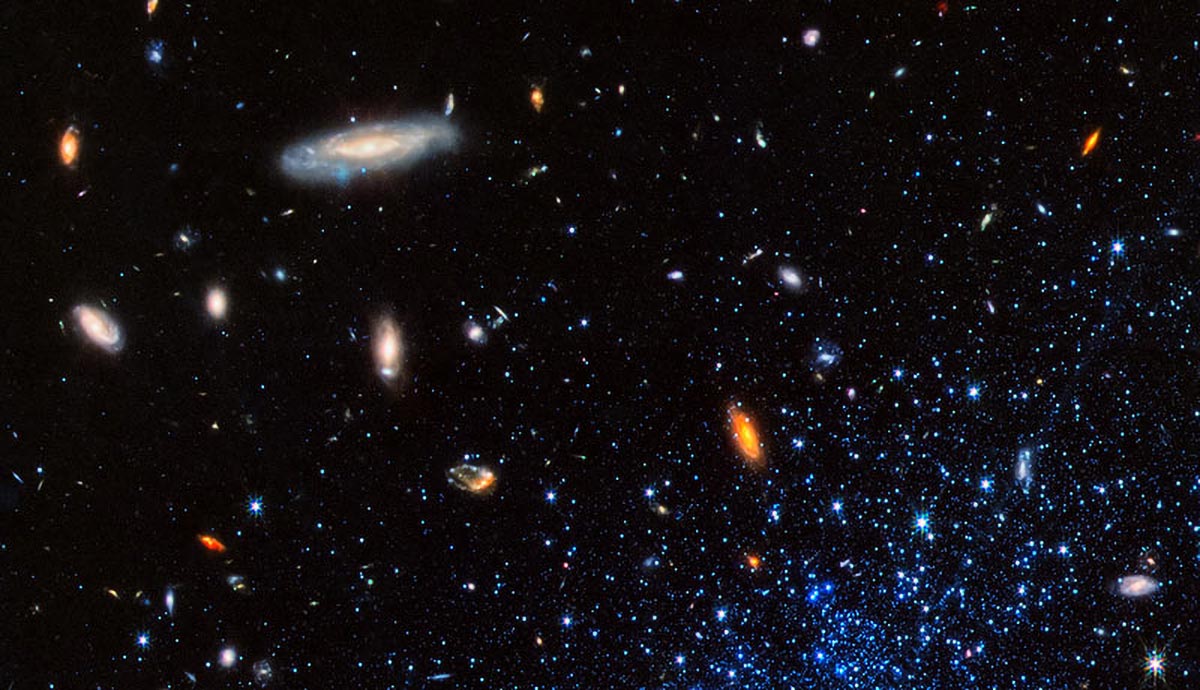
Leo P, a galaxy once dormant, has reawakened to form stars again, offering new clues about the universe’s earliest galaxies.
This research, aided by cutting-edge telescope technology, suggests environmental factors significantly influence galaxy development.
The Revival of Star Formation in Leo P
Leo P, a small galaxy and a distant neighbor of the Milky Way, is offering astronomers valuable insights into star formation and galaxy growth.
In research published in the Astrophysical Journal, a team led by Kristen McQuinn — scientist at the Space Telescope Science Institute and associate professor at Rutgers University — revealed that Leo P experienced a remarkable “reignition.” This galaxy began forming stars again during a critical era in the universe’s history, even as many other small galaxies remained dormant.
By examining galaxies at different stages of their evolution and in diverse environments, astronomers aim to uncover new details about the universe’s origins and the fundamental processes driving its development.
Analyzing Leo P with Advanced Telescopes
McQuinn and other members of the research team studied Leo P through NASA’s James Webb Space Telescope, a space-based apparatus that features a large, segmented mirror and an expansive sunshield, both of which enable it to capture detailed images of distant celestial objects.
Leo P, a dwarf galaxy some 5.3 million light-years from Earth, was discovered by McQuinn and other scientists in 2013. The celestial structure is far enough away from the Local Group, a clump of galaxies straddling the Milky Way, to be its neighbor without being affected by the gravitational fields of larger star systems.
The galaxy, located in the constellation Leo, is about the same size as a star cluster within the Milky Way and is about the same age as the Milky Way. The “P” in Leo P refers to “pristine,” because the galaxy has so few chemical elements besides hydrogen and helium.
“Leo P provides a unique laboratory to explore the early evolution of a low-mass galaxy in detail,” said McQuinn, who also is the mission head for the Science Operations Center for the Nancy Grace Roman Space Telescope at the Space Telescope Science Institute in Baltimore.

The Historical Insights from Leo P
The team started by looking deeply into the past. Since the stars detected by the team with the telescope are about 13 billion years old, they can serve as “fossil records” of star formation that occurred at earlier times. “Essentially, instead of studying the stars in situ [in their original positions] as they are forming in the early universe, we study the stars that have survived over cosmic history and use their present-day properties to infer what was occurring at earlier times,” McQuinn said.
The team found that Leo P formed stars early on but then stopped making them for a few billion years. This stoppage happened during a period known as the Epoch of Reionization. It took a few billion years after the epoch for the galaxy to reignite and start forming new stars.
Star Formation Patterns Across Galaxies
“We have a measurement like this for only three other galaxies – all isolated from the Milky Way – and they all show a similar pattern,” McQuinn said.
Observations of the dwarf galaxies within the Local Group, however, show that, in contrast, star production disappeared during this period.
The Epoch, regarded by astronomers as a significant period in the history of the universe, occurred between about 150 million and one billion years after the Big Bang. It was during this period that the first stars and galaxies formed.
The contrast between the star production of the dwarf galaxies provides compelling evidence that it isn’t just the mass of a galaxy at the time of reionization that determines whether it will be quenched, McQuinn said. Its environment – meaning whether it is isolated or functioning as a satellite of a larger system – is an important factor.
Implications of Leo P’s Research Findings
McQuinn said the observations will help pin down not only when little galaxies formed their stars, but how the reionization of the universe may have impacted how small structures form.
“If the trend holds, it provides insights on the growth of low-mass structures that is not only a fundamental constraint for structure formation but a benchmark for cosmological simulations,” she said.
The researchers also found that Leo P is metal-poor, possessing 3% of the sun’s metallicity. This means that the stars of the dwarf galaxy contain 30 times fewer heavy elements than the sun, which makes Leo P similar to the primordial galaxies of the early universe.
Knowledge gleaned from these observations will help astronomers piece together the timeline of cosmic events, understand how small structures evolved over billions of years, and learn about the processes that led to the creation of stars, McQuinn said.
Reference: “The Ancient Star Formation History of the Extremely Low-mass Galaxy Leo P: An Emerging Trend of a Post-reionization Pause in Star Formation” by Kristen B. W. McQuinn, Max J. B. Newman, Evan D. Skillman, O. Grace Telford, Alyson Brooks, Elizabeth A. K. Adams, Danielle A. Berg, Martha L. Boyer, John M. Cannon, Andrew E. Dolphin, Anthony J. Pahl, Katherine L. Rhode, John J. Salzer, Roger E. Cohen and Steve R. Goldman, 13 November 2024, The Astrophysical Journal.
DOI: 10.3847/1538-4357/ad8158
Other scientists from Rutgers on the study included Alyson Brooks, an associate professor; Roger Cohen, a postdoctoral associate; and Max Newman, a doctoral student, all with the Department of Physics and Astronomy.
Never miss a breakthrough: Join the SciTechDaily newsletter.
Follow us on Google and Google News.