
Researchers discovered that our ability to recognize trees in art is linked to a mathematical principle called the branch diameter scaling exponent. This pattern, found in real trees, appears across artistic styles and cultures, allowing even abstract depictions to remain recognizable.
While artistic beauty may be subjective, our ability to recognize trees in works of art could be linked to objective—and relatively simple—mathematics, according to a new study.
Conducted by researchers from the University of Michigan and the University of New Mexico, the study explored how the relative thickness of a tree’s branching boughs influences its tree-like appearance.
Although artists, including Leonardo da Vinci, have examined this concept for centuries, the researchers brought a newer branch of math into the equation to reveal deeper insights.
“There are some characteristics of the art that feel like they’re aesthetic or subjective, but we can use math to describe it,” said Jingyi Gao, lead author of the study. “I think that’s pretty cool.”
Gao performed the research as an undergraduate in the U-M Department of Mathematics, working with Mitchell Newberry, now a research assistant professor at UNM and an affiliate of the U-M Center for the Study of Complex Systems. Gao is now a doctoral student at the University of Wisconsin.
In particular, the researchers revealed one quantity related to the complexity and proportions of a tree’s branches that artists have preserved and played with to affect if and how viewers perceive a tree.
“We’ve come up with something universal here that kind of applies to all trees in art and in nature,” said Newberry, senior author of the study. “It’s at the core of a lot of different depictions of trees, even if they’re in different styles and different cultures or centuries.”
The work is published in the journal PNAS Nexus.
As a matter of fractals
The math the duo used to approach their question of proportions is rooted in fractals. Geometrically speaking, fractals are structures that repeat the same motifs across different scales.
Fractals are name-dropped in the Oscar-winning smash hit “Let it Go” from Disney’s “Frozen,” making it hard to argue there’s a more popular physical example than the self-repeating crystal geometries of snowflakes. But biology is also full of important fractals, including the branching structures of lungs, blood vessels and, of course, trees.
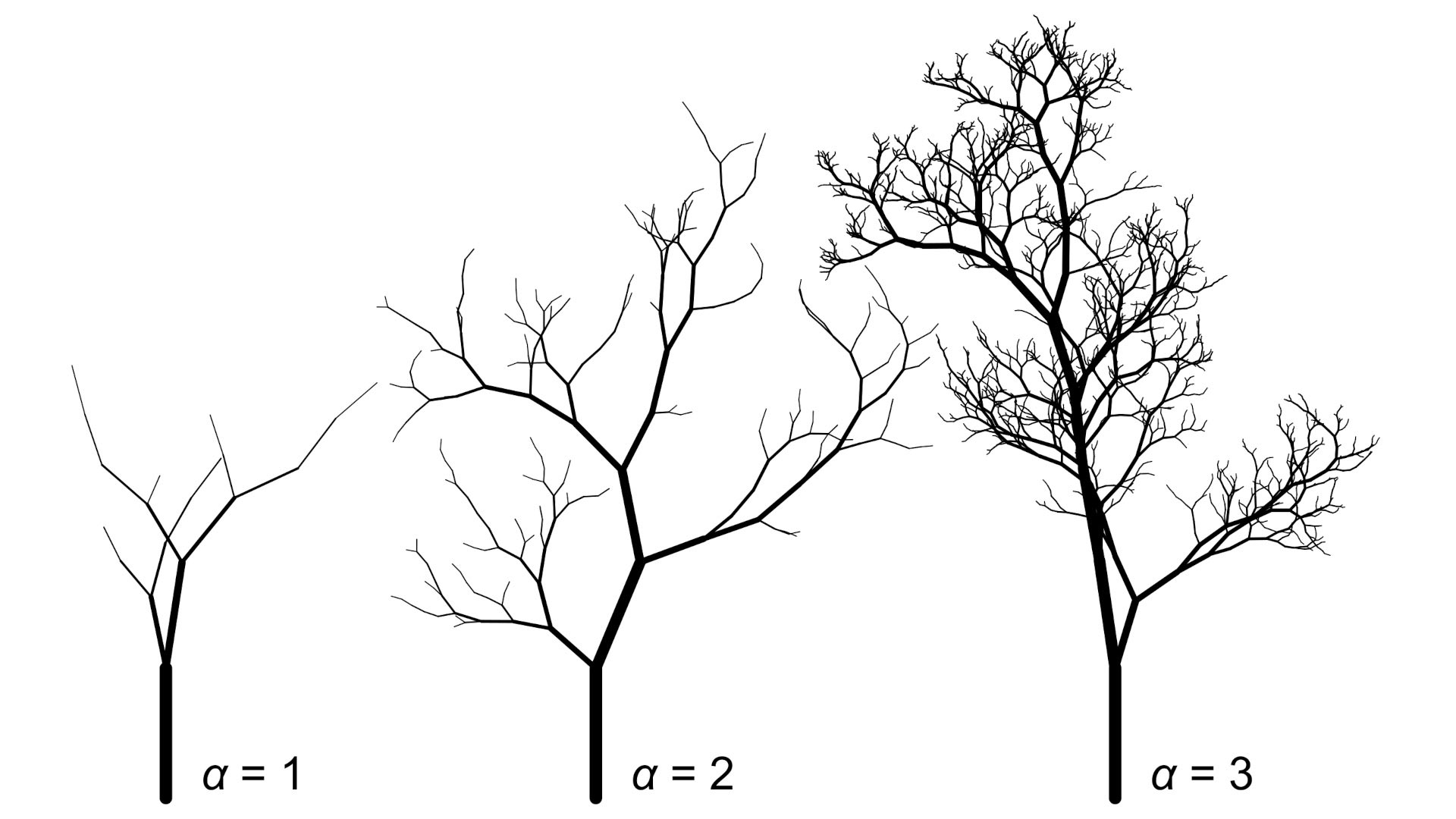
“Fractals are just figures that repeat themselves,” Gao said. “If you look at a tree, its branches are branching. Then the child branches repeat the figure of the parent branch.”
In the latter half of the 20th century, mathematicians introduced a number that is referred to as a fractal dimension to quantify the complexity of a fractal. In their study, Gao and Newberry analyzed an analogous number for tree branches, which they called the branch diameter scaling exponent. Branch diameter scaling describes the variation in branch diameter in terms of how many smaller branches there are per larger branch.
“We measure branch diameter scaling in trees and it plays the same role as fractal dimension,” Newberry said. “It shows how many more tiny branches there are as you zoom in.”
While bridging art and mathematics, Gao and Newberry worked to keep their study as accessible as possible to folks from both realms and beyond. Its mathematical complexity maxes out with the famous—or infamous, depending on how you felt about middle school geometry—Pythagorean theorem: a2 + b2 = c2.
Roughly speaking, a and b can be thought of as the diameter of smaller branches stemming from a larger branch with diameter c. The exponent 2 corresponds to the branch diameter scaling exponent, but for real trees its value can be between about 1.5 and 3.
The researchers found that, in works of art that preserved that factor, viewers were able to easily recognize trees—even if they had been stripped of other distinguishing features.
Artistic experimentation
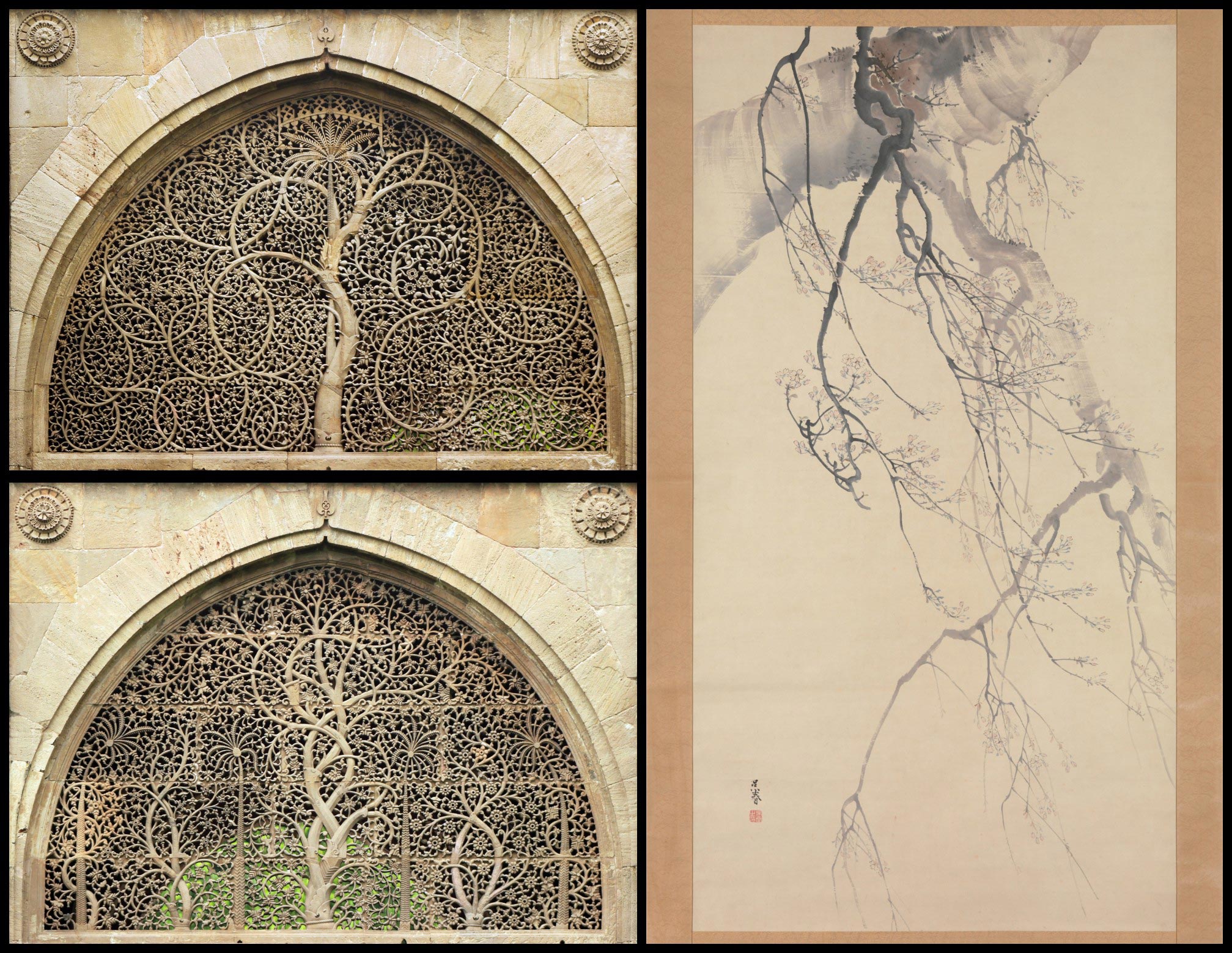
For their study, Gao and Newberry analyzed artwork from around the world, including 16th-century stone window carvings from the Sidi Saiyyed Mosque in India, an 18th-century painting called “Cherry Blossoms” by Japanese artist Matsumura Goshun and two early 20th century works by Dutch painter Piet Mondrian.
It was the mosque carvings in India that initially inspired the study. Despite their highly stylized curvy, almost serpentine branches, these trees have a beautiful, natural sense of proportion to them, Newberry said. That got him wondering if there might be a more universal factor in how we recognize trees. The researchers took a clue from DaVinci’s analysis of trees to understand that branch thickness was important.
Looking at the branch diameter scaling factor, Gao and Newberry found that some of the carvings had values closer to real trees than the tree in “Cherry Blossoms,” which appears more natural.
“That was actually quite surprising for me because Goshun’s painting is more realistic,” Gao said.
Newberry shared that sentiment and hypothesized that having a more realistic branch diameter scaling factor enables artists to take trees in more creative directions and have them still appear as trees.
“As you abstract away details and still want viewers to recognize this as a beautiful tree, then you may have to be closer to reality in some other aspects,” Newberry said.
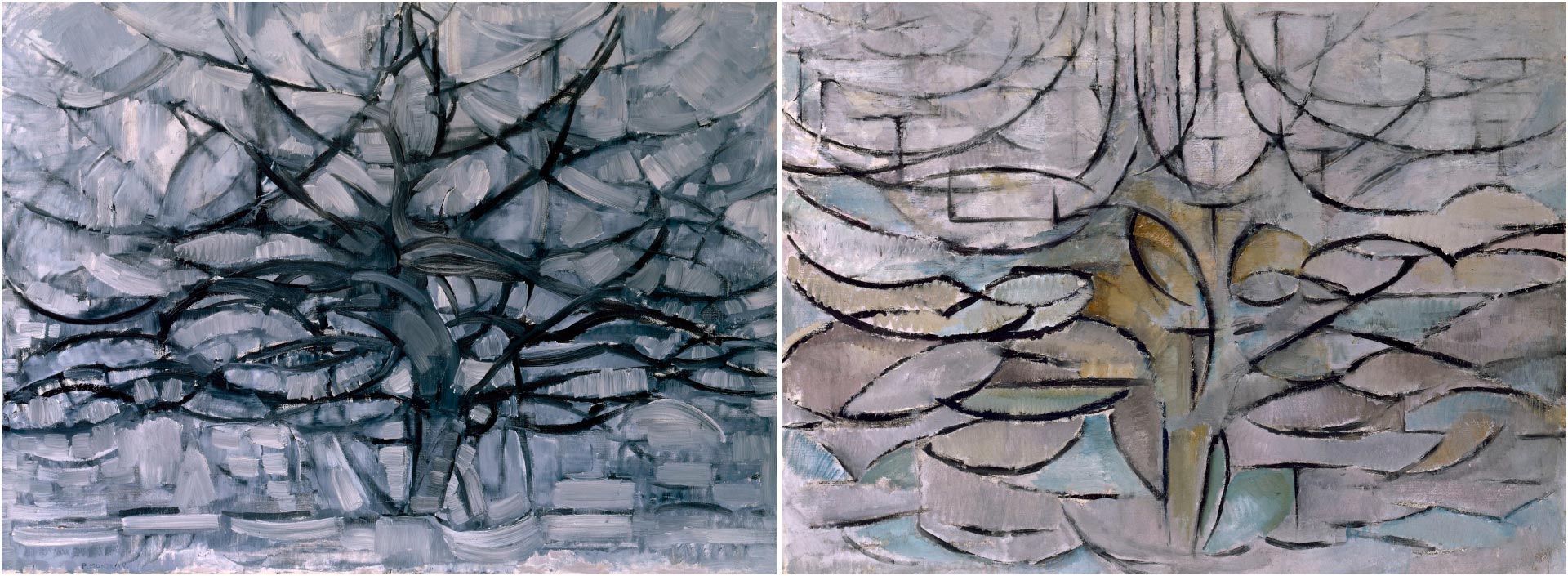
Mondrian’s work provided a serendipitous experiment to test this thinking. He painted a series of pieces depicting the same tree, but in different, increasingly abstract ways. For his 1911 work “De grijze boom” (“The gray tree”), Mondrian had reached a point in the series where he was representing the tree with just a series of black lines against a gray background.
“If you show this painting to anyone, it’s obviously a tree,” Newberry said. “But there’s no color, no leaves and not even branching, really.”
The researchers found that Mondrian’s branch scaling exponent fell in the real tree range at 2.8. For Mondrian’s 1912 “Bloeiende appelboom” (“Blooming apple tree”), however, that scaling is gone, as is the consensus that the object is a tree.
“People see dancers, fish scales, water, boats, all kinds of things,” Newberry said. “The only difference between these two paintings—they’re both black strokes on a basically gray background—is whether there is branch diameter scaling.”
Gao designed the study and measured the first trees as part of her U-M Math Research Experience for Undergraduates project supported by the James Van Loo Applied Mathematics and Physics Undergraduate Support Fund. Newberry undertook the project as a junior fellow of the Michigan Society of Fellows. Both researchers acknowledged how important interdisciplinary spaces at Michigan were to the study.
“We could not have done this research without interaction between the Center for the Study of Complex Systems and the math department. This center is a very special thing about U of M, where math flourishes as a common language to talk across disciplinary divides,” Newberry said. “And I have been really inspired by conversations that put mathematicians and art historians at the same table as part of the Society of Fellows.”
Reference: “Scaling in branch thickness and the fractal aesthetic of trees” by Jingyi Gao and Mitchell G Newberry, 11 February 2025, PNAS Nexus.
DOI: 10.1093/pnasnexus/pgaf003
Never miss a breakthrough: Join the SciTechDaily newsletter.
Follow us on Google and Google News.
6 Comments
I suspect that the universe can be described in many hundreds of different ways quantum mechanics is popular method at the moment, however, since fractals appear to be so natural in the description of life itself, which we are, he are most likely to be more inclined to recognize it in other forms living or otherwise. We will probably recognize later that we, ourselves being a composition of fractals; that form of math would be the best form of mathematics for us to use, because it’s so intuitive to our very nature.
Indeed!
A new approach to understanding of art.
A new way to understanding and appreciating art.
Link to article not working.
The link has been fixed, thank you for your note.