
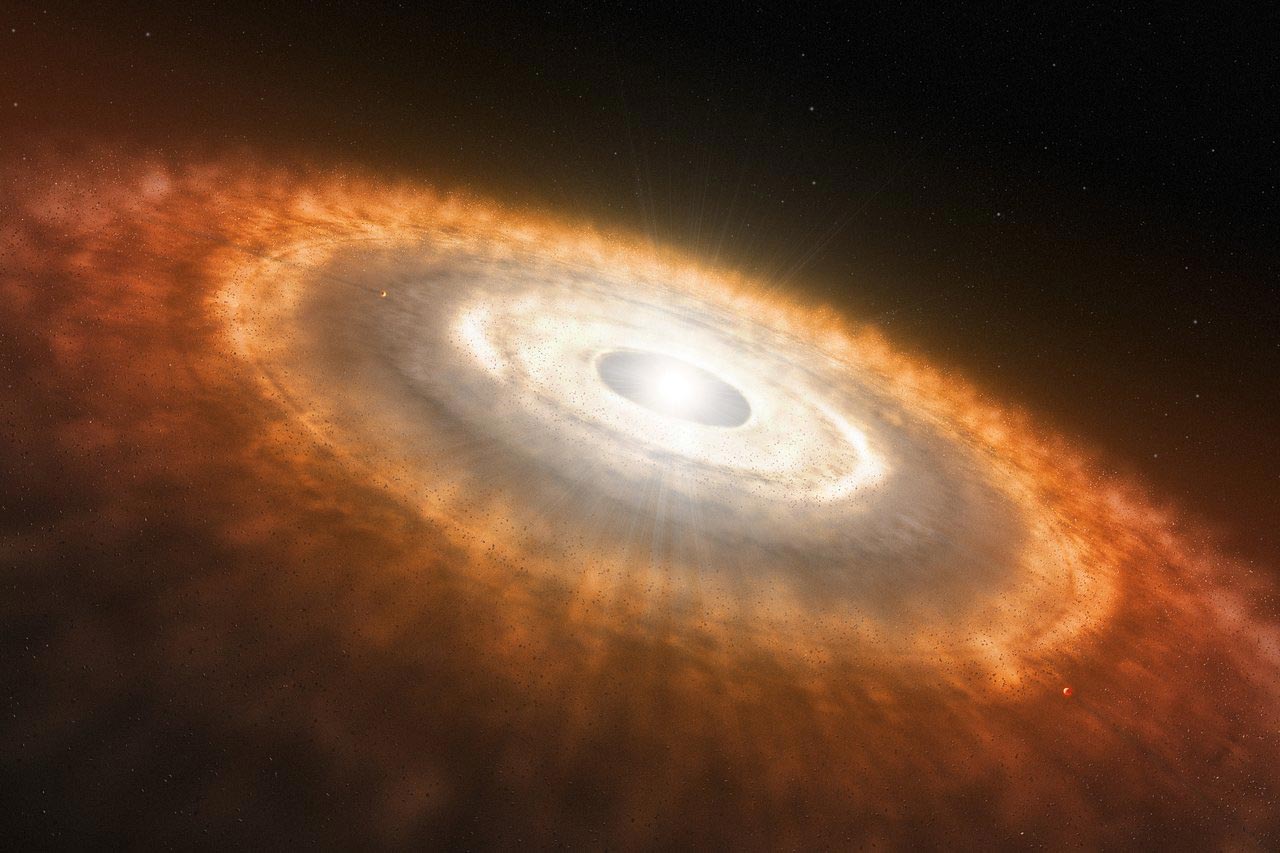
Early Earth lacked life’s essentials until a collision with Theia added them. This chance event made life possible.
After the Solar System formed, it took no more than three million years for the proto-Earth to finish developing its chemical composition, according to a new study from the Institute of Geological Sciences at the University of Bern. At that stage, however, the young planet contained almost none of the key ingredients for life, such as water or carbon compounds. Researchers conclude that only a later planetary impact likely delivered water to Earth, creating the conditions needed for life to emerge.
Earth remains the only planet known to support life, with both liquid water and a stable atmosphere. Yet when the planet formed, the environment was far from habitable. The gas and dust cloud that gave rise to the Solar System contained volatile elements essential for life, including hydrogen, carbon, and sulfur. But in the inner Solar System—where Mercury, Venus, Earth, Mars, and the asteroid belt reside today—these volatile substances could not easily survive.
The Sun’s intense heat kept them from condensing, leaving them largely in a gaseous state. Because they were not incorporated into the rocky material that built the planets, the proto-Earth ended up with very little of these crucial elements. Only celestial bodies forming farther from the Sun, in cooler regions, could accumulate them. The question of when and how Earth became a planet capable of supporting life remains unresolved.
Reconstructing Earth’s early chemistry
In their study, the Bern researchers demonstrated for the first time that the proto-Earth’s chemical makeup was fully established within three million years of the Solar System’s birth—but in a form that made life impossible. Their findings, published in Science Advances, indicate that a later event must have provided the missing ingredients that transformed Earth into a habitable world.

The study’s lead author is Dr. Pascal Kruttasch, who completed the work as part of his dissertation at the Institute of Geological Sciences, supported by the Swiss National Science Foundation. He now continues his research as an SNSF Postdoc.Mobility Fellow at Imperial College London.
Using a precise clock to measure the history of the Earth’s formation
The researchers combined isotope data with elemental measurements from both meteorites and terrestrial rocks to trace how Earth formed. Through model calculations, they were able to pinpoint the timeframe in which Earth’s chemical composition took shape and compare it with that of other planetary building blocks.
Kruttasch explains: “A high-precision time measurement system based on the radioactive decay of manganese-53 was used to determine the precise age. This isotope was present in the early Solar System and decayed to chromium-53 with a half-life of around 3.8 million years.” This method allowed ages to be determined with an accuracy of less than one million years for materials that are several billion years old. “These measurements were only possible because the University of Bern has internationally recognized expertise and infrastructure for the analysis of extraterrestrial materials and is a leader in the field of isotope geochemistry,” says co-author Klaus Mezger, Professor Emeritus of Geochemistry at the Institute of Geological Sciences at the University of Bern.
Life on Earth thanks to a cosmic coincidence?
Using model calculations, the research team was able to show that the chemical signature of the proto-Earth, i.e. the unique pattern of chemical substances of which it is composed, was already complete less than three million years after the formation of the Solar System. Their study thus provides empirical data on the time of formation of the original material of the young Earth. “Our Solar System formed around 4,568 million years ago. Considering that it only took up to 3 million years to determine the chemical properties of the Earth, this is surprisingly fast,” says first author Kruttasch.
The results of the study thus support the assumption that a later collision with another planet – Theia – brought the decisive turning point and made the Earth a life-friendly planet. Theia probably formed further out in the Solar System, where volatile substances such as water accumulated. “Thanks to our results, we know that the proto-Earth was initially a dry rocky planet. It can therefore be assumed that it was only the collision with Theia that brought volatile elements to Earth and ultimately made life possible there,” says Kruttasch.
Life-friendliness in the universe cannot be taken for granted
The new study contributes significantly to our understanding of the processes in the early phase of the Solar System and provides clues as to when and how planets on which life is possible can form. “The Earth does not owe its current life-friendliness to a continuous development, but probably to a chance event – the late impact of a foreign, water-rich body. This makes it clear that life-friendliness in the universe is anything but a matter of course,” says Mezger.
The next step would be to investigate the collision event between proto-Earth and Theia in more detail. “So far, this collision event is insufficiently understood. Models are needed that can fully explain not only the physical properties of the Earth and Moon, but also their chemical composition and isotope signatures,” concludes Kruttasch.
Reference: “Time of proto-Earth reservoir formation and volatile element depletion from 53Mn-53Cr chronometry” by Pascal M. Kruttasch and Klaus Mezger, 1 August 2025, Science Advances.
DOI: 10.1126/sciadv.adw1280
Never miss a breakthrough: Join the SciTechDaily newsletter.
Follow us on Google and Google News.
3 Comments
Planet Theia also perhaps contributed its iron core which may explain the oversize core of earth and the life friendly magnetosphere.
Compared to Mercury, Earth core is relatively undersize.
The geodynamo protects surface life from solar wind most of the time, but they are survivable when they don’t (strong solar winds, geodynamo pole reversals).
The paper makes little sense to me, since its model cannot distinguish between different scenarios (se fig. 3) and their “volatile depleted proto Earth” references suggests other mantle compositions than they do. It seems they assume what they want to show, and that the timing they observe has little to do with that.