

Researchers are uncovering how a poisonous chemical could have helped life emerge.
A chemical that is deadly to humans may have contributed to the earliest steps toward life on Earth. Hydrogen cyanide can freeze into solid crystals at low temperatures. Computer modeling work reported in ACS Central Science shows that certain crystal surfaces are highly reactive, allowing chemical reactions to occur that normally would not happen in such cold conditions. Researchers suggest these reactions may have triggered a chain process that produced several of the fundamental building blocks of life.
“We may never know precisely how life began, but understanding how some of its ingredients take shape is within reach. Hydrogen cyanide is likely one source of this chemical complexity, and we show that it can react surprisingly quickly in cold places,” says Martin Rahm, the corresponding author of the study.
Hydrogen Cyanide in Space and Prebiotic Chemistry
Hydrogen cyanide is common in environments beyond Earth. It has been found on comets and in the atmospheres of planets and moons (e.g., Saturn’s moon Titan). When hydrogen cyanide comes into contact with water, it can give rise to polymers, amino acids, and nucleobases (components of proteins and DNA strands, respectively). To better understand how this molecule behaves under frozen conditions, Marco Capelletti, Hilda Sandström and Martin Rahm used computer simulations to study solid hydrogen cyanide.
Simulating Crystal Shapes Seen in Nature
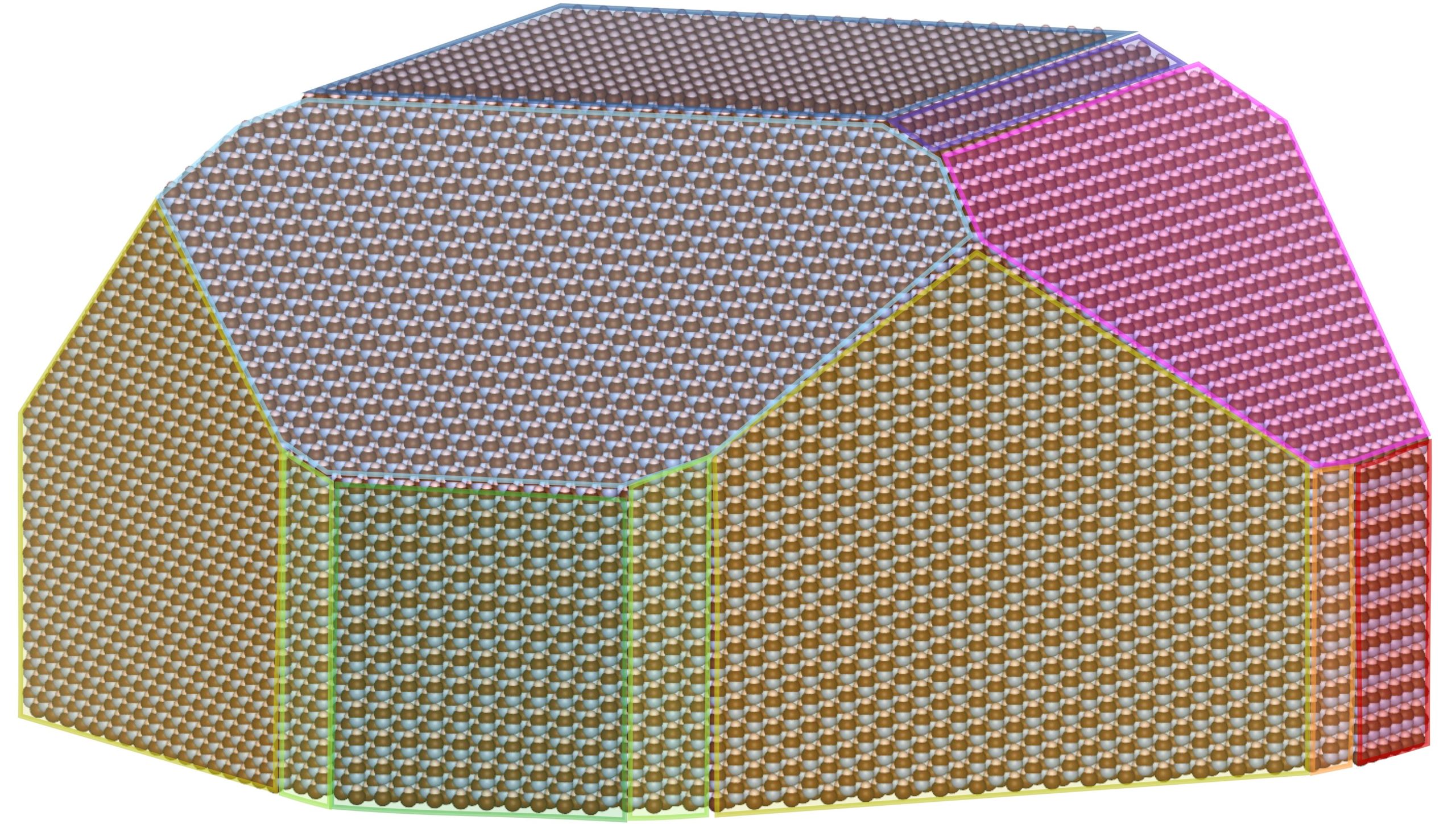
In the simulations, the team modeled a stable hydrogen cyanide crystal as a cylinder about 450 nanometers long. The structure included a rounded base and a top with multiple flat faces, similar in appearance to a cut gemstone. According to the researchers, this geometry matches earlier observations of crystal formations described as “cobwebs” that spread outward from a central point where the multifaceted ends meet.
Unexpected Chemical Activity in Extreme Cold
The calculations showed that these frozen crystals could promote chemical reactions that rarely occur in extremely cold environments. By analyzing the chemistry of the crystal surfaces, the researchers identified two reaction routes that could convert hydrogen cyanide into hydrogen isocyanide, a more reactive compound.
Depending on the temperature, this transformation could take place within minutes or over several days. The presence of hydrogen isocyanide on the crystal surface suggests that even more complex prebiotic precursors could form in these regions.
Next Steps Toward Experimental Tests
The researchers hope their predictions will be tested in laboratory experiments. One possible approach would involve crushing hydrogen cyanide crystals in the presence of substances like water. Exposing fresh crystal surfaces could reveal whether these surfaces truly encourage the formation of complex molecules at extremely low temperatures.
Reference: “Electric Fields Can Assist Prebiotic Reactivity on Hydrogen Cyanide Surfaces” by Marco Cappelletti, Hilda Sandström and Martin Rahm, 14 January 2026, ACS Central Science.
DOI: 10.1021/acscentsci.5c01497
The authors acknowledge funding from the Swedish Research Council and the National Academic Infrastructure for Supercomputing in Sweden.
Never miss a breakthrough: Join the SciTechDaily newsletter.
Follow us on Google and Google News.
3 Comments
“Hydrogen cyanide can freeze into solid crystals at low temperatures.”
I think that it would be appropriate to mention just how low those temperatures are (-13°C) and how rare they are on Earth, particularly during the Hadean Era when life probably first evolved.
Try standing around in Antarctica. or even in the Arctic, or for that matter in a Canadian winter even as far south as Minneapolis. Or perhaps even during a Russian winter such as killed Paulus’ ambitions to capture Stalingrad. Even bits of the UK could get cold. -13 deg Cis not uncommon.
I wasn’t around in the Hadean, so no comment about that.
I didn’t say that temperatures lower than -13°C were impossible today. I implied that they were improbable during the Hadean. If you are unfamiliar with the conditions during the Hadean, why would you mention Recent ‘Cold House’ temperatures as being an analog for the Hadean?
Temperature is a measure of the average speed of gaseous molecules, and the vibratory agitation of the molecules in condensed matter. Chemical reactions slow down as temperatures drop. That is, the probability of elements coming together and sticking to each other to create new chemical compounds decreases with decreasing temperatures. While temperatures below -13°C may not be uncommon today, they certainly were during the Hadean!