

Eukaryogenesis occurred suddenly, driven by the growing length of genes and the limitations on producing longer proteins.
An international team of four senior scientists from Mainz, Valencia, Madrid, and Zurich has published groundbreaking research in the journal PNAS that explores one of the most significant leaps in the evolution of life on Earth: the origin of the eukaryotic cell.
While the endosymbiotic theory, which proposes that eukaryotic cells emerged from a fusion between an archaeon and a bacterium, is widely accepted, billions of years have passed since that event. As a result, there are few, if any, evolutionary intermediates visible in the phylogenetic tree leading up to eukaryotes. This missing link has been referred to as the black hole at the heart of biology.
“The new study is a blend of theoretical and observational approaches that quantitatively understands how the genetic architecture of life was transformed to allow such an increase in complexity,” explained Dr. Enrique M. Muro, a representative of Johannes Gutenberg University Mainz (JGU) involved in the project.
Proteins and protein-coding genes increase in length
The PNAS article shows that the lengths of proteins and their corresponding genes follow log-normal distributions across the entire tree of life. To reach this conclusion, the team analyzed 9,913 proteomes and 33,627 genomes. Log-normal distributions are typically the result of multiplicative processes. Applying Ockham’s razor, the researchers modeled gene length evolution as a multiplicative stochastic process. This approach considered the combined effects of all genetic mechanisms in relation to sequence length.
Starting from LUCA, the last universal common ancestor of Bacteria, Archaea, and Eukarya, they demonstrated both theoretically and with data that average gene lengths have increased exponentially over time. They also discovered a scaling-invariant mechanism in gene length evolution, where the variance in gene lengths scales with the mean. Using the 33,627 genomes, they confirmed that these patterns hold across species and showed that average gene length is a strong indicator of organismal complexity.
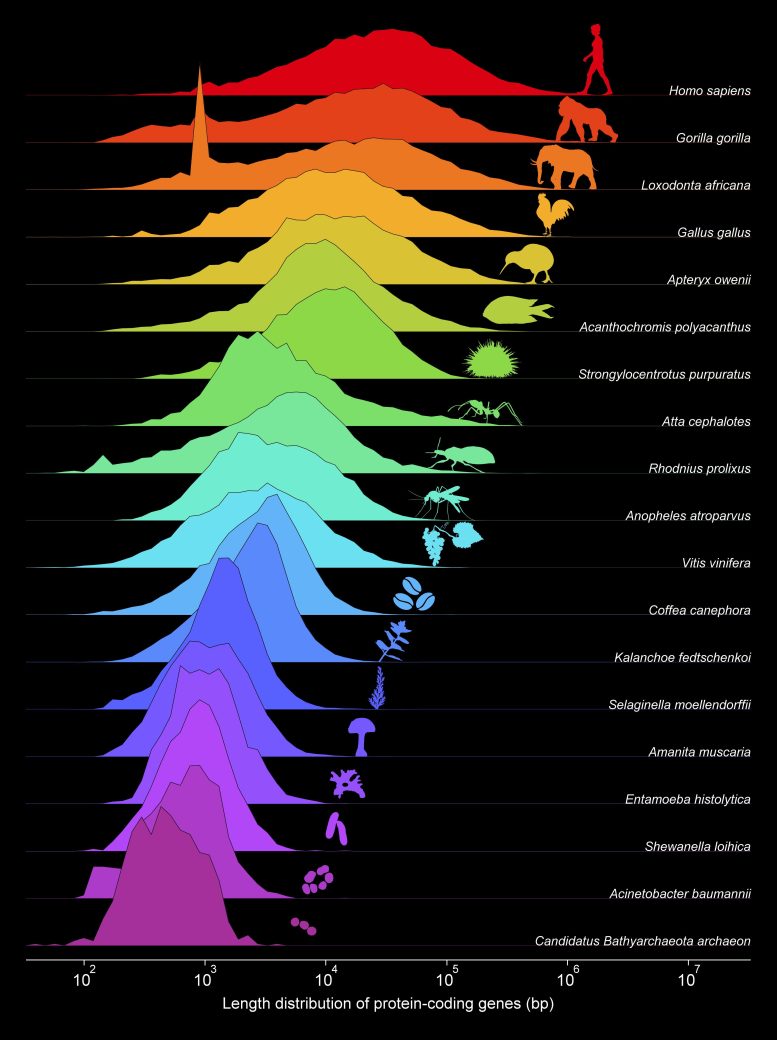
In summarizing the practical outcome of their quantitative approach, Dr. Bartolo Luque from the Polytechnic University of Madrid noted, “From knowing the average length of protein-coding genes in a species, we can calculate the whole distribution of gene length within that species.”
When representing the evolution of the average protein lengths versus their corresponding gene lengths across different species, it is observed that they evolve simultaneously in prokaryotes, because there are almost no non-coding sequences in their genes. However, once the average gene length reaches 1,500 nucleotides, the proteins decouple from the multiplicative process of gene growth, and the average protein length stabilizes after the onset of the eukaryotic cell at about 500 amino acids in a clear threshold, marking the appearance of the eukaryotic cell. From that point onward, and unlike what happens with proteins, the average gene length continues to increase as it did in prokaryotes, due to the presence of non-coding sequences.
Algorithmic phase transition
A critical phenomena analysis then concluded that a phase transition, well studied in the physics of magnetic materials, occurred at a critical gene length of 1,500 nucleotides. This marked eukaryogenesis and divides the evolution of life into two distinct phases: a coding phase (Prokarya) and a non-coding phase (Eukarya). Additionally, characteristic phenomena of these transitions are observed, such as critical slowing down, where the system’s dynamics become trapped in many metastable states around the critical point. “This is corroborated in early protists and fungi,” said Dr. Fernando Ballesteros from the University of Valencia.

Moreover, “the phase transition was algorithmic,” added Professor Jordi Bascompte from the University of Zurich. In the coding phase, in a scenario close to LUCA, with short proteins, increasing the length of proteins and their corresponding genes was computationally simple. However, as the protein lengths grew, the search for longer proteins became unfeasible.
This tension caused by genes that grew at the same rate as before, while proteins could not was resolved continuously but abruptly with the incorporation of non-coding sequences into the genes. With this innovation, the algorithm for searching for new proteins rapidly reduced its computational complexity, becoming non-linear through the spliceosome and the nucleus, which separated transcription and splicing from translation. This happened at the critical point of phase transition, which this study dates to 2.6 billion years ago.
The study recently published in PNAS not only answers essential questions but is interdisciplinary, combining computational biology, evolutionary biology, and physics. “It has the potential to interest a wide audience across many disciplines and serve as a foundation for other groups to explore different research avenues, such as energy or information theory,” emphasized Dr. Enrique Muro of the Institute of Organismic and Molecular Evolution at Mainz University.
The eukaryotic cell, the most significant increase in complexity in the history of life’s evolution on Earth, emerged as a phase transition and unlocked the path toward other major transitions, such as multicellularity, sexuality, and sociability, that shaped life on our planet as we know it today.
Reference: “The emergence of eukaryotes as an evolutionary algorithmic phase transition” by Enrique M. Muro, Fernando J. Ballesteros, Bartolo Luque and Jordi Bascompte, 27 March 2025, Proceedings of the National Academy of Sciences.
DOI: 10.1073/pnas.2422968122
Never miss a breakthrough: Join the SciTechDaily newsletter.
Follow us on Google and Google News.
3 Comments
What the devil is a spliceosome?.”…….becoming non-linear through the spliceosome and the nucleus, which separated transcription and splicing from translation………” May be science but how does that type of writing translate to the average oik who reads SciTech Daily for information?
look it up in Google search. It’s interesting!
The scholarship money must have started running out, so they quickly came up with some crap to get more.