
Close Menu
    Facebook X (Twitter) Instagram
    SciTechDaily
    • Biology
    • Chemistry
    • Earth
    • Health
    • Physics
    • Science
    • Space
    • Technology
    Facebook X (Twitter) Pinterest YouTube RSS
    SciTechDaily
    Home»Physics»Light “Hypernucleus” Predicted to Be Stable Despite Having Two Strange Quarks
    Physics

    Light “Hypernucleus” Predicted to Be Stable Despite Having Two Strange Quarks

    By RIKENJuly 11, 20201 Comment3 Mins Read
    Facebook Twitter Pinterest Telegram LinkedIn WhatsApp Email Reddit
    Share
    Facebook Twitter LinkedIn Pinterest Telegram Email Reddit
    Bound Nucleus Containing Three Normal Nucleons
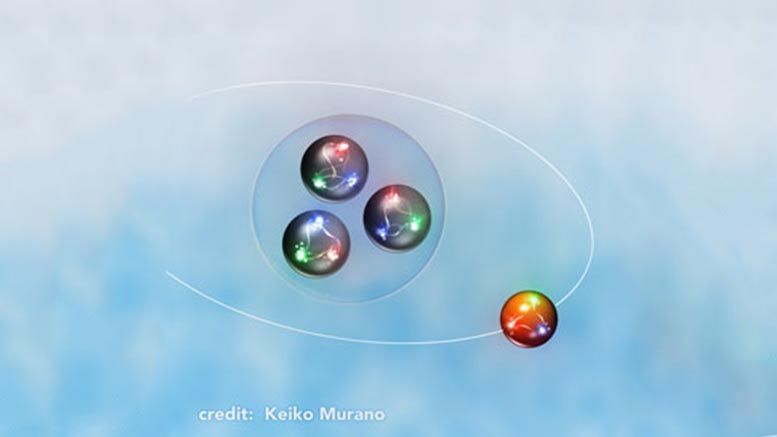
    An artist’s impression of a bound nucleus containing three normal nucleons, which have up and down quarks, and a Xi hyperon (gold sphere at bottom right), which contains two strange quarks. Calculations by RIKEN nuclear physicists predict that this exotic nucleus will be stable. Credit: © 2020 Keiko Murano

    Calculations predict that a light ‘hypernucleus’ containing a particle with two strange quarks will be stable

    Adding an exotic particle known as a Xi hyperon to a helium nucleus with three nucleons could produce a nucleus that is temporarily stable, calculations by RIKEN nuclear physicists have predicted. This result will help experimentalists search for the nucleus and provide insights into both nuclear physics and the structure of neutron stars.

    Normal atomic nuclei consist of protons and neutrons, which are collectively known as nucleons. Each proton and neutron in turn is made up of three quarks. Quarks come in six types: up, down, strange, charm, bottom and top. But protons and neutrons consist only of up and down quarks.

    Nuclear physicists have long been interested in hypernuclei—nuclei that contain one or more hyperons in which at least one of the three quarks is a strange quark. While only a handful of hypernuclei have been created at nuclear physics facilities, they provide a valuable new window into the mysteries of nuclei.

    “Standard nuclei are defined by how many protons and neutrons they contain, and that’s it. They’re essentially two dimensional,” says Takumi Doi at the RIKEN Nishina Center for Accelerator-Based Science and the RIKEN Interdisciplinary Theoretical and Mathematical Sciences Program. “Hyperons offer us an extra dimension through the number of strange quarks—this enables us to gain deeper insight into a nucleus, such as the interactions that make a nucleus stable.”

    Most studies have focused on hyperons that contain just one strange quark. But hyperons with two strange quarks, known as Xi hyperons, are also possible. So far, one hypernucleus containing a Xi hyperon and 14 nucleons has been made.

    Doi and co-workers suspected that lighter hypernuclei containing Xi hyperon may exist, and they performed calculations of the interaction between a Xi hyperon and a nucleon on RIKEN’s K supercomputer to find out. Their results predict that a hypernucleus made up of three normal nucleons and one Xi hyperon should be stable enough to be made in experiments. According to their calculations, this is the lightest hypernucleus containing a Xi hyperon.

    Their results came as a surprise because they differed greatly from those obtained using an approximation. “We predicted that the interaction is attractive when the Xi hyperon and a nucleon are in a particular state, whereas an approximate approach estimates that the corresponding potential will be repulsive,” says Doi. “So these results are very different.”

    The results will not only give experimentalists a target to aim for, they will also inform studies into neutron stars. Neutron stars are the extremely dense remnants of large stars that have collapsed under their own gravity and undergone supernova explosions. Their interiors may provide the conditions under which hypernuclei containing Xi hyperons could exist.

    Reference: “Possible Lightest Ξ Hypernucleus with Modern ΞN Interactions” by E. Hiyama, K. Sasaki, T. Miyamoto, T. Doi, T. Hatsuda, Y. Yamamoto and Th. A. Rijken, 4 March 2020, Physical Review Letters.
    DOI: 10.1103/PhysRevLett.124.092501

    Never miss a breakthrough: Join the SciTechDaily newsletter.
    Follow us on Google and Google News.

    Particle Physics RIKEN
    Share. Facebook Twitter Pinterest LinkedIn Email Reddit

    Related Articles

    Ghost Particles No More: A New Theory Shines Light on Superconductor Mysteries

    The Chilling Antimatter Experiment That Could Unlock the Universe’s Secrets

    Boson Systems Shatter Quantum Speed Limits: Information Races Faster Than Particles

    Strange Quark Matter: Gravitational Waves Hold Clues to the Universe’s Densest Matter

    Emergent Matter Scientists Successfully Manipulate a Single Skyrmion at Room Temperature

    Incredible Cosmic Conditions: Bringing Neutron Stars Down to Earth

    Dark Matter Candidate Could Generate String-Like Entities in Exotic Materials

    Intense Isotope Beam Used to Confirm a New ‘Magic Number’ for Neutrons

    Physicists Reveal a Neutron Halo Around Neutron-Rich Magnesium Nuclei

    1 Comment

    1. kamir bouchareb st on October 21, 2020 3:11 am

      very good

      Reply
    Leave A Reply Cancel Reply

    • Facebook
    • Twitter
    • Pinterest
    • YouTube

    Don't Miss a Discovery

    Subscribe for the Latest in Science & Tech!

    Trending News

    The Universe Is Expanding Too Fast and Scientists Can’t Explain Why

    “Like Liquid Metal”: Scientists Create Strange Shape-Shifting Material

    Early Warning Signals of Esophageal Cancer May Be Hiding in Plain Sight

    Common Blood Pressure Drug Shows Surprising Power Against Deadly Antibiotic-Resistant Superbug

    Scientists Uncover Dangerous Connection Between Serotonin and Heart Valve Disease

    Scientists Discover a “Protector” Protein That Could Help Reverse Hair Loss

    Bone-Strengthening Discovery Could Reverse Osteoporosis

    Scientists Uncover Hidden Trigger Behind Stem Cell Aging

    Follow SciTechDaily
    • Facebook
    • Twitter
    • YouTube
    • Pinterest
    • Newsletter
    • RSS
    SciTech News
    • Biology News
    • Chemistry News
    • Earth News
    • Health News
    • Physics News
    • Science News
    • Space News
    • Technology News
    Recent Posts
    • Scientists Create Improved Insulin Cells That Reverse Diabetes in Mice
    • Scientists Stunned After Finding Plant Thought Extinct for 60 Years
    • A Common Diabetes Drug May Hold the Key to Stopping HIV From Coming Back
    • Ancient “Syphilis-Like” Disease in Vietnam Challenges Key Scientific Assumptions
    • Drinking Alcohol To Cope in Your 20s Could Damage Your Brain for Life
    Copyright © 1998 - 2026 SciTechDaily. All Rights Reserved.
    • Science News
    • About
    • Contact
    • Editorial Board
    • Privacy Policy
    • Terms of Use

    Type above and press Enter to search. Press Esc to cancel.