
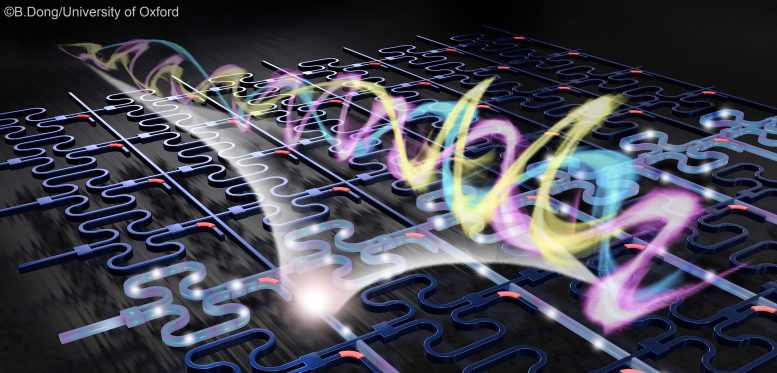
Researchers have developed an integrated photonic-electronic hardware capable of processing 3D data. This innovation significantly improves data processing parallelism for AI tasks.
- A breakthrough development in photonic-electronic hardware could significantly boost processing power for AI and machine learning applications.
- The approach uses multiple radio frequencies to encode data, enabling multiple calculations to be carried out in parallel.
- The method shows promise for outperforming state-of-the-art electronic processors, with further enhancements possible.
New Advancements in Photonic-Electronic Hardware for AI
In a paper published on October 19 in the journal Nature Photonics, researchers from the University of Oxford, along with collaborators from the Universities of Muenster, Heidelberg, and Exeter, report on their development of integrated photonic-electronic hardware capable of processing three-dimensional (3D) data, substantially boosting data processing parallelism for AI tasks.
Challenges With Current Computing Power and the Role of Photonics
Conventional computer chip processing efficiency doubles every 18 months, but the processing power required by modern AI tasks is currently doubling around every 3.5 months. This means that new computing paradigms are urgently needed to cope with the rising demand.
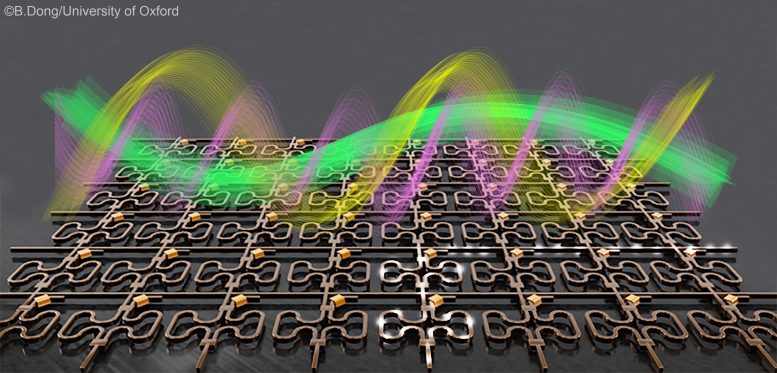
One approach is to use light instead of electronics – this allows multiple calculations to be carried out in parallel using different wavelengths to represent different sets of data. Indeed, in groundbreaking work published in the journal Nature in 2021, many of the same authors demonstrated a form of integrated photonic processing chip that could carry out matrix vector multiplication (a crucial task for AI and machine learning applications) at speeds far outpacing the fastest electronic approaches. This work resulted in the birth of the photonic AI company, Salience Labs, a spin-out from the University of Oxford.
Innovations in Parallel Processing and Real-world Application
Now the team has gone further by adding an extra parallel dimension to the processing capability of their photonic matrix-vector multiplier chips. This “higher-dimensional” processing is enabled by exploiting multiple different radio frequencies to encode the data, propelling parallelism to a level far beyond that previously achieved.
As a test case, the team applied their novel hardware to the task of assessing the risk of sudden death from electrocardiograms of heart disease patients. They were able to successfully analyze 100 electrocardiogram signals simultaneously, identifying the risk of sudden death with a 93.5% accuracy.
Future Prospects and Expert Opinions
The researchers further estimated that even with a moderate scaling of 6 inputs × 6 outputs, this approach can outperform state-of-the-art electronic processors, potentially providing a 100-times enhancement in energy efficiency and compute density. The team anticipates further enhancement in computing parallelism in the future, by exploiting more degrees of freedom of light, such as polarization and mode multiplexing.
First author Dr. Bowei Dong at the Department of Materials, University of Oxford said: “We previously assumed that using light instead of electronics could increase parallelism only by the use of different wavelengths – but then we realized that using radio frequencies to represent data opens up yet another dimension, enabling superfast parallel processing for emerging AI hardware.”
Professor Harish Bhaskaran, Department of Materials, University of Oxford and CO-founder of Salience Labs, who led the work said: “This is an exciting time to be doing research in AI hardware at the fundamental scale, and this work is one example of how what we assumed was a limit can be further surpassed.”
Reference: “Higher-dimensional processing using a photonic tensor core with continuous-time data” by Bowei Dong, Samarth Aggarwal, Wen Zhou, Utku Emre Ali, Nikolaos Farmakidis, June Sang Lee, Yuhan He, Xuan Li, Dim-Lee Kwong, C. D. Wright, Wolfram H. P. Pernice and H. Bhaskaran, 19 October 2023, Nature Photonics.
DOI: 10.1038/s41566-023-01313-x
Never miss a breakthrough: Join the SciTechDaily newsletter.
Follow us on Google and Google News.
1 Comment
Working together worldwide 365 days 24/7 hours