

An experiment has measured gold formation from lead nuclei during near-miss collisions in the Large Hadron Collider.
These high-speed interactions trigger electromagnetic processes that occasionally eject three protons, yielding gold atoms. Billions are made, but only for a split second.
Lead to Gold: A Modern Alchemical Feat at CERN
In a newly published study in Physical Review Journals, scientists from CERN’s ALICE experiment have observed something extraordinary: the transformation of lead into gold inside the powerful Large Hadron Collider (LHC).
For centuries, alchemists dreamed of turning lead into gold. Known as chrysopoeia, this ancient quest was based on the idea that both metals were heavy and shared similar properties. Of course, we now know that lead and gold are completely different elements, and no chemical process can turn one into the other.
A New Kind of Alchemy—Powered by Physics
In the 20th century, nuclear physics revealed that atoms could change from one element into another. This could happen naturally through radioactive decay or be triggered in laboratories using high-energy particles like neutrons or protons. Gold has been made this way before, but now, the ALICE team has measured a completely new method of element-changing magic—this time using near misses between high-speed lead atoms.
When two lead nuclei race through the LHC at nearly the speed of light, they sometimes just miss each other. Instead of colliding head-on, they pass close enough to trigger intense electromagnetic forces. These interactions can generate bursts of energy that change the very identity of atomic nuclei, including turning lead into gold.
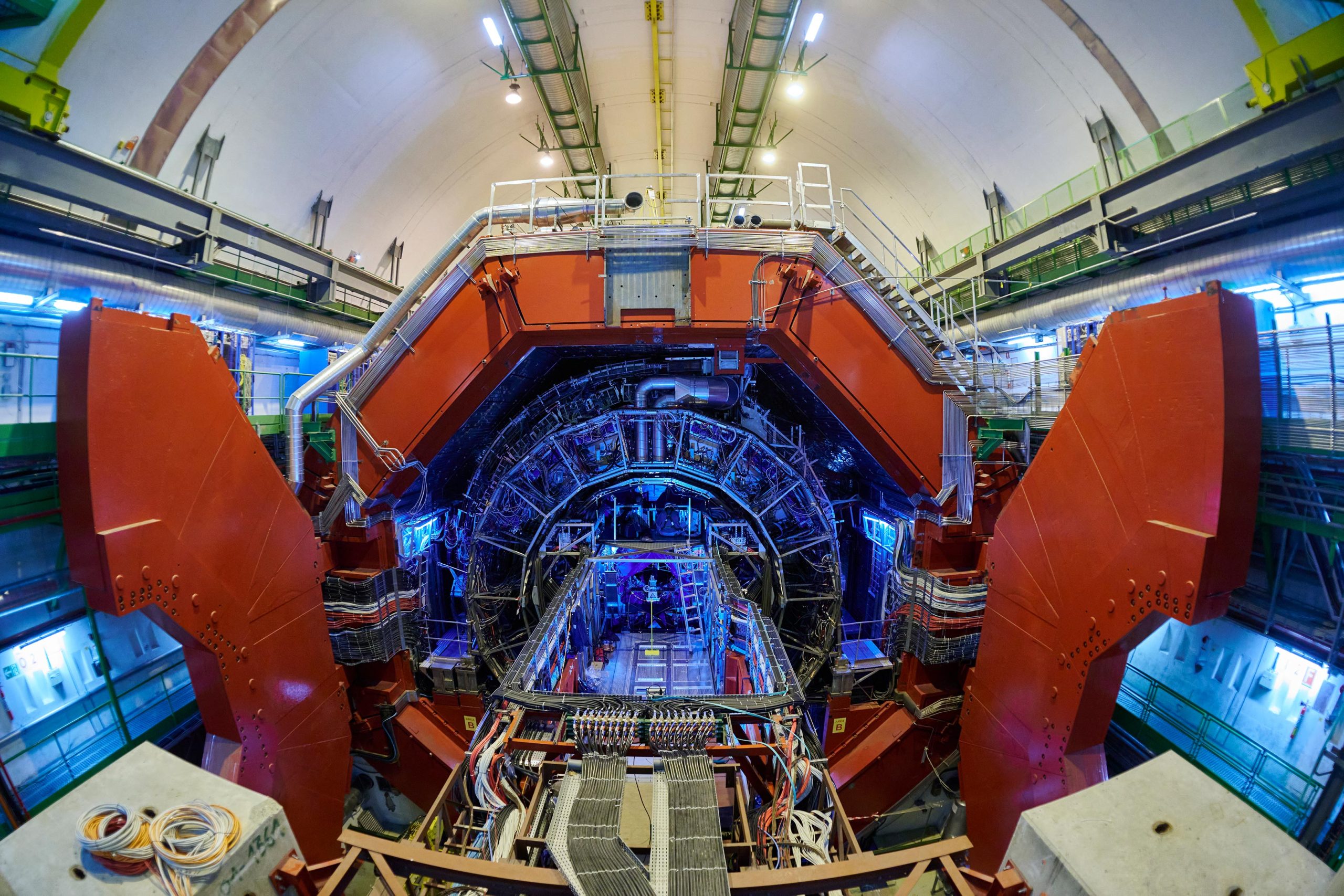
Photon Bursts and Nuclear Shifts
The electromagnetic field emanating from a lead nucleus is particularly strong because the nucleus contains 82 protons, each carrying one elementary charge. Moreover, the very high speed at which lead nuclei travel in the LHC (corresponding to 99.999993% of the speed of light) causes the electromagnetic field lines to be squashed into a thin pancake, transverse to the direction of motion, producing a short-lived pulse of photons. Often, this triggers a process called electromagnetic dissociation, whereby a photon interacting with a nucleus can excite oscillations of its internal structure, resulting in the ejection of small numbers of neutrons and protons. To create gold (a nucleus containing 79 protons), three protons must be removed from a lead nucleus in the LHC beams.
“It is impressive to see that our detectors can handle head-on collisions producing thousands of particles, while also being sensitive to collisions where only a few particles are produced at a time, enabling the study of electromagnetic ‘nuclear transmutation’ processes,” says Marco Van Leeuwen, ALICE spokesperson.
Counting Gold Atoms in the Particle Smash
The ALICE team used the detector’s zero degree calorimeters (ZDC) to count the number of photon–nucleus interactions that resulted in the emission of zero, one, two and three protons accompanied by at least one neutron, which are associated with the production of lead, thallium, mercury and gold, respectively. While less frequent than the creation of thallium or mercury, the results show that the LHC currently produces gold at a maximum rate of about 89,000 nuclei per second from lead–lead collisions at the ALICE collision point. Gold nuclei emerge from the collision with very high energy and hit the LHC beam pipe or collimators at various points downstream, where they immediately fragment into single protons, neutrons, and other particles. The gold exists for just a tiny fraction of a second.
A Fleeting Treasure: Billion Gold Atoms, But No Jewelry
The ALICE analysis shows that, during Run 2 of the LHC (2015–2018), about 86 billion gold nuclei were created at the four major experiments. In terms of mass, this corresponds to just 29 picograms (2.9 ×10⁻¹¹ g). Since the luminosity in the LHC is continually increasing thanks to regular upgrades to the machines, Run 3 has produced almost double the amount of gold that Run 2 did, but the total still amounts to trillions of times less than would be required to make a piece of jewellery. While the dream of medieval alchemists has technically come true, their hopes of riches have once again been dashed.
Beyond Gold: Improving Collider Physics
“Thanks to the unique capabilities of the ALICE ZDCs, the present analysis is the first to systematically detect and analyse the signature of gold production at the LHC experimentally,” says Uliana Dmitrieva of the ALICE collaboration.
“The results also test and improve theoretical models of electromagnetic dissociation, which, beyond their intrinsic physics interest, are used to understand and predict beam losses that are a major limit on the performance of the LHC and future colliders,” adds John Jowett, also of the ALICE collaboration.
Reference: “Proton emission in ultraperipheral Pb-Pb collisions at √𝑠𝑁𝑁=5.02 TeV” by S. Acharya, A. Agarwal, G. Aglieri Rinella, L. Aglietta, M. Agnello, N. Agrawal, Z. Ahammed, S. Ahmad, S. U. Ahn, S. U. Ahn, I. Ahuja, A. Akindinov, V. Akishina, M. Al-Turany, D. Aleksandrov, B. Alessandro, H. M. Alfanda, R. Alfaro Molina, B. Ali, A. Alici, N. Alizadehvandchali, A. Alkin, J. Alme, G. Alocco, T. Alt, A. R. Altamura, I. Altsybeev, J. R. Alvarado, C. O. R. Alvarez, M. N. Anaam, C. Andrei, N. Andreou, A. Andronic, E. Andronov, V. Anguelov, F. Antinori, P. Antonioli, N. Apadula, L. Aphecetche, H. Appelshäuser, C. Arata, S. Arcelli, R. Arnaldi, J. G. M. C. A. Arneiro, I. C. Arsene, M. Arslandok, A. Augustinus, R. Averbeck, D. Averyanov, M. D. Azmi, H. Baba, A. Badalà, J. Bae, Y. Bae, Y. W. Baek, X. Bai, R. Bailhache, Y. Bailung, R. Bala, A. Baldisseri, B. Balis, Z. Banoo, V. Barbasova, F. Barile, L. Barioglio, M. Barlou, B. Barman, G. G. Barnaföldi, L. S. Barnby, E. Barreau, V. Barret, L. Barreto, C. Bartels, K. Barth, E. Bartsch, N. Bastid, S. Basu, G. Batigne, D. Battistini, B. Batyunya, D. Bauri, J. L. Bazo Alba, I. G. Bearden, C. Beattie, P. Becht, D. Behera, I. Belikov, A. D. C. Bell Hechavarria, F. Bellini, R. Bellwied, S. Belokurova, L. G. E. Beltran, Y. A. V. Beltran, G. Bencedi, A. Bensaoula, S. Beole, Y. Berdnikov, A. Berdnikova, L. Bergmann, M. G. Besoiu, L. Betev, P. P. Bhaduri, A. Bhasin, B. Bhattacharjee, L. Bianchi, J. Bielčík, J. Bielčíková, A. P. Bigot, A. Bilandzic, A. Binoy, G. Biro, S. Biswas, N. Bize, J. T. Blair, D. Blau, M. B. Blidaru, N. Bluhme, C. Blume, F. Bock, T. Bodova, J. Bok, L. Boldizsár, M. Bombara, P. M. Bond, G. Bonomi, H. Borel, A. Borissov, A. G. Borquez Carcamo, E. Botta, Y. E. M. Bouziani, D. C. Brandibur, L. Bratrud, P. Braun-Munzinger, M. Bregant, M. Broz, G. E. Bruno, V. D. Buchakchiev, M. D. Buckland, D. Budnikov, H. Buesching, S. Bufalino, P. Buhler, N. Burmasov, Z. Buthelezi, A. Bylinkin, S. A. Bysiak, J. C. Cabanillas Noris, M. F. T. Cabrera, H. Caines, A. Caliva, E. Calvo Villar, J. M. M. Camacho, P. Camerini, F. D. M. Canedo, S. L. Cantway, M. Carabas, A. A. Carballo, F. Carnesecchi, R. Caron, L. A. D. Carvalho, J. Castillo Castellanos, M. Castoldi, F. Catalano, S. Cattaruzzi, R. Cerri, I. Chakaberia, P. Chakraborty, S. Chandra, S. Chapeland, M. Chartier, S. Chattopadhay, M. Chen, T. Cheng, C. Cheshkov, D. Chiappara, V. Chibante Barroso, D. D. Chinellato, E. S. Chizzali, J. Cho, S. Cho, P. Chochula, Z. A. Chochulska, D. Choudhury, S. Choudhury, P. Christakoglou, C. H. Christensen, P. Christiansen, T. Chujo, M. Ciacco, C. Cicalo, F. Cindolo, M. R. Ciupek, G. Clai, F. Colamaria, J. S. Colburn, D. Colella, A. Colelli, M. Colocci, M. Concas, G. Conesa Balbastre, Z. Conesa del Valle, G. Contin, J. G. Contreras, M. L. Coquet, P. Cortese, M. R. Cosentino, F. Costa, S. Costanza, P. Crochet, M. M. Czarnynoga, …, J. Wan, C. Wang, D. Wang, Y. Wang, Y. Wang, Z. Wang, A. Wegrzynek, F. T. Weiglhofer, S. C. Wenzel, J. P. Wessels, P. K. Wiacek, J. Wiechula, J. Wikne, G. Wilk, J. Wilkinson, G. A. Willems, B. Windelband, M. Winn, J. R. Wright, W. Wu, Y. Wu, Z. Xiong, R. Xu, A. Yadav, A. K. Yadav, Y. Yamaguchi, S. Yang, S. Yano, E. R. Yeats, Z. Yin, I.-K. Yoo, J. H. Yoon, H. Yu, S. Yuan, A. Yuncu, V. Zaccolo, C. Zampolli, F. Zanone, N. Zardoshti, A. Zarochentsev, P. Závada, N. Zaviyalov, M. Zhalov, B. Zhang, C. Zhang, L. Zhang, M. Zhang, M. Zhang, S. Zhang, X. Zhang, Y. Zhang, Z. Zhang, M. Zhao, V. Zherebchevskii, Y. Zhi, D. Zhou, Y. Zhou, J. Zhu, S. Zhu, Y. Zhu, S. C. Zugravel and N. Zurlo, 7 May 2025, Physical Review C.
DOI: 10.1103/PhysRevC.111.054906
Never miss a breakthrough: Join the SciTechDaily newsletter.
Follow us on Google and Google News.
2 Comments
Note 2505141443_Source1. Analyzing【
_[1-2]In the past, unknown substances are being identified by modern science. In the past, I only thought that mabangjin was a ‘jammit-guri puzzle arithmetic number’, but who knew that this would appear as a super-right science by juggoolee appearing in today’s Facebook blog? Haha.
msoms.master.jglee tells you how lead actually turns into a gold nugget msbase.gold_galaxy, not just gold for a second. lol.
_[2-2] Gold number 79, lead number 82. The accelerator draws two leads that are close to the speed of light through the equation’s complex number at the local point of the electromagnetic field, so removing the three protons results in gold. Of course, this scenario can be accompanied by protons through two or more local points. Uh-huh.
Photons are like qcells, emitting a small number of neutrons and protons by vibrating the internal structure of the nucleus through electromagnetic dissociation in the nucleus.
_[2-3] Consider the electromagnetic nuclear transformation process as the radius r(xy) of a circle clustered at the central local point of a circle on a huge circumference. We can estimate the meaning of two or more fan-shaped vertices in the qpeoms (poms, qms) model with head-on collision or deviation or one side recessed to one side. Uh-huh.
Of course, there is also a scene in which lead turns into gold during this process. Huh. The elements of qpeoms are protons, so creating a scenario of a fan-shaped collision with bosons and fermion particles is a very interesting experiment in the concept of combination emergencies.
≈≈==========
Source 1.
https://scitechdaily.com/lightning-fast-alchemy-cern-just-turned-lead-into-gold-then-watched-it-vanish/
1.
Lightning Fast Alchemy: CERN, I watched lead change to gold and then disappear.
Scientists at CERN realized what medieval alchemists had dreamed of: turning lead into gold. An experiment measured the formation of gold in the lead nucleus during the risk of collision with a large hadron collider.
This high-speed interaction triggers electromagnetic processes, in which three protons are sometimes emitted to form gold atoms. Billions are created, but the moment is very short.
1-2.
According to the research, scientists who participated in CERN’s ALICE experiment observed a surprising phenomenon. Lead is converted into gold inside the powerful Large Hadron Collider (LHC).
For centuries, alchemists dreamed of turning lead into gold. This ancient search, known as chrysopoeia, was based on the idea that both metals were heavy and shared similar properties. Of course, we now know that lead and gold are completely different elements, and that no chemical process can change both of them into different ones.
2. A New Kind of Alchemy Based on Physics
In the 20th century, nuclear physics discovered that atoms can change from one element to another. This can happen naturally through radioactive decay, or it can be induced in the lab using high-energy particles such as neutrons or protons. Gold has been made this way before, but now the ALICE team has measured a whole new way of element change magic. This time, the near miss phenomenon between high-speed lead atoms is used.
2-1.
When two lead nuclei pass through the LHC at nearly the speed of light, they sometimes pass by each other. Instead of colliding head-on, they pass close enough to cause a strong electromagnetic force. This interaction can lead to an energy explosion that changes the nature of the nucleus itself, such as converting lead into gold.
2-2. Photon explosion and nuclear displacement
Electromagnetic fields from lead nuclei are particularly strong because they contain 82 protons each with one fundamental charge.
Moreover, since lead nuclei travel at the LHC at very high speeds (equivalent to 99.999993% of the speed of light), electromagnetic lines are pressed into thin pancakes perpendicular to the direction of motion, producing short-lived photon pulses. This often triggers a process called electromagnetic dissociation, in which photons interact with the nuclei to vibrate the internal structure of the nuclei, emitting a small number of neutrons and protons.
To produce gold (nuclei containing 79 protons), three protons must be removed from the lead nucleus in the LHC beam.
2-3.
The detector is impressive in that it can handle head-on collisions that produce thousands of particles and react sensitively to collisions that produce only a few particles at a time. This made it possible to study [the electromagnetic ‘nuclear transformation’ process].
3. Gold atomic strength in particle collisions
The ALICE team counted the number of photon-nucleus interactions that resulted in the release of 0, 1, 2, and 3 protons accompanied by at least one neutron, using a zero-degree calorimeter (ZDC) of the detector. It is associated with the production of lead, thallium, mercury, and gold, respectively. Although less frequent than the production of thallium or mercury, the results show that the LHC currently produces up to about 89,000 nuclei per second in lead-nucleus collisions at the ALICE collision site.
The gold nucleus comes out of the collision with very high energy and hits a LHC beam pipe or collimator at various points downstream, where it immediately splits into a single proton, neutron and other particles. Gold only existed for an extremely short time.
3-1. Unleashed treasure: Billions of gold atoms, but no gems
According to ALICE analysis, approximately 86 billion gold atomic nuclei were produced through the fourth major experiment during the LHC secondary experiment (2015-2018). In terms of mass, this is only 29 picograms (2.9×10⁻¹¹ g).
Because the luminosity of the LHC is constantly increasing thanks to regular equipment upgrades, the third experiment produced nearly twice as much gold as the second, but the total is only a few trillion times the amount needed to make a piece of jewelry.
CERN Just Turned Lead Into Gold – Then Watched It Vanish.
good.
ASK THE CERN:
Where go It Vanish to?
Please ask researchers to think deeply:
Where do things in space come from? If things in space do not come from the dynamic evolution of space itself, what other fundamental processes may they come from? Are the spacetime vortices (based on topological phase transitions) point defects in space?
Disregarding the incompressible, non-viscous, and isotropic ideal fluid properties of absolute space, the reckless promotion of two counter-rotating cobalt-60 isotopes as mirror-image counterparts has constructed a pseudoscientific theoretical framework more shameless than the “geocentric model”, laying bare the corruption, filth, and ugliness permeating contemporary physics and so-called peer-reviewed publications (including Physical Review Letters, Nature, Science, etc.).
If anyone is interested, please browse https://zhuanlan.zhihu.com/p/1905658918916589273.