
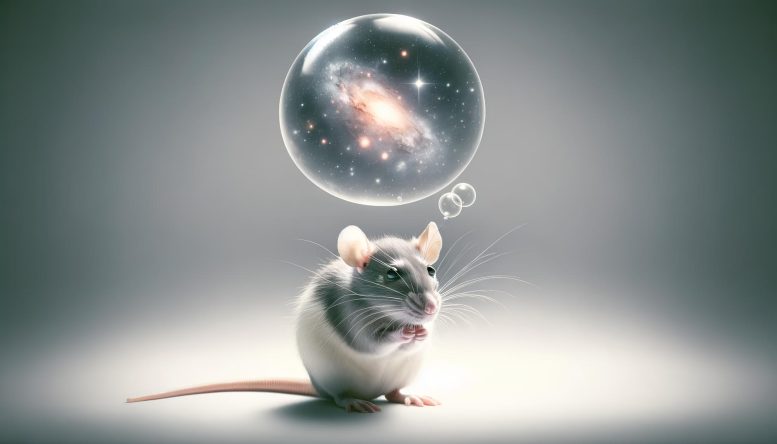
Do Animals Have an Imagination?
As human beings, our lives are intertwined with our thoughts, whether we’re contemplating dinner options or indulging in memories of our recent beach getaway.
Interestingly, scientists at HHMI’s Janelia Research Campus have discovered that animals also have an imagination.
A group of researchers from the Lee and Harris laboratories devised an innovative approach that fuses virtual reality with a brain-machine interface to explore the inner thoughts of rats.
They found that, like humans, animals can think about places and objects that aren’t right in front of them, using their thoughts to imagine walking to a location or moving a remote object to a specific spot.
A team from HHMI’s Janelia Research Campus has developed a novel system combining virtual reality and a brain-machine interface to probe the rat’s inner thoughts. The rat is harnessed in the VR system. As the rat walks on a spherical treadmill, its movements are translated on the 360-degree screen. The rat is rewarded when it navigates to its goal. Credit: Chongxi Lai
Like humans, when rodents experience places and events, specific neural activity patterns are activated in the hippocampus, an area of the brain responsible for spatial memory. The new study finds rats can voluntarily generate these same activity patterns and do so to recall remote locations distant from their current position.
“The rat can indeed activate the representation of places in the environment without going there,” says Chongxi Lai, a postdoc in the Harris and Lee Labs and first author of a paper describing the new findings. “Even if his physical body is fixed, his spatial thoughts can go to a very remote location.”
This ability to imagine locations away from one’s current position is fundamental to remembering past events and imagining possible future scenarios. Therefore, the new work shows that animals, like humans, possess a form of imagination, according to the study’s authors.
At the same time that the rat is navigating in the VR arena, the BMI system records the rat’s hippocampal activity. The researchers can see which neurons are activated when the rat navigates the arena to reach each goal. These signals provide the basis for a real-time hippocampal BMI, with the brain’s hippocampal activity translated into actions on the screen. Credit: Chongxi Lai
“To imagine is one of the remarkable things that humans can do. Now we have found that animals can do it too, and we found a way to study it,” says Albert Lee, formerly a Group Leader at Janelia and now an HHMI Investigator at Beth Israel Deaconess Medical Center.
A Novel Brain-Machine Interface
The project began nine years ago when Lai arrived at Janelia as a graduate student with an idea to test whether an animal could think. His advisor, Janelia Senior Fellow Tim Harris, suggested Lai walk down the hall to chat with Lee, whose lab had similar questions.
Together, the labs worked to develop a system to understand what animals are thinking – a real-time “thought detector” that could measure neural activity and translate what it meant.
Next, the researchers disconnected the treadmill and reward the rat for reproducing the hippocampal activity pattern associated with a goal location. In this “Jumper” task – named after a 2008 movie of the same name — the BMI translates the animal’s brain activity into motion on the virtual reality screen. Essentially, the animal uses its thoughts to navigate to the reward by first thinking about where they need to go to get the reward. Credit: Chongxi Lai
The system uses a brain-machine interface (BMI), which provides a direct connection between brain activity and an external device. In the team’s system, the BMI produces a connection between the electrical activity in the rat’s hippocampus and its position in a 360-degree virtual reality arena.
The hippocampus stores mental maps of the world involved in recalling past events and imagining future scenarios. Memory recall involves the generation of specific hippocampal activity patterns related to places and events. But no one knew whether animals could voluntarily control this activity.
The BMI allows the researchers to test whether a rat can activate hippocampal activity to just think about a location in the arena without physically going there – essentially, detecting if the animal is able to imagine going to the location.
A new brain-machine interface and virtual reality system for rats. In this experiment, a rat uses this system to navigate to a goal solely by thinking about where it wants to go. According to the rules of this system, physical movement by the rat does not affect the rat’s location in the virtual environment. Only by controlling its hippocampal brain activity can the rat control where it goes. Specifically, in this system the animal is virtually moved toward the ‘decoded location’ that the hippocampal activity represents. Credit: Lai et al. DOI: 10.1126/science.adh5206
Probing the Rat’s Inner Thoughts
Once they developed their system, the researchers had to create the “thought dictionary” that would allow them to decode the rat’s brain signals. This dictionary compiles what activity patterns look like when the rat experiences something – in this case, places in the VR arena.
The rat is harnessed in the VR system, designed by Shinsuke Tanaka, a postdoc in the Lee Lab. As the rat walks on a spherical treadmill, its movements are translated on the 360-degree screen. The rat is rewarded when it navigates to its goal.
At the same time, the BMI system records the rat’s hippocampal activity. The researchers can see which neurons are activated when the rat navigates the arena to reach each goal. These signals provide the basis for a real-time hippocampal BMI, with the brain’s hippocampal activity translated into actions on the screen.
Next, the researchers disconnect the treadmill and reward the rat for reproducing the hippocampal activity pattern associated with a goal location. In this “Jumper” task – named after a 2008 movie of the same name — the BMI translates the animal’s brain activity into motion on the virtual reality screen. Essentially, the animal uses its thoughts to navigate to the reward by first thinking about where they need to go to get the reward. This thought process is something humans experience regularly. For example, when we’re asked to pick up groceries at a familiar store, we might imagine the locations we will pass along the way before we ever leave the house.
Normally, hippocampal brain activity is like a GPS that reflects one’s current location. But, using a new brain-machine interface + virtual reality system, a rat can control its hippocampal activity to reflect remote locations (‘decoded locations’) and use this to move an object to where it wants the object to go. These experiments could reveal how our hippocampus allows us to recall memories of places we have visited before and how we can imagine being in different places. This work could also lead to new hippocampal-based neuroprosthetic devices. Credit: Lai et al. DOI: 10.1126/science.adh5206
In the second task, the “Jedi” task – a nod to Star Wars – the rat moves an object to a location by thoughts alone. The rat is fixed in a virtual place but “moves” an object to a goal in the VR space by controlling its hippocampal activity, like how a person sitting in their office might imagine taking a cup next to the coffee machine and filling it with coffee. The researchers then changed the location of the goal, requiring the animal to produce activity patterns associated with the new location.
The team found that rats can precisely and flexibly control their hippocampal activity, in the same way humans likely do. The animals are also able to sustain this hippocampal activity, holding their thoughts on a given location for many seconds — a timeframe similar to the one at which humans relive past events or imagine new scenarios.
“The stunning thing is how rats learn to think about that place, and no other place, for a very long period of time, based on our, perhaps naïve, notion of the attention span of a rat,” Harris says.
The research also shows that BMI can be used to probe hippocampal activity, providing a novel system for studying this important brain region. Because BMI is increasingly used in prosthetics, this new work also opens up the possibility of designing novel prosthetic devices based on the same principles, according to the authors.
Reference: “Volitional activation of remote place representations with a hippocampal brain–machine interface” by Chongxi Lai, Shinsuke Tanaka, Timothy D. Harris and Albert K. Lee, 2 November 2023, Science.
DOI: 10.1126/science.adh5206
Never miss a breakthrough: Join the SciTechDaily newsletter.
Follow us on Google and Google News.
1 Comment
So, they deep-faked rats into trusting their reality. They created The Matrix. Next step: humans.