
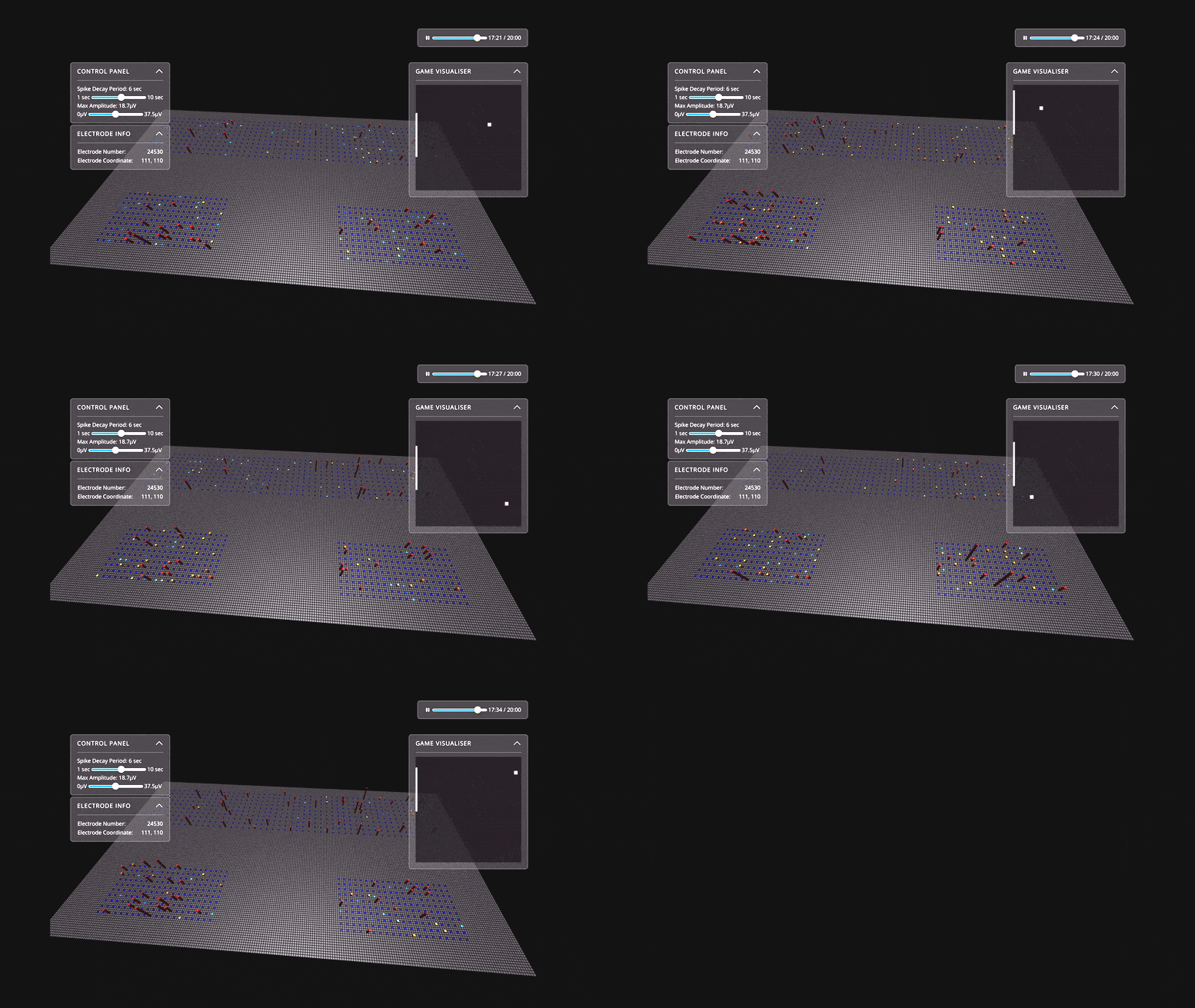
Neurons in a dish learned to play Pong by adapting to real-time feedback, highlighting their ability to exhibit intelligence.
Human and mouse neurons living in a dish learned to play the video game Pong. Scientists reported the achievement on October 12 in the journal Neuron. Their fascinating experiments are evidence that even brain cells in a dish can exhibit inherent intelligence, modifying their behavior over time.
“From worms to flies to humans, neurons are the starting block for generalized intelligence,” says first author Brett Kagan. “So, the question was, can we interact with neurons in a way to harness that inherent intelligence?” Kagan is chief scientific officer at Cortical Labs in Melbourne, Australia.
First, the scientists connected the neurons to a computer in such a way that the neurons received feedback on whether their in-game paddle was hitting the ball. Using electric probes that recorded “spikes” on a grid, the researchers were able to monitor the neuron’s activity and responses to this feedback.
This video shows the game Pong being controlled by a layer of neurons in a dish. Credit: Kagan et. al / Neuron
The more a neuron moved its paddle and hit the ball, the stronger the spikes became. When neurons missed, their playstyle was critiqued by a software program created by Cortical Labs. This demonstrated that the neurons could adapt their activity in real-time to a changing environment, in a goal-oriented way.
“We chose Pong due to its simplicity and familiarity, but, also, it was one of the first games used in machine learning, so we wanted to recognize that,” says Kagan, who worked with collaborators from 10 other institutions on the project.
“An unpredictable stimulus was applied to the cells, and the system as a whole would reorganize its activity to better play the game and to minimize having a random response,” he says. “You can also think that just playing the game, hitting the ball, and getting predictable stimulation, is inherently creating more predictable environments.”
This is a visual representation of the simulated Pong environment where neuron activity is reflected in the tiles growing in height. Credit: Kagan et. al / Neuron
Free-Energy Principle in Neuronal Learning
The theory behind this learning is rooted in the free-energy principle. Simply put, the brain adapts to its environment by changing either its world view or its actions to better fit the world around it.
Pong wasn’t the only game the research team tested. “You know when the Google Chrome browser crashes and you get that dinosaur that you can make jump over obstacles (Project Bolan). We’ve done that and we’ve seen some nice preliminary results, but we still have more work to do building new environments for custom purposes,” says Kagan.
Future directions of this work have potential in disease modeling, drug discoveries, and expanding the current understanding of how the brain works and how intelligence arises.
“This is the start of a new frontier in understanding intelligence,” Kagan says. “It touches on the fundamental aspects of not only what it means to be human but what it means to be alive and intelligent at all, to process information and be sentient in an ever-changing, dynamic world.”
For more on this research, see Watch Live Human Brain Cells Learn To Play Pong.
Reference: “In vitro neurons learn and exhibit sentience when embodied in a simulated game-world” by Brett J. Kagan, Andy C. Kitchen, Nhi T. Tran, Forough Habibollahi, Moein Khajehnejad, Bradyn J. Parker, Anjali Bhat, Ben Rollo, Adeel Razi and Karl J. Friston, 12 October 2022, Neuron.
DOI: 10.1016/j.neuron.2022.09.001
Financial support was provided by Cortical Labs.
Never miss a breakthrough: Join the SciTechDaily newsletter.
Follow us on Google and Google News.
1 Comment
neurons in a petri dish “learned” how to play Pong? Seriously? Has Scitechdaily morphed into the Onion? my brain has way more neurons than a petri dish could contain and I never learned to play Pong.