
Live biological neurons show more about how a brain works than AI ever will.
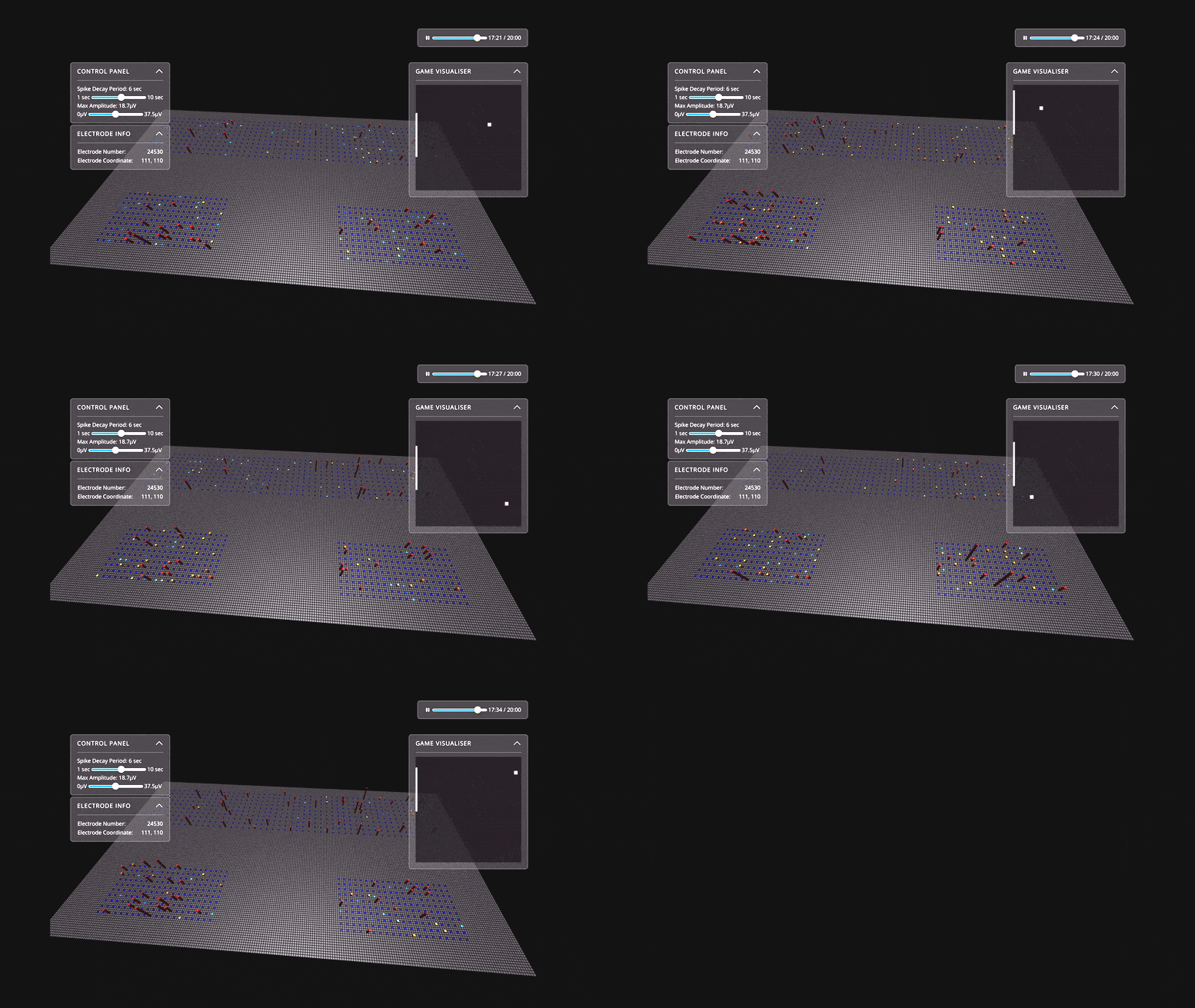
Scientists have shown for the first time that 800,000 brain cells living in a dish can perform goal-directed tasks. In this case, they played the simple tennis-like computer game, Pong. The results of the Melbourne-led study are published today (October 12) in the journal Neuron.
Now the researchers are going to investigate what happens when their DishBrain is affected by medicines and alcohol.
“We have shown we can interact with living biological neurons in such a way that compels them to modify their activity, leading to something that resembles intelligence,” says lead author Dr. Brett Kagan. He is Chief Scientific Officer of biotech start-up Cortical Labs, which is dedicated to building a new generation of biological computer chips. His co-authors are affiliated with Monash University, RMIT University, University College London, and the Canadian Institute for Advanced Research.

“DishBrain offers a simpler approach to test how the brain works and gain insights into debilitating conditions such as epilepsy and dementia,” says Dr. Hon Weng Chong, Chief Executive Officer of Cortical Labs.
Understanding Brain Function Through DishBrain
Although researchers have been able to mount neurons on multi-electrode arrays and read their activity for some time now, this is the first time that cells have been stimulated in a structured and meaningful way.
“In the past, models of the brain have been developed according to how computer scientists think the brain might work,” Kagan says. “That is usually based on our current understanding of information technology, such as silicon computing.
“But in truth, we don’t really understand how the brain works.”
This video shows the game Pong being controlled by a layer of neurons in a dish. Credit: Kagan et. al / Neuron
By constructing a living model brain from basic structures in this way, scientists will be able to experiment using real brain function rather than flawed analogous models such as a computer.
For example, Kagan and his team will next experiment to see what effect alcohol has when introduced to DishBrain.
“We’re trying to create a dose-response curve with ethanol – basically get them ‘drunk’ and see if they play the game more poorly, just as when people drink,” says Kagan.
That may pave the way for completely new methods of understanding what is happening with the brain.
Potential for Revolutionizing Brain Research and Technology
“This new capacity to teach cell cultures to perform a task in which they exhibit sentience – by controlling the paddle to return the ball via sensing – opens up new discovery possibilities which will have far-reaching consequences for technology, health, and society,” says Dr. Adeel Razi. He is the Director of Monash University’s Computational & Systems Neuroscience Laboratory.
“We know our brains have the evolutionary advantage of being tuned over hundreds of millions of years for survival. Now, it seems we have in our grasp where we can harness this incredibly powerful and cheap biological intelligence.”

The findings also raise the possibility of creating an alternative to animal testing when investigating how new drugs or gene therapies respond in these dynamic environments.
“We have also shown we can modify the stimulation based on how the cells change their behavior and do that in a closed-loop in real-time,” says Kagan.
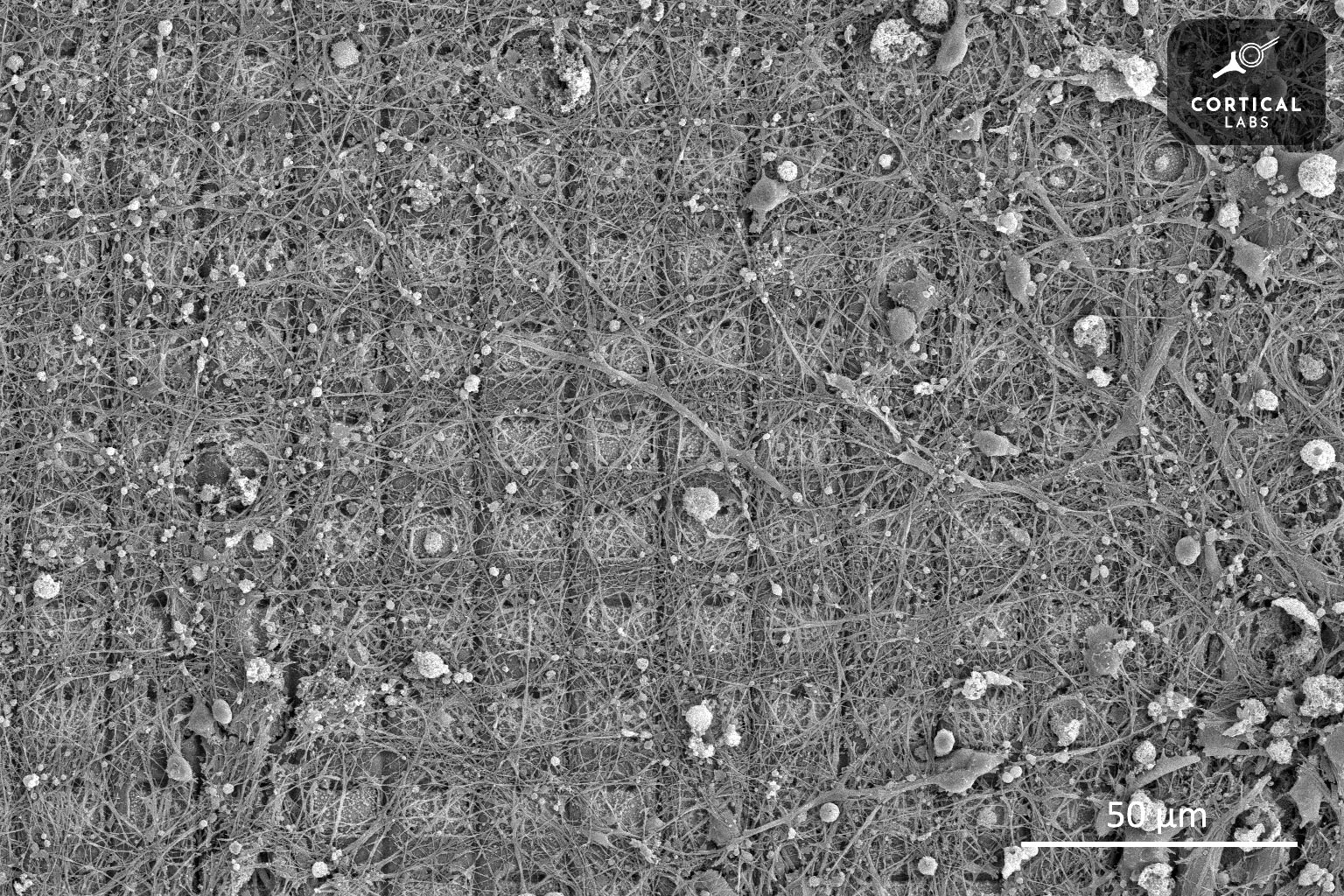
To perform the experiment, the team of scientists gathered mouse cells from embryonic brains as well as some human brain cells derived from stem cells. They grew them on top of microelectrode arrays that could both stimulate them and read their activity.
Electrodes on the left or right of one array were fired to tell Dishbrain which side the ball was on, while the distance from the paddle was indicated by the frequency of signals. Feedback from the electrodes taught DishBrain how to return the ball, by making the cells act as if they themselves were the paddle.
The Beauty of Interactive Neuron Systems
“We’ve never before been able to see how the cells act in a virtual environment,” says Kagan. “We managed to build a closed-loop environment that can read what’s happening in the cells, stimulate them with meaningful information, and then change the cells in an interactive way so they can actually alter each other.”
“The beautiful and pioneering aspect of this work rests on equipping the neurons with sensations — the feedback — and crucially the ability to act on their world,” says co-author Professor Karl Friston, a theoretical neuroscientist at UCL, London.
“Remarkably, the cultures learned how to make their world more predictable by acting upon it. This is remarkable because you cannot teach this kind of self-organization; simply because — unlike a pet — these mini-brains have no sense of reward and punishment,” he says.
Translational Potential: Testing Drugs in Real-Time
“The translational potential of this work is truly exciting: it means we don’t have to worry about creating ‘digital twins’ to test therapeutic interventions. We now have, in principle, the ultimate biomimetic ‘sandbox’ in which to test the effects of drugs and genetic variants – a sandbox constituted by exactly the same computing (neuronal) elements found in your brain and mine.”
The research also supports the “free energy principle” developed by Professor Friston.
“We faced a challenge when we were working out how to instruct the cells to go down a certain path. We don’t have direct access to dopamine systems or anything else we could use to provide specific real-time incentives so we had to go a level deeper to what Professor Friston works with: information entropy – a fundamental level of information about how the system might self-organize to interact with its environment at the physical level.
“The free energy principle proposes that cells at this level try to minimize the unpredictability in their environment.”
Kagan says one exciting finding was that DishBrain did not behave like silicon-based systems. “When we presented structured information to disembodied neurons, we saw they changed their activity in a way that is very consistent with them actually behaving as a dynamic system,” he says.
“For example, the neurons’ ability to change and adapt their activity as a result of experience increases over time, consistent with what we see with the cells’ learning rate.”
Chong says he was excited by the discovery, but it was just the beginning.
“This is brand new, virgin territory. And we want more people to come on board and collaborate with this, to use the system that we’ve built to further explore this new area of science,” he says.
“As one of our collaborators said, it’s not every day that you wake up and you can create a new field of science.”
Reference: “In vitro neurons learn and exhibit sentience when embodied in a simulated game-world” by Brett J. Kagan, Andy C. Kitchen, Nhi T. Tran, Forough Habibollahi, Moein Khajehnejad, Bradyn J. Parker, Anjali Bhat, Ben Rollo, Adeel Razi and Karl J. Friston, 12 October 2022, Neuron.
DOI: 10.1016/j.neuron.2022.09.001
B.J.K. is an employee of Cortical Labs. B.J.K. and A.C.K. are shareholders of Cortical Labs. B.J.K. and A.C.K. hold an interest in patents related to this publication. F.H. and M.K. received funding from Cortical Labs for work related to this publication.
Never miss a breakthrough: Join the SciTechDaily newsletter.
Follow us on Google and Google News.
2 Comments
i think the DOI might be wrong
This must also prove, the soul is in the brain not the heart. It’s also been found although death is considered when heart flatlines,the brsin still is functional for several hour