
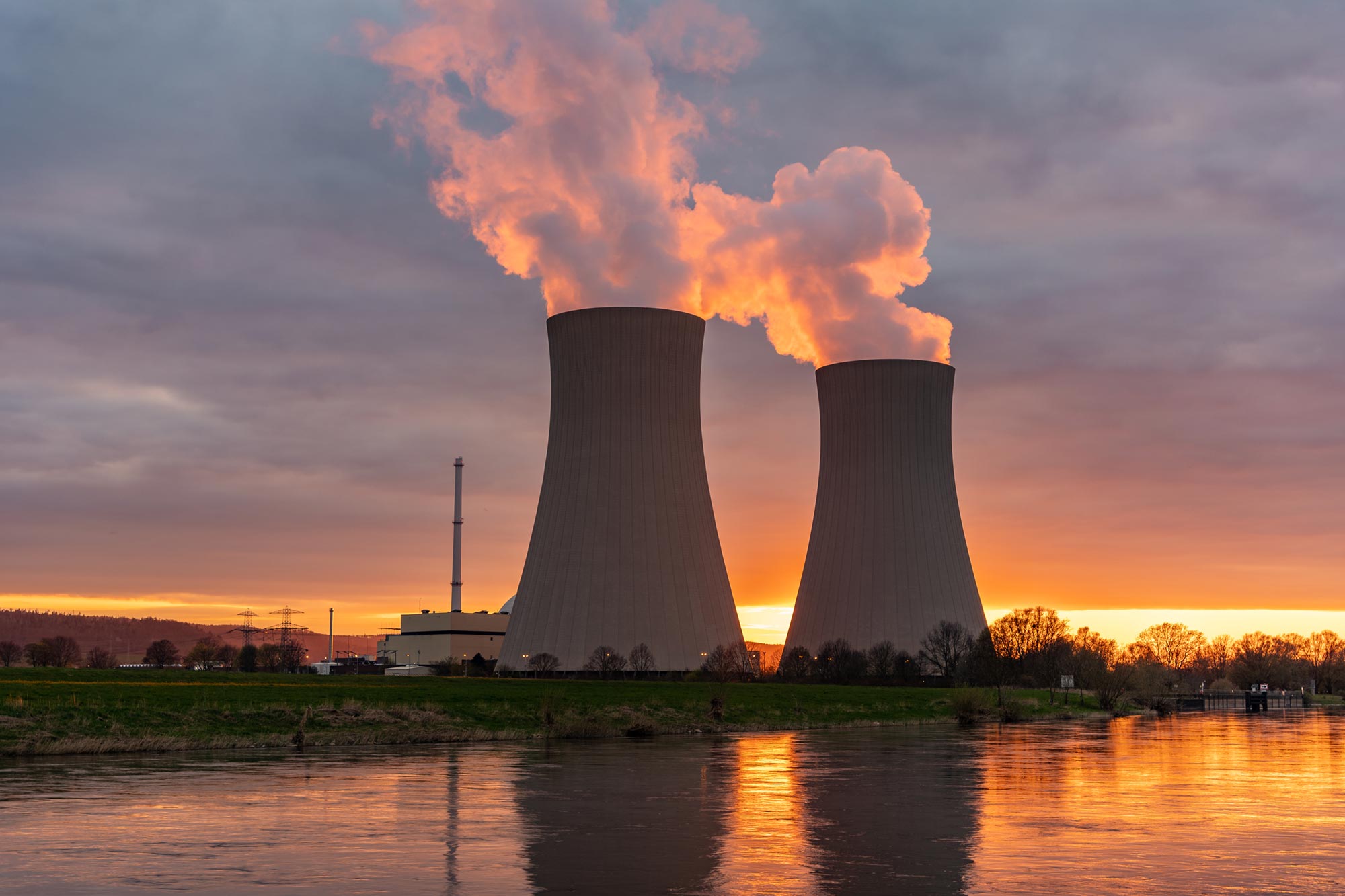
The closer a county is to a nuclear power plant, the higher its cancer death rate appears to be—raising new questions about nuclear energy’s hidden health costs.
- Counties located closer to operating nuclear power plants (NPPs) show higher cancer death rates than those farther away, even after researchers adjusted for income, education, environmental conditions, smoking, obesity, and access to health care.
- This is the first nationwide study of the 21st century to examine the link between proximity to every U.S. nuclear power plant and cancer mortality across all U.S. counties.
- The findings do not prove that nuclear power plants cause cancer. However, they raise important questions and point to the need for deeper investigation, especially as nuclear energy gains renewed attention as a climate solution.
Cancer Mortality Rates Higher Near Nuclear Power Plants
Counties in the United States that are closer to operating nuclear power plants (NPPs) have higher cancer death rates than counties located farther away, according to new research led by the Harvard T.H. Chan School of Public Health.
This nationwide analysis is the first in the 21st century to examine the relationship between proximity to NPPs and cancer mortality across every nuclear power plant and all U.S. counties. The researchers stress that the findings do not prove nuclear plants cause cancer deaths. However, they say the results underscore the need for more detailed investigation into the potential health effects of nuclear power.
The study is scheduled for publication in Nature Communications today, February 23, 2026.
Nationwide Analysis of Nuclear Plants and Cancer Deaths
Past research from around the world has explored possible links between nuclear power plants and cancer, but results have been mixed. In the United States, most studies have focused narrowly on a single plant and nearby communities, limiting the broader picture.
To address this gap, the research team conducted a nationwide study covering the years 2000 through 2018. They applied a method called “continuous proximity,” which evaluates how close each county is to nuclear facilities and accounts for the combined influence of multiple nearby plants rather than examining just one. Information on plant locations and operating dates in the U.S., along with some facilities in Canada, came from the U.S. Energy Information Administration. County-level cancer mortality data was obtained from the Centers for Disease Control and Prevention.
The analysis also adjusted for a wide range of factors that could influence cancer death rates. These included educational attainment, median household income, racial composition, average temperature and relative humidity, smoking prevalence, BMI, and distance to the nearest hospital.
Estimated 115,000 Cancer Deaths Linked to Proximity
After accounting for these socioeconomic, environmental, and health care variables, the pattern remained. Counties situated nearer to nuclear power plants had higher cancer mortality rates. Over the 18 year study period, the researchers estimate that approximately 115,000 cancer deaths nationwide, or about 6,400 per year, were associated with living closer to NPPs. The relationship was most pronounced among older adults.
“Our study suggests that living near a NPP may carry a measurable cancer risk—one that lessens with distance,” said senior author Petros Koutrakis, Akira Yamaguchi Professor of Environmental Health and Human Habitation. “We recommend that more studies be done that address the issue of NPPs and health impacts, particularly at a time when nuclear power is being promoted as a clean solution to climate change.”
Consistent Findings and Study Limitations
The team noted that the findings align with results from a previous study they conducted in Massachusetts, which found higher cancer incidence among people living closer to nuclear facilities.
They also acknowledged important limitations. The study did not include direct radiation measurements and instead treated all nuclear power plants as having the same potential impact. As a result, while the research identifies a significant association, it cannot determine whether nuclear plants directly caused the increase in cancer deaths.
Reference: “National analysis of cancer mortality and proximity to nuclear power plants in the United States” by Yazan Alwadi, Barrak Alahmad, Carolina L. Zilli Vieira, Philip J. Landrigan, David C. Christiani, Eric Garshick, Marco Kaltofen, Brent Coull, Joel Schwartz, John S. Evans and Petros Koutrakis, 23 February 2026, Nature Communications.
DOI: 10.1038/s41467-026-69285-4
Never miss a breakthrough: Join the SciTechDaily newsletter.
Follow us on Google and Google News.
11 Comments
How odd; I thought nuclear power was rated the safest power of all…….
fossil fuels are worse
Do you have any support you can provide for your fact-free opinion?
Not including Chernobyl and Three Miile Island, of course. The bigger problem is where to put that toxic nuclear waste.
This is a garbage study.
After 99 years of the LNT model (no-safe-dose) in use, there has still been no verified evidence of harmful effects below 100 mSv per year.
Living down the road from a nuke plant gives you the equivalent radiation as eating two bananas a year, or about 2 microSieverts.
Working in the granite halls of Congress subjects people to wayyyyy more radiation.
“While our study does not include dosimetry, ionizing radiation is a well-established carcinogen …”
In other words, this could be a spurious correlation. They did NOT make direct measurements of a known causative factor. They are making a risk assumption about the proximity to a nuclear power plant. However, power plants are built where the population has a need for power. Those same people are indirect sources of things like benzene and other carcinogenic chemicals and asbestos.
“First, our nuclear power plant proximity exposure ASSUMES equal contribution from all nuclear power plants within 200 km and does NOT include direct radiation measurements (dosimetry)”
That is probably an invalid assumption. The greatest risk from nuclear power plants is probably fugitive radioactive krypton. Being a gas, it can be expected to be most continuously available as an exposure risk to people downwind from the presumed source(s). No mention is made of using a wind rose diagram to determine the common direction(s) of the wind passing over the presumed source of radioactivity. They also did not consider the background radiation from geology as mapped by the US Geological Survey and readily available, and in particular, the radioactive radon that frequently accumulates under homes and in basements in granitic and black shale terrains.
In their own words, “…, while the research identifies a significant ASSOCIATION, it cannot determine whether nuclear plants directly caused the increase in cancer deaths.” This comes across like a group senior project by inexperienced undergraduates. They have only demonstrated ‘guilt by association.’ Yet another example of a poorly designed science experiment that will probably be given more weight than it deserves. There is an old saying: “If something is worth doing, it is worth doing right.”
“…, They applied a method called ‘continuous proximity,’ which evaluates how close each county is to nuclear facilities and accounts for the combined influence of multiple nearby plants rather than examining just one.”
It appears, however, that they did NOT scale for the size of the power plant, which will determine the amount of krypton released into the atmosphere. I suspect that the amount of krypton is at least as important, if not more, as the distance.
Total rubbish. A UK study years ago linked childhood leukemia to military installations. Everyone jumped up and down about it until the researcher then pointed out the military establishments were old castles. Correlation not causation
There you go. How many said castles used granite in their construction? Or sandstone derived from granite……………….?
The one problem, if there are no others, is that cancers often develop slowly and appear many years later than the alleged cause. 70 years ago I was living downwind of Windscale and Cockroft’s Folly. Ho hum………….And the streets in my then town were paved with granite cobbles with sandstone pavements.
The factor causing the cancer rate change is not being closer to NPP’s, it’s being further away from coal power plants.
The reason this likely works is that coal power spews untracked radioactivity into the atmosphere, where it rains down to find its way into local people’s lungs. (See study done by ORNL)
But don’t worry: this only causes a low level of radiation dosage, it seems likely to me that this study is simply showing that this low level is conferring some protection against cancers of all types, due to exercising the DNA repair mechanisms.
NPP’s are strictly regulated under a nonsense “linear, not-threshold” dose model that assumes if too much radiation increases risk of cancer, then any at all applied to a population must be resulting in at least some statistical cancers.
Which is NOT the case. All the data about the affects of even moderate dosage on human health that we have shows the opposite effect.
Getting too little exposure to ionising radiation therefore increases your risk of all kinds of cancer, particularly those caused by chemicals and immune cell irritants.
Getting more ionising radiation, ironically from a coal power plant, because the nearest NPP is far away, is therefore “good” for you.
We could be exploiting this effect to train up our personnel immunity to cancer: but the nuclear regulations (and fear propaganda) were paid for by big coal. It’s all to prevent all the investments into coal from losing relevancy.
NPP’s could produce energy more than an order of magnitude cheaper than cheap coal otherwise. They simply need a little less bureaucratic waste, and be allowed to use good quality refined U235, and avoid making reactor-poisoning Pu239. Then they could also be small and modular without breaking the bank as well.
As to this specific issue: someone needs to check my hypothesis with the data: It’s not that you’re closer to NPP’s, it’s that you’re further from CPP’s and/or another source of radiation dosage such as natural radon.
And if course, legislation that exists to protect people, should be changed to actually do so, rather than put them into harms way.
We don’t know how they do it. It’s maaaagic! It’s nuclear! It’s something we don’t like so we jigger the investigation until it shows what we want.
{+_+}