
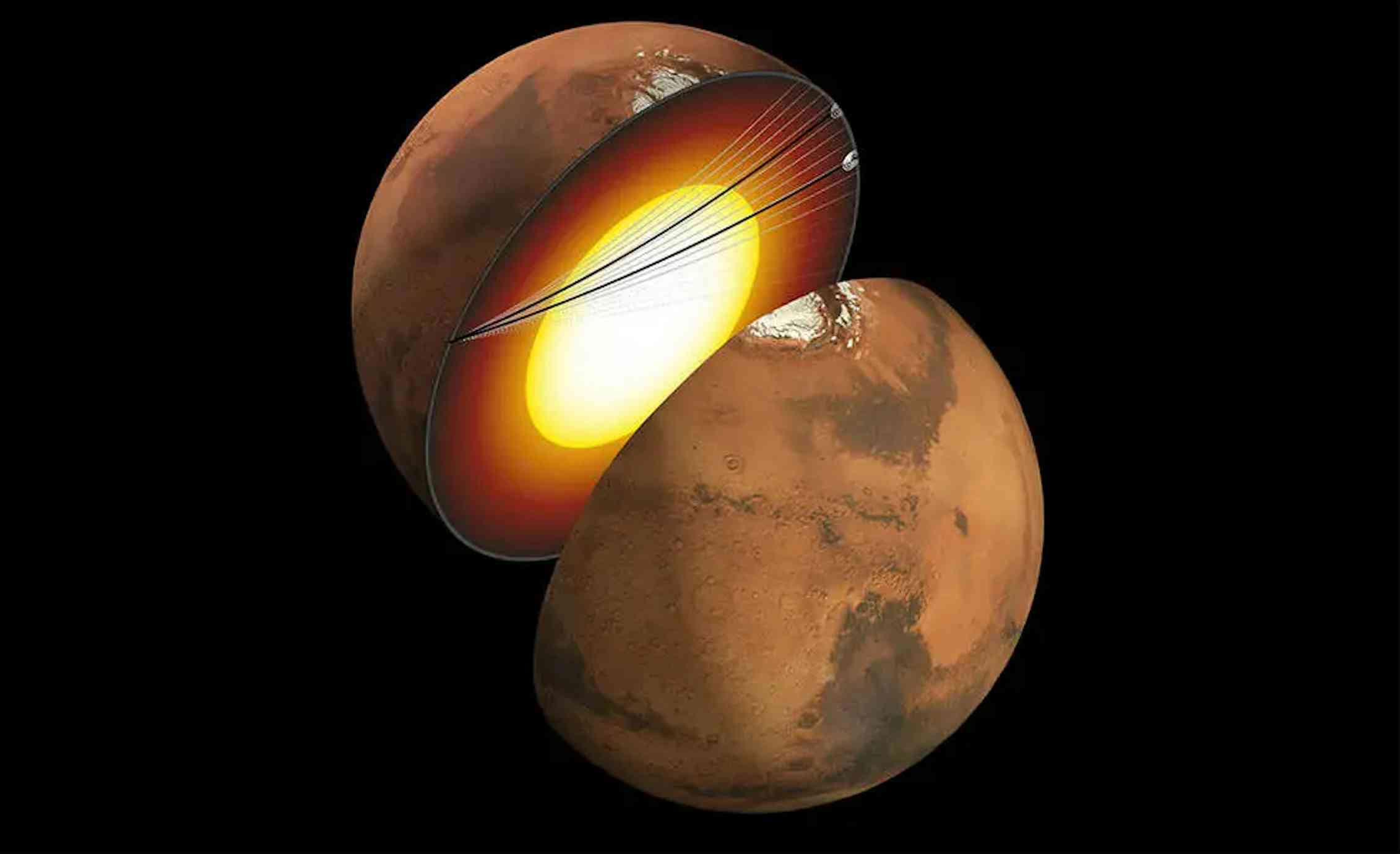
Seismic studies reveal Mars may have a solid inner core. The result deepens knowledge of its evolution and lost magnetic field.
Researchers have determined that Mars shares a structural similarity with Earth’s interior. Data collected by NASA’s InSight mission indicate that beneath its surface, the red planet contains a solid inner core enclosed by a liquid outer core, a result that helps resolve a question that has puzzled scientists for decades.
Published in Nature, the study carries major implications for how Mars developed over time. Billions of years ago, the planet likely supported a denser atmosphere, one capable of sustaining flowing water across its surface.
This atmosphere may have been preserved by a magnetic shield similar to Earth’s. Today, however, Mars no longer possesses such protection. Many researchers suspect that the disappearance of this magnetic field allowed the atmosphere to gradually escape into space, transforming Mars into the cold, arid planet we observe now.
Earth’s core as a comparison
On Earth, the core consists of a solid center encased in a liquid outer layer. Movement within this liquid region generates a dynamo that produces the planet’s magnetic field. That magnetic field serves as a shield, deflecting charged solar particles that would otherwise erode the atmosphere, thereby maintaining Earth’s long-term habitability.
Clues from the magnetized crust on Mars suggest that the planet once had a magnetic field as well, perhaps driven by a similar internal structure. Scientists believe, however, that Mars’ core eventually cooled and lost its motion, ending this protective system.
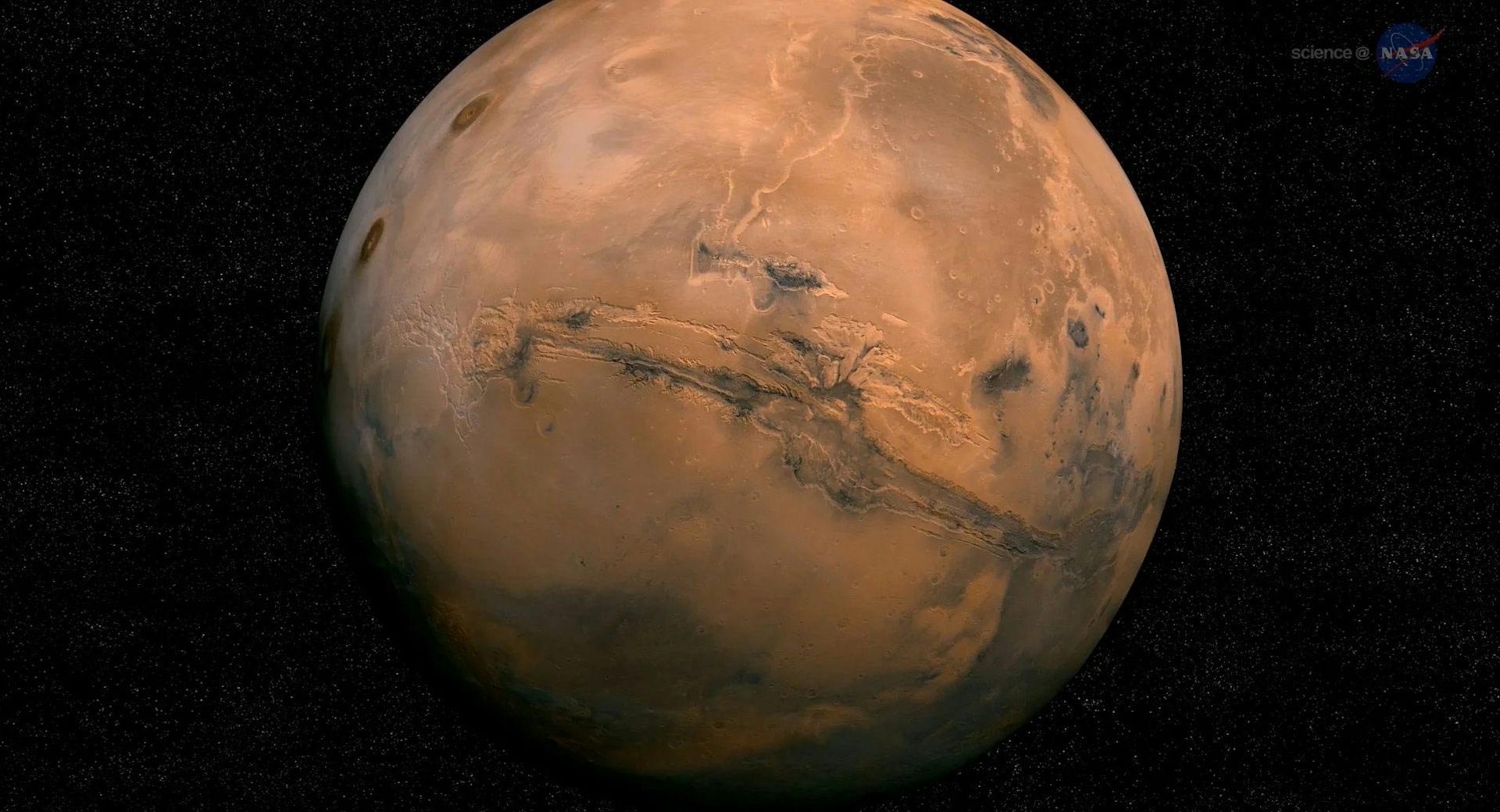
The Martian landscape also holds striking evidence that liquid water once flowed freely, pointing to a more favorable climate in the distant past. This evidence includes dried lake beds containing water-formed minerals and vast networks of valleys carved by rivers and streams. Yet today, Mars has only a thin atmosphere, and the amount of water required to sustain such features is no longer present.
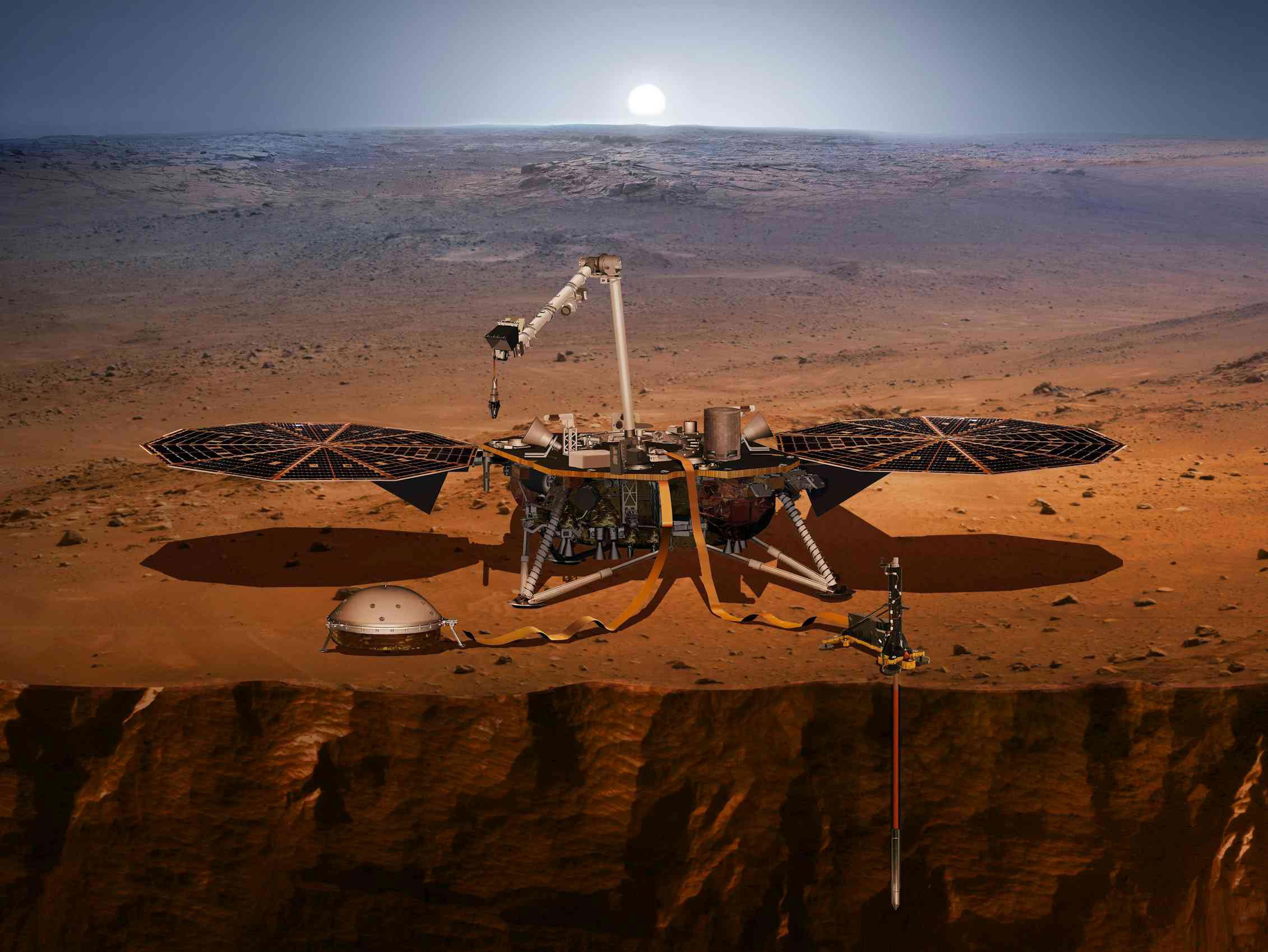
Teams working with the seismometers on NASA’s InSight Mars lander first identified the Martian core and determined that it was actually still liquid. Now, the new results from Huixing Bi, at the University of Science and Technology of China in Hefei and colleagues, show that there may also be a solid layer inside the liquid core.
Longstanding planetary mystery
The nature of the interior structure of Mars has been an intriguing mystery. Was it ever like Earth’s, with a dynamic liquid layer around a solid center? Or did Mars’ smaller size prevent such a formation? How big must a planet be to gain the protection of a magnetic field, like Earth’s, and support a habitable climate?
To understand what happened, how Mars evolved, we need to understand Mars today. These questions about Mars’ atmosphere, water, and core have motivated several high profile Mars missions. While the NASA Mars rovers, Spirit, Opportunity, Curiosity, and Perseverance have studied the surface mineralogy, the European Space Agency’s ExoMars Trace Gas Orbiter is studying the water cycle, NASA’s Maven spacecraft is studying atmospheric loss to space, and NASA’s InSight lander was sent to study seismic activity.
In 2021, Simon Stähler, from ETH Zurich in Switzerland, and colleagues, published a seminal paper from the InSight mission. In it, they presented an analysis of the way that seismic waves pass through Mars from Mars quakes in the vicinity of InSight, through the mantle, through the core, and then reflecting off the other side of the planet and reaching InSight.
Core size and composition findings
They detected evidence of the core for the first time and were able to constrain its size and density. They modelled a core with a single liquid layer that was both larger and less dense than expected and without a solid inner core. The size was huge, about half of Mars’ radius of 1,800 km, and the low density implied that it was full of lighter elements. The light elements, such as carbon, sulphur, and hydrogen, change the core’s melt temperature and affect how it could crystallise over time, making it more likely to remain liquid.
The solid inner core (610 km radius) found by Huxing Bi and colleagues is hugely significant. The very presence of a solid inner core shows that crystallization and solidification is taking place as the planet cools over time.
The core structure is more like Earth’s and therefore more likely to have produced a dynamo at some point. On Earth, it is the thermal (heat) changes between the solid inner core, the liquid layer, and the mantle that drive convection in the liquid layer and create the dynamo that leads to a magnetic field. This result makes it more likely that a dynamo on Mars was possible in the past.
With Simon Stähler and co-authors reporting a fully liquid core and Huxing Bi and colleagues reporting a solid inner core, it might seem as if there will be some controversy. But that is not the case. This is an excellent example of progress in scientific data collection and analysis.
Competing models of Mars
InSight landed in November 2018 and its last contact with Earth occurred in December 2022. With Stähler publishing in 2021, there is some new data from InSight to look at. Stähler’s model was revised in 2023 by Henri Samuel, from the Université Paris Cité, and colleagues. A revised core size and density helped reconcile the InSight results with some other pieces of evidence.
In Stähler’s paper, a solid inner core is specifically not ruled out. The authors state that the signal strength of the analyzed data was not strong enough to be used to identify seismic waves crossing an inner core boundary. This was an excellent first measurement of the core of Mars, but it left the question of additional layers and structure open.
For the latest study in Nature, the scientists achieved their result through a careful selection of specific seismic event types, at a certain distance from InSight. They also employ some novel data analysis techniques to get a weak signal out of the instrument noise.
This result is sure to have an impact within the community, and it will be very interesting to see whether additional re-analyses of the InSight data support or reject their model. A thorough discussion of the broader geological context and whether the model fits other available data that constrain the core size and density fit will also follow.
Understanding the interior structure of planets in our Solar System is critical to developing ideas about how they form, grow, and evolve. Prior to InSight, models for Mars that were similar to Earth were investigated, but were certainly not favored.
Reference: “Seismic detection of a 600-km solid inner core in Mars” by Huixing Bi, Daoyuan Sun, Ningyu Sun, Zhu Mao, Mingwei Dai and Douglas Hemingway, 3 September 2025, Nature.
DOI: 10.1038/s41586-025-09361-9
Adapted from an article originally published in The Conversation.
Never miss a breakthrough: Join the SciTechDaily newsletter.
Follow us on Google and Google News.