
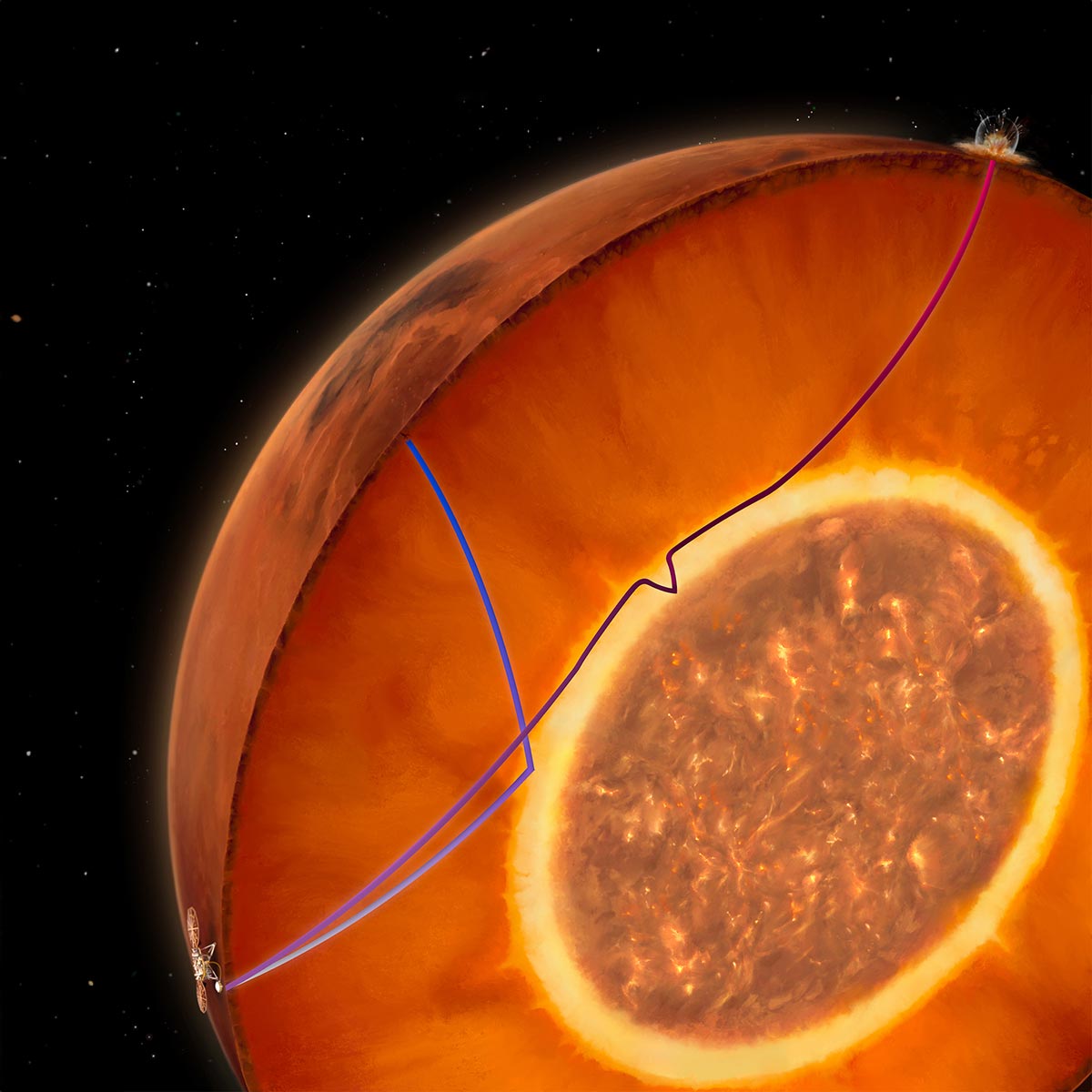
New NASA InSight research reveals a liquid silicate ‘blanket’ wrapped around Mars’ core, leading to new clues about the planet’s evolutionary history and the loss of its potential to sustain life.
NASA’s InSight mission to Mars helped scientists map out Mars’ internal structure, including the size and composition of its core, and provided general hints about its tumultuous formation.
However, findings from a new paper published in the journal Nature could lead to a reanalysis of that data. An international team of researchers discovered the presence of a molten silicate layer overlying Mars’ metallic core—providing new insights into how Mars formed, evolved, and became the barren planet it is today.
New Seismic Findings
Published on October 25, 2023, the team’s paper details the use of seismic data to locate and identify a thin layer of molten silicates (rock-forming minerals that make up the crust and mantle of Mars and Earth) lying between the Martian mantle and core. With the discovery of this molten layer, the researchers determined that Mars’ core is both denser and smaller than previous estimates, a conclusion that better aligns with other geophysical data and analysis of Martian meteorites.
Vedran Lekic, a professor of geology at the University of Maryland and co-author of the paper, compared the molten layer to a ‘heating blanket’ covering the Martian core.
“The blanket not only insulates the heat coming from the core and prevents the core from cooling, but also concentrates radioactive elements whose decay generates heat,” Lekic said. “And when that happens, the core is likely to be unable to produce the convective motions that would create a magnetic field—which can explain why Mars currently doesn’t have an active magnetic field around it.”
Implications for Life on Mars
Without a functional protective magnetic field around itself, a terrestrial planet such as Mars would be extremely vulnerable to harsh solar winds and lose all the water on its surface, making it incapable of sustaining life. Lekic added that this difference between Earth and Mars could be attributed to differences in internal structure and the different planetary evolution paths the two planets took.
“The thermal blanketing of Mars’ metallic core by the liquid layer at the base of the mantle implies that external sources are necessary to generate the magnetic field recorded in the Martian crust during the first 500 to 800 million years of its evolution,” said the paper’s lead author Henri Samuel, a scientist with the French National Center for Scientific Research. “These sources could be energetic impacts or core motion generated by gravitational interactions with ancient satellites which have since then disappeared.”
The team’s conclusions support theories that Mars was at one time a molten ocean of magma that later crystallized to produce a layer of silicate melt enriched in iron and radioactive elements at the base of the Martian mantle. The heat emanating from the radioactive elements would then have dramatically altered the thermal evolution and cooling history of the red planet.
Consequences and Future Research
“These layers, if widespread, can have pretty big consequences for the rest of the planet,” Lekic said. “Their existence can help tell us whether magnetic fields can be generated and maintained, how planets cool over time, and also how the dynamics of their interiors change over time.”
NASA’s InSight mission officially ended in December 2022 after more than four years of collecting data on Mars, but the analysis of the observations continues. Samuel, Lekic, and their co-authors are among the latest researchers to reexamine prior models of Mars using seismology to confirm the planet’s structure and turbulent history.
“This new discovery of a molten layer is just one example of how we continue to learn new things from the completed InSight mission,” Lekic said. “We hope that the information we’ve gathered on planetary evolution using seismic data is paving the way for future missions to celestial bodies like the moon and other planets like Venus.”
For more on this study:
Reference: “Geophysical evidence for an enriched molten silicate layer above Mars’s core” by Henri Samuel, Mélanie Drilleau, Attilio Rivoldini, Zongbo Xu, Quancheng Huang, Raphaël F. Garcia, Vedran Lekić, Jessica C. E. Irving, James Badro, Philippe H. Lognonné, James A. D. Connolly, Taichi Kawamura, Tamara Gudkova and William B. Banerdt, 25 October 2023, Nature.
DOI: 10.1038/s41586-023-06601-8
This research was supported by NASA (Award Nos. 80NSSC18K1628, 80NSSC19M0216, and 80NSSC18K1680), the National Center for Space Studies and the French National Research Agency (Award Nos. ANR-19-CE31-0008-08 and ANR-18-IDEX-0001), the European Research Council (Award No. 101019965) and the U.K. Space Agency (Award No. ST/W002515/1). This story does not necessarily reflect the views of these organizations.
Never miss a breakthrough: Join the SciTechDaily newsletter.
Follow us on Google and Google News.