

Mars’ magnetic mystery may finally have a solution—scientists now think the Red Planet’s ancient magnetic field only existed in its southern hemisphere.
A new study suggests this bizarre imbalance could be the result of a molten core and uneven internal heating that generated a powerful, lopsided magnetic field. This flips earlier Earth-like assumptions on their head and paints Mars as a world shaped from deep within.
Mars’ Lost Magnetism: A Southern Mystery
Mars, like Earth, once had a strong magnetic field that helped protect its thick atmosphere from the solar wind. Today, that field is gone – but traces of it remain in the planet’s crust. What has puzzled scientists for years is why those magnetic remnants are mostly found in the southern hemisphere.
Now, researchers at the University of Texas Institute for Geophysics (UTIG) may have an answer. Their new study suggests that Mars’ magnetic field may have existed only in the planet’s southern half.
This uneven, or hemispheric, magnetic field would match the pattern seen in the crust today, said lead author Chi Yan, a research associate at UTIG and the UT Jackson School of Geosciences. It also means that, unlike Earth’s global magnetic field, Mars’ ancient field may have been lopsided.
A Liquid Core’s Role in Magnetic Asymmetry
According to Yan, one explanation is that Mars had a fully liquid core at the time.
“The logic here is that with no solid inner core, it’s much easier to produce hemispheric (one-sided) magnetic fields,” Yan said. “That could have implications for Mars’ ancient dynamo and possibly how long it was able to sustain an atmosphere.”
Modeling Mars with a Molten Core
In the study, published in the journal Geophysical Research Letters, the researchers used a computer simulation to model this scenario.
Until now, most studies of early Mars had relied on magnetic field models that gave the Red Planet an Earth-like inner core that’s solid and surrounded by molten iron.
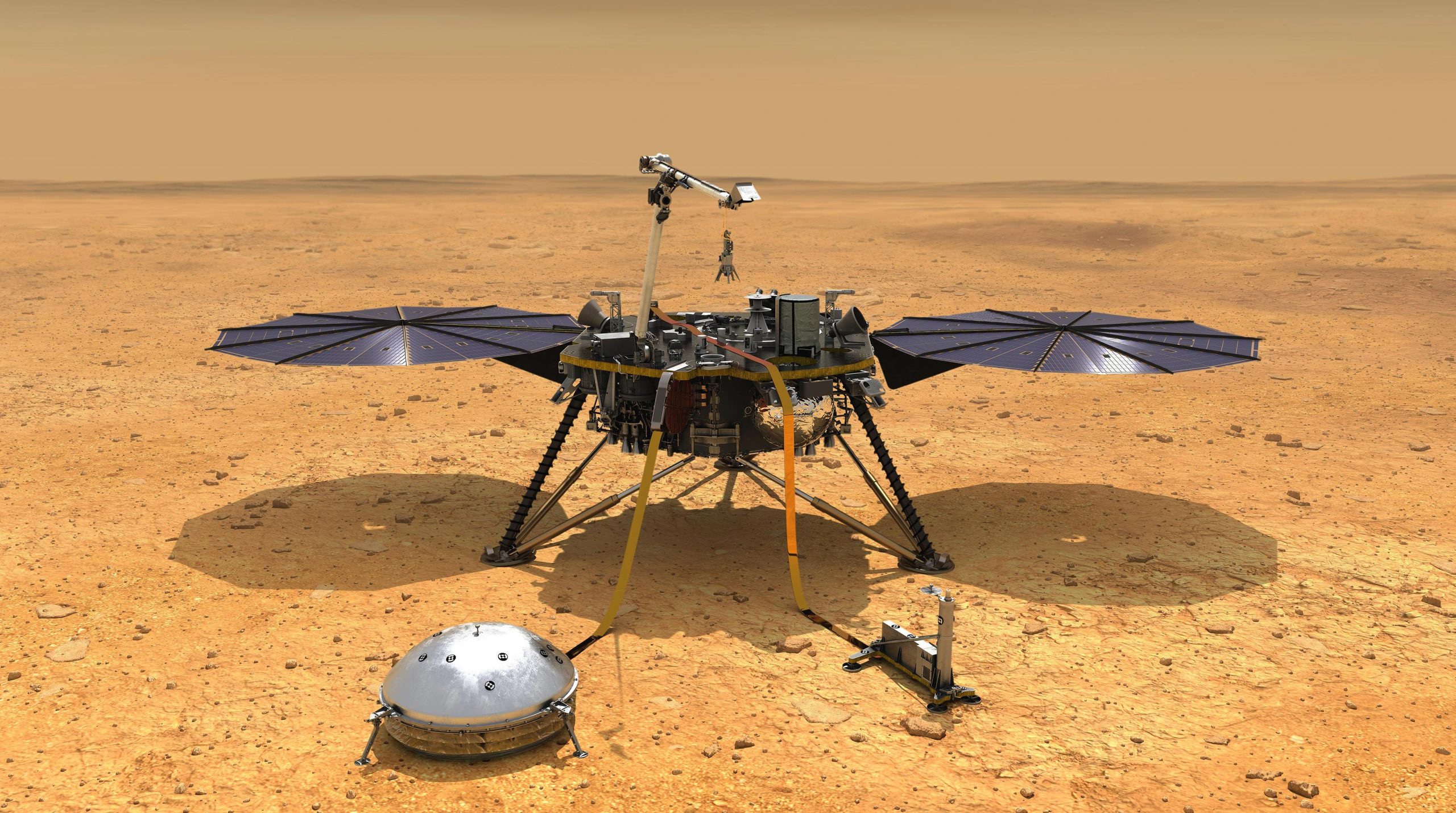
The researchers were inspired to try simulating a fully liquid core after NASA’s InSight lander found that Mars’ core was made of lighter elements than expected. That means the core’s melting temperature is different from Earth’s and therefore quite possibly molten, said study co-author Sabine Stanley, a Bloomberg Distinguished Professor at Johns Hopkins University.
If Mars’ core is molten now, it almost certainly would have been molten 4 billion years ago when Mars’ magnetic field is known to have been active, Stanley said.
How a Hot Mantle Shaped the Field
To test the idea, the researchers prepared simulations of early Mars with a liquid core and ran them a dozen times on supercomputers. With each run the researchers made the planet’s northern half of the mantle a little hotter than the south.
Eventually, the temperature difference between the hotter mantle in the north and the cooler mantle in the south led to the heat escaping from the core to be released only at the southern end of the planet. Channeled in such a way, the escaping heat was sufficiently vigorous to drive a dynamo and generate a strong magnetic field focused in the southern hemisphere.
Dynamo Drives a Southern Shield
A planetary dynamo is a self-sustaining mechanism that generates a magnetic field, typically through movement in the molten metallic core.
“We had no idea if it was going to explain the magnetic field, so it’s exciting to see that we can create a (single) hemispheric magnetic field with an interior structure that matches what InSight told us Mars’ interior is like today,” Stanley said.
A New Theory for Martian Asymmetry
According to UTIG planetary researcher Doug Hemingway, the finding offers a compelling alternative theory to a common assumption that involves asteroid impacts obliterating evidence of a planet-wide magnetic field in northern hemisphere rocks.
“Mars is naturally interesting to look at because it’s like Earth in some ways and it’s the closest planet that we can imagine actually setting up shop on,” said Hemingway, who was not part of the study. “But then, it’s got this dramatic hemispheric dichotomy where the topography, the terrain and the magnetic field of the northern hemisphere and southern hemisphere are dramatically different. Anything that gives a clue at what could account for some of that asymmetry is valuable.”
Reference: “Mars’ Hemispheric Magnetic Field From a Full-Sphere Dynamo” by C. Yan, A. Barik, S. Stanley, A. Mittelholz, A.-C. Plesa and C.-L. Johnson, 5 February 2025, Geophysical Research Letters.
DOI: 10.1029/2024GL113926
The study was funded by the NASA InSight program. The simulations were conducted at the Maryland Advanced Research Computing Center.
Never miss a breakthrough: Join the SciTechDaily newsletter.
Follow us on Google and Google News.
1 Comment
Excuse my ignorance: might that molten core, of comparable temperatures to Earth’s core; not have heated any water present to the point that Martian geysers may have erupted at the Martian surface? Would not such a cycle be yet traceable today?