

Researchers have observed seismic waves traveling throughout the surface of a planet other than Earth for the first time after two large meteorite impacts on Mars.
Researchers at ETH Zurich’s Marsquake Service have been studying data from the NASA InSight mission’s seismometer on one of our neighboring planets. For over three years, the only seismic waves identified on Mars were those that traveled through the planet’s depths from each quake’s focus or hypocenter. However, the scientists had always hoped for an event that would also cause waves to move throughout the planet’s surface. On December 24, 2021, a meteorite impact on Mars produced the kind of surface waves they had been longing for, finally rewarding their wait.
Atypical features in the quake measurements prompted the researchers to assume that the source was near the surface, so they contacted colleagues who were working with a Mars probe orbiting the planet. Images taken by the Mars Reconnaissance Orbiter in late December 2021 revealed a massive impact crater around 3,500 kilometers (2,200 miles) from InSight.
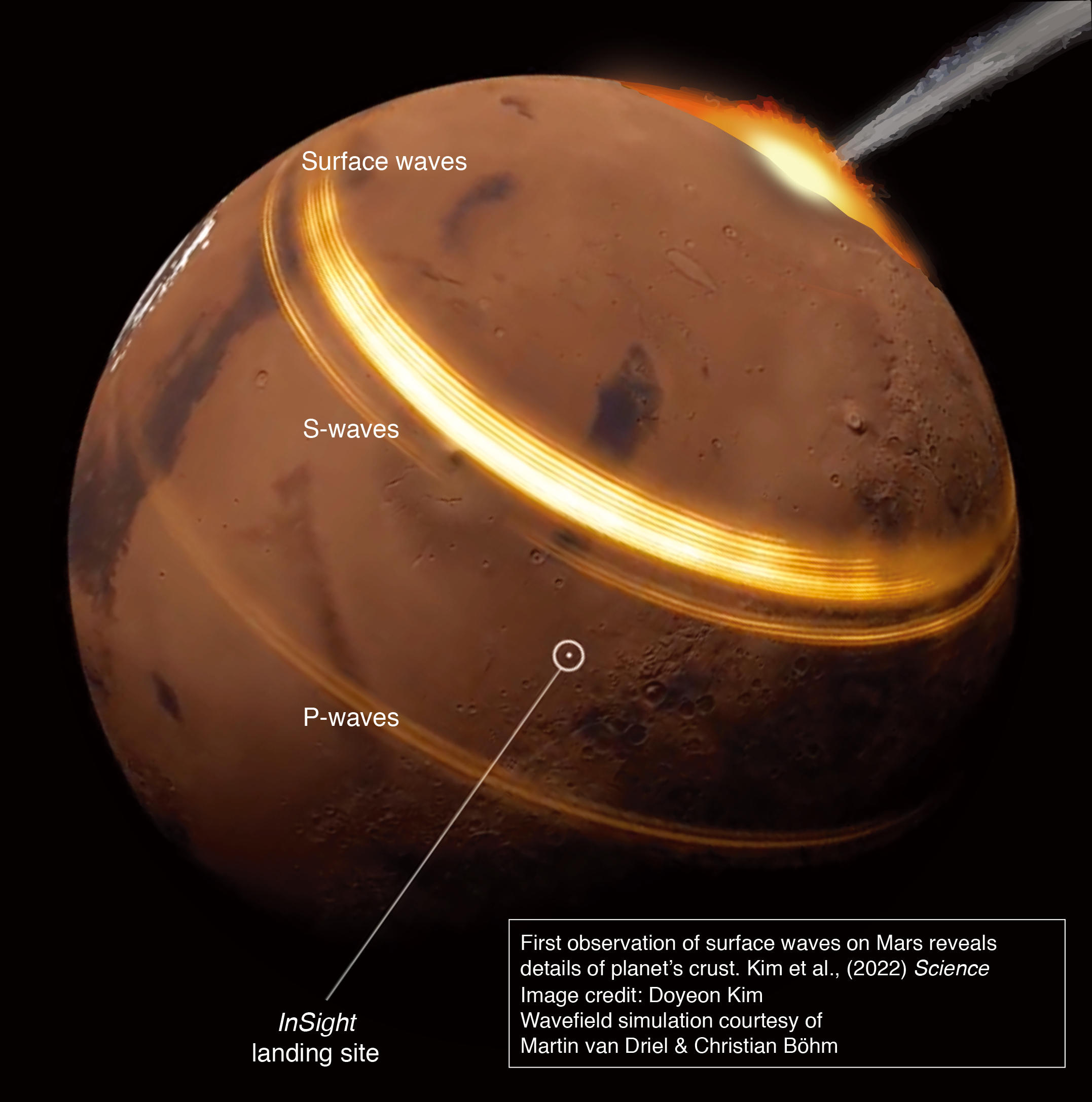
“The location was a good match with our estimates for the source of the quake,” says Doyeon Kim, a geophysicist and senior research scientist at ETH Zurich’s Institute of Geophysics. Kim is the lead author of a study that has recently been published in the journal Science. The researchers were also able to pinpoint a meteorite impact at just under 7,500 kilometers (about 5,000 miles) from InSight as the source of a second atypical quake.
Each earthquake’s hypocenter was at the surface, therefore in addition to generating seismic body waves like those of earlier marsquakes with deeper hypocenters, they also sent out waves that propagated along the surface of the planet.
“This is the first-time seismic surface waves have been observed on a planet other than Earth. Not even the Apollo missions to the Moon managed it,” Kim says.
What makes the seismic surface waves so important to researchers is that they provide information about the structure of the Martian crust. Seismic body waves, which travel through the planet’s interior during a quake, have so far provided insights into Mars’s core and mantle, but have revealed little about the crust away from the lander itself.
A surprising Result
“Until now, our knowledge of the Martian crust has been based on only a single point measurement under the InSight lander,” Kim explains. The result of the surface wave analysis surprised him. On average, the Martian crust between the impact sites and InSight’s seismometer has a very uniform structure and high density. Directly below the lander, however, the researchers had previously detected three layers of crust that implied a lower density.
The new findings are remarkable because a planet’s crust provides important clues about how that planet formed and evolved. Since the crust itself is the result of early dynamic processes in the mantle and subsequent magmatic processes, it can tell us about conditions billions of years ago and the timeline of impacts, which were particularly common in Mars’ early days.
Kim explains how the new measurement was made, “The speed at which surface waves propagate depends on their frequency, which in turn depends on their depth.” By measuring changes in velocity in the seismic data across different frequencies, it is possible to infer how the velocity changes at different depths because each frequency is sensitive to different depths. This provides the basis for estimating the average density of the rock because the seismic velocity also depends on the elastic properties of the material through which the waves travel. This data allowed the researchers to determine the structure of the crust at depths between roughly 5 and 30 kilometers below the surface of Mars.
Greater Seismic Velocity Explained
Why then was the average speed of the surface waves recently observed considerably higher than would be expected based on the earlier point measurement under the Mars InSight lander? Is this mainly due to the surface rock, or are other mechanisms in play? In general, volcanic rocks tend to exhibit higher seismic velocities than sedimentary rocks. Also, the paths between the two meteorite impacts and the measurement site pass through one of the largest volcanic regions in Mars’ northern hemisphere.
Lava flows and the closure of pore spaces from heat created by volcanic processes can increase the velocity of seismic waves. “On the other hand, the crustal structure beneath InSight’s landing site may have been formed in a unique way, perhaps when material was ejected during a large meteoritic impact more than three billion years ago. That would mean the structure of the crust under the lander is probably not representative of the general structure of the Martian crust,” Kim explains.
Solving the Mystery of the Mars Dichotomy
The new research could also help solve a centuries-old mystery. Ever since the first telescopes were pointed at Mars, it has been known that a sharp contrast exists between the planet’s southern and northern hemispheres. While the dominant feature of the southern hemisphere is a plateau covered by meteorite craters, the northern hemisphere consists mostly of flat, volcanic lowlands that may have been covered by oceans in the planet’s early history. This division into southern highlands and northern lowlands is called the Mars dichotomy.
“As things stand, we don’t yet have a generally accepted explanation for the dichotomy because we’ve never been able to see the planet’s deep structure,” says Domenico Giardini, ETH Zurich Professor of Seismology and Geodynamics. “But now we’re beginning to uncover this.” The initial results appear to disprove one of the widespread theories for the Mars dichotomy: the crusts in the north and in the south are probably not composed of different materials, as has often been assumed, and their structure may be surprisingly similar at relevant depths.
A Long Wait for the Wave
The ETH Zurich researchers are expecting further results soon. In May 2022, InSight observed the largest marsquake to date, with a magnitude of 5. It also recorded seismic surface waves generated by this shallow event. This happened just in time since the InSight mission will soon be coming to an end now that the lander’s solar panels are covered in dust, and it is running out of power. An initial analysis of the data confirms the findings that the researchers obtained from the other two meteorite impacts.
“It’s crazy. We’d been waiting for so long for these waves, and now, just months after the meteorite impacts, we observed this big quake that produced extremely rich surface waves. These allow us to see even deeper into the crust, to a depth of about 90 kilometers,” says Kim.
For more on this research, see InSight Mars Lander Detects Stunning Meteoroid Impact on Red Planet.
Reference: “Largest recent impact craters on Mars: Orbital imaging and surface seismic co-investigation” by L. V. Posiolova, P. Lognonné, W. B. Banerdt, J. Clinton, G. S. Collins, T. Kawamura, S. Ceylan, I. J. Daubar, B. Fernando, M. Froment, D. Giardini, M. C. Malin, K. Miljković, S. C. Stähler, Z. Xu, M. E. Banks, É. Beucler, B. A. Cantor, C. Charalambous, N. Dahmen, P. Davis, M. Drilleau, C. M. Dundas, C. Durán, F. Euchner, R. F. Garcia, M. Golombek, A. Horleston, C. Keegan, A. Khan, D. Kim, C. Larmat, R. Lorenz, L. Margerin, S. Menina, M. Panning, C. Pardo, C. Perrin, W. T. Pike, M. Plasman, A. Rajšić, L. Rolland, E. Rougier, G. Speth, A. Spiga, A. Stott, D. Susko, N. A. Teanby, A. Valeh, A. Werynski, N. Wójcicka and G. Zenhäusern, 27 October 2022, Science.
DOI: 10.1126/science.abq7704
Never miss a breakthrough: Join the SciTechDaily newsletter.
Follow us on Google and Google News.