
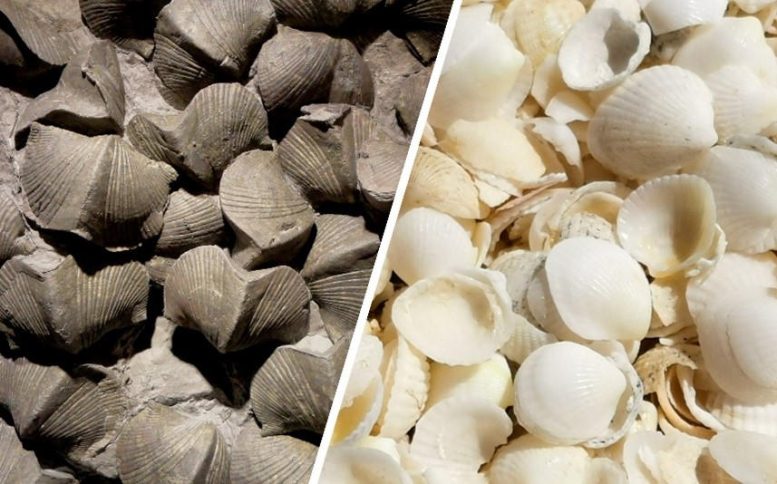
Paleontologists used Bayesian analysis of 330,000 fossils to show that bivalves overtook brachiopods after the end-Permian mass extinction due to environmental adaptability, not direct competition.
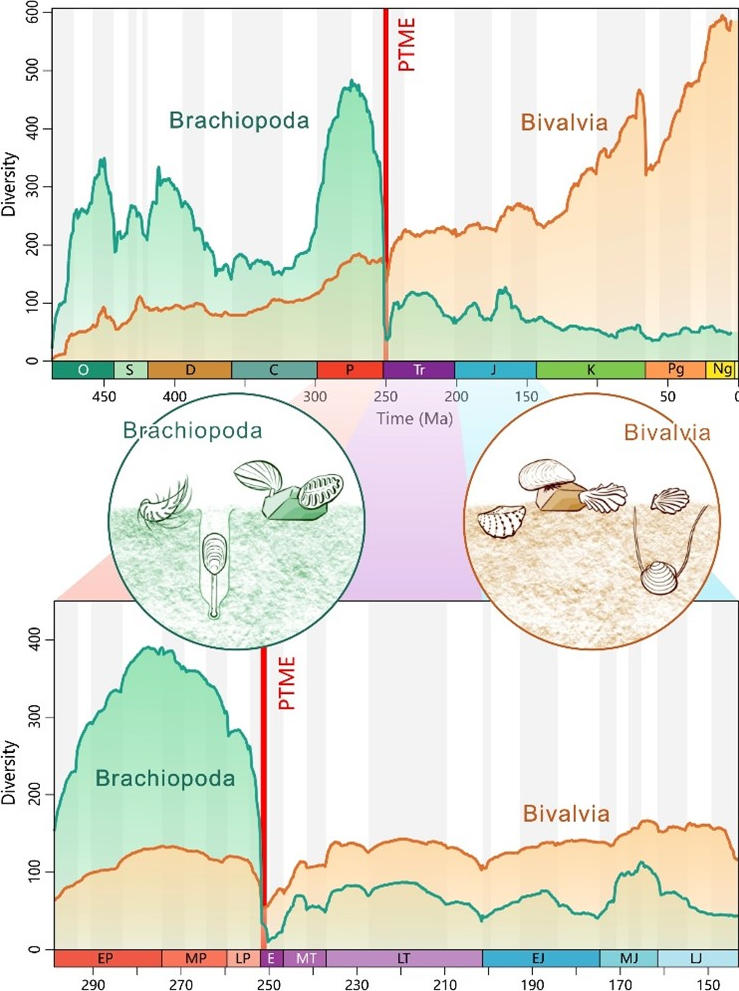
One of the biggest crises in Earth’s history, marked by a significant shift in shellfish, saw the widespread replacement of brachiopods, often referred to as ‘lamp shells’, with bivalve species such as oysters and clams. This happened as a result of the devastating end-Permian mass extinction, which effectively reset the evolution of life roughly 250 million years ago.
Research conducted by paleontologists based in Bristol, UK and Wuhan, China has shed new light on this crucial turnover when ocean ecosystems changed from ancient-style to modern-style.
Life on land and in the sea is rich and forms particular ecosystems. In modern oceans, the seabed is dominated by animals such as bivalves, gastropods, corals, crustaceans, and fishes. But these ecosystems all date back to the Triassic when life came back from the brink. During that crisis, only one in twenty species survived, and there has been long debate about how the new ecosystems were constructed and why some groups survived, and others did not.
Brachiopods dominated shelled animals before the extinction, however, bivalves thrived after, better adapting to their new conditions.
“A classic case has been the replacement of brachiopods by bivalves,” explained Zhen Guo at Wuhan and Bristol, who led the project. “Paleontologists used to say that the bivalves were better competitors and so beat the brachiopods somehow during this crisis time. There is no doubt that brachiopods were the major group of shelled animals before the extinction, and bivalves took over after.”
Investigating the Evolutionary Shift with Computational Analysis
“We wanted to explore the interactions between brachiopods and bivalves through their long history and especially around the Permian-Triassic handover period,” said Joe Flannery-Sutherland, a collaborator. “So we decided to use a computational method called Bayesian analysis to calculate rates of origination, extinction, and fossil preservation, as well as testing whether the brachiopods and bivalves interacted with each other. For example, did the rise of bivalves cause the decline of brachiopods?”
“We found that in fact, both groups shared similar trends in diversification dynamics right through the crisis time,” said Professor Michael Benton from Bristol’s School of Earth Sciences. “This means that they weren’t really competing or preying on each other, but more probably both responding to similar external drivers such as sea temperature and short-lived crises. But the bivalves eventually prevailed and the brachiopods retreated to deeper waters, where they still occur, but in reduced numbers.”
Professor Zhong-Qiang Chen of Wuhan commented: “It was great to see how modern computational methods can tackle such a long-standing question.
Why Did Bivalves Prevail?
“We always thought that the end-Permian mass extinction marked the end of the brachiopods and that was that. But it seems that both brachiopods and bivalves were hit hard by the crisis, and both recovered in the Triassic, but the bivalves could adapt better to high ocean temperatures. So, this gave them the edge, and after the Jurassic, they just rocketed in numbers, and the brachiopods didn’t do much.”
Zhen Guo said: “I had to check and compile records of over 330000 fossils of brachiopods and bivalves through the study interval, and then run the Bayesian analysis which took weeks and weeks on the Bristol supercomputer. I like the method though because it repeats everything millions of times to take account of all kinds of uncertainties in the data and gives a great deal of rich information about what was going on.”
“The end-Permian mass extinction was the biggest of all time, and it massively reset evolution,’ concluded Professor Benton. “In fact the 50 million years after the crisis, the Triassic, marked a revolution in life on land and in the sea. Understanding just how life could come back from near-annihilation and then set the basis for modern ecosystems is one of the big questions in macroevolution. I’m sure we haven’t said the last word here though!”
Reference: “Bayesian analyses indicate bivalves did not drive the downfall of brachiopods following the Permian-Triassic mass extinction” by Zhen Guo, Joseph T. Flannery-Sutherland, Michael J. Benton, and Zhong-Qiang Chen, 9 September 2023, Nature Communications.
DOI: 10.1038/s41467-023-41358-8
Never miss a breakthrough: Join the SciTechDaily newsletter.
Follow us on Google and Google News.