
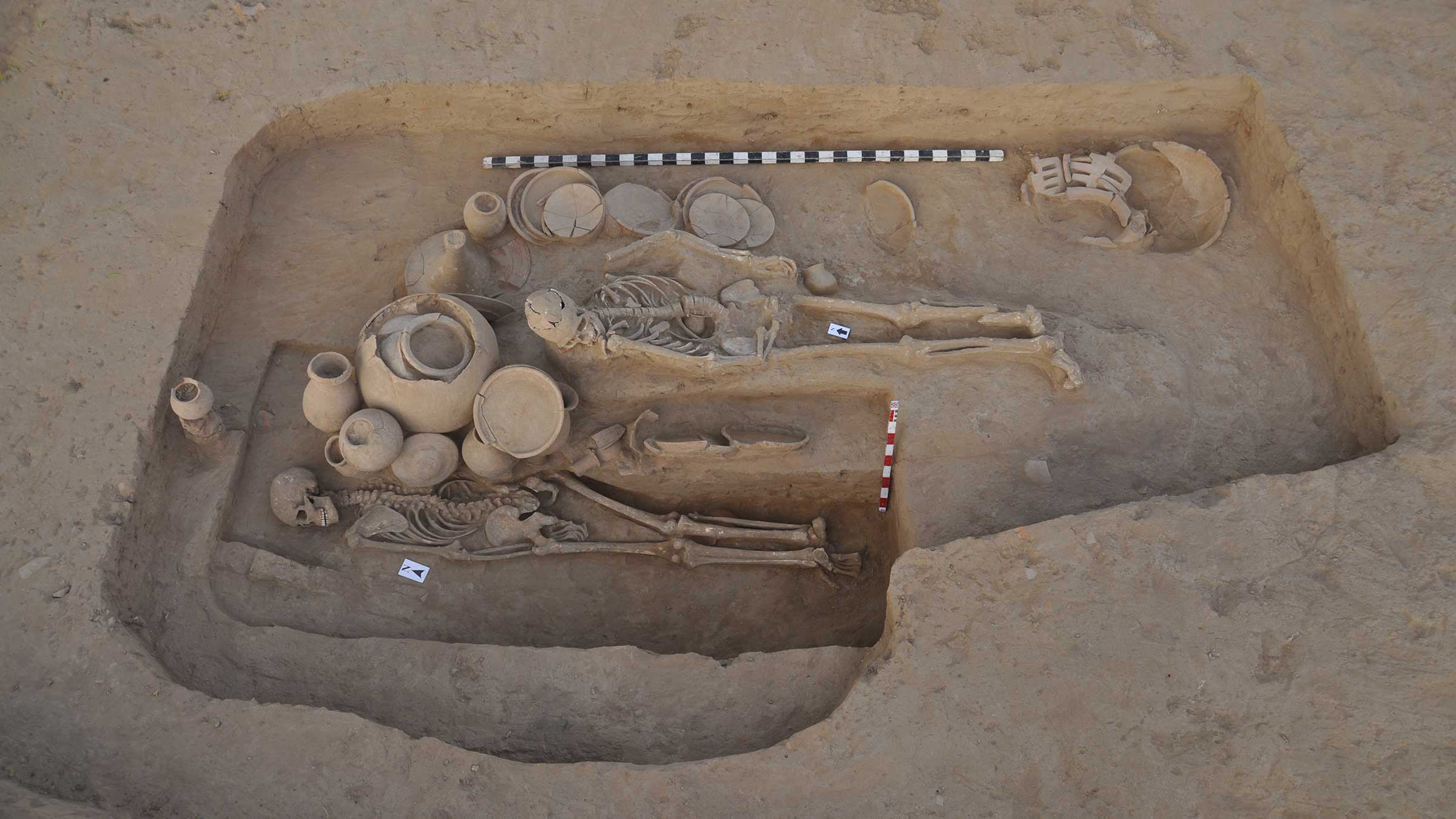
Using ancient samples, the scientists were able to peer into the past and reveal new markers of adaptation from the early days of the agricultural revolution.
Using a novel statistical analysis on ancient DNA from human skeletal remains, researchers from The University of Texas at Austin and the University of California, Los Angeles have uncovered new insights into how ancient Europeans adapted to their environments over 7,000 years. The findings were recently published in Nature Communications.
“Studying ancient DNA lets us reach back in time, tracking evolutionary changes directly in historical populations,” said lead researcher Vagheesh Narasimhan, assistant professor of integrative biology and statistics and data sciences at UT Austin. “We’re revealing genetic signatures that have been largely erased or masked in present-day genomes.”
The researchers studied more than 700 samples taken from archeological sites across Europe and parts of what is modern-day Russia. The samples span from the Neolithic period (about 8,500 years ago) to the late Roman period (about 1,300 years ago). Researchers were able to uncover traces of natural selection—signs of genetic adaptation to environmental pressures—that are undetectable in the DNA of modern Europeans. These findings not only provide a window into the distant past but also illustrate how genetic traits beneficial for survival and well-being can vanish over time.
Studies of modern genetic samples face challenges in detecting ancient natural selection events. Natural selection leaves subtle signatures on our genome, but these marks can erode over generations due to recombination, where segments of DNA are shuffled and diluted. Additionally, ancient adaptation signals can be masked by genetic drift—random fluctuations in the frequency that genes appear—and population mixing, which causes certain adaptive traits to disappear from the gene pool. Ancient DNA provides a direct look at the genomes of individuals who lived closer in time to these events, allowing researchers to observe evolutionary changes before they were lost. In this way, ancient DNA helps scientists reconstruct the historical dynamics of human adaptation.
Novel Statistical Methods Unlock Hidden Patterns
The research team employed a novel statistical approach that is uniquely suited for examining ancient DNA data. This new technique allowed the team to detect signs of natural selection more effectively than traditional methods. The team grouped the samples into four time periods: Neolithic, Bronze Age, Iron Age, and Historical. This approach allowed them to track genetic changes in response to shifts in lifestyle, such as the transition from hunting and gathering to farming.
“Our method provides a clearer picture of how and when certain traits were selected for, especially when those signals have been lost in modern genomes,” said Devansh Pandey, a graduate student in cell and molecular biology and co-first author on the paper.
In studying human adaptation during the transition from hunting and gathering to farming as well as the development of state-level societies, researchers were able to observe how genes changed when humans lived in closer proximity to each other and to domesticated animals.
Key Genetic Findings
In total, the study identified 14 regions of the genome that appear to have undergone significant natural selection across these time periods. For example, genes associated with traits that allowed early Europeans to produce vitamin D and digest milk into adulthood showed strong signs of selection, but only in the most recent time periods. While light skin pigmentation likely aided early farmers in producing vitamin D in less sunny climates, the ability to digest animal milk enabled people to utilize milk as a nutrition source after dairy farming became common in Europe.
“It’s possible this ability to digest dairy was important to survival during periods of crop failure, food scarcity, and disease,” Narasimhan said.
The researchers also found that immune-related genes underwent selective pressures across multiple time periods, likely as ancient populations adapted to new diseases introduced by the spread of agriculture and subsequent migrations. Interestingly, about half of these adaptive signals were detectable only in the oldest time periods, meaning they later vanished due to genetic drift or were masked by extensive population mixing.
This research provides an unprecedented view into how European populations adapted to environmental challenges over millennia, helping us understand how certain traits have persisted, disappeared, or been altered over time. These findings emphasize the importance of ancient DNA in reconstructing human history, demonstrating how traits that once conferred a survival advantage in early Europeans were rendered invisible in the genetic landscape of today.
Reference: “Leveraging ancient DNA to uncover signals of natural selection in Europe lost due to admixture or drift” by Devansh Pandey, Mariana Harris, Nandita R. Garud and Vagheesh M. Narasimhan, 12 November 2024, Nature Communications.
DOI: 10.1038/s41467-024-53852-8
Mariana Harris and Nandita Garud of UCLA were also authors on the paper. The research was funded by the Paul G. Allen Family Foundation, the Good Systems Fellowship for Ethical AI at UT Austin, the Paul G. Allen Foundation, the Research Corporation for Science Advancement, the University of California Hellman Fellowship, the National Science Foundation and the National Institutes of Health.
Never miss a breakthrough: Join the SciTechDaily newsletter.
Follow us on Google and Google News.
3 Comments
The assumption of farming arising towards the end of the Neolithic is a very plastic one and should not be used to underpin other research.
I agree 100%. But someone needs that observation to be done as so.
And there’s not clear description of what ‘farming’ is. ‘We know the herds like to graze in that field right there, and we don’t discourage them. They keep the grains fertilized and thriving, and we’ll take some calves for milk, meat and hides, when the population gets too big.’ Farming?