
Close Menu
    Facebook X (Twitter) Instagram
    SciTechDaily
    • Biology
    • Chemistry
    • Earth
    • Health
    • Physics
    • Science
    • Space
    • Technology
    Facebook X (Twitter) Pinterest YouTube RSS
    SciTechDaily
    Home»Space»Lunar Landers Could Blast Deposit Instant Landing Pads as They Arrive at the Moon
    Space

    Lunar Landers Could Blast Deposit Instant Landing Pads as They Arrive at the Moon

    By Andy Tomaswick, Universe TodayOctober 4, 20214 Comments4 Mins Read
    Facebook Twitter Pinterest Telegram LinkedIn WhatsApp Email Reddit
    Share
    Facebook Twitter LinkedIn Pinterest Telegram Email Reddit
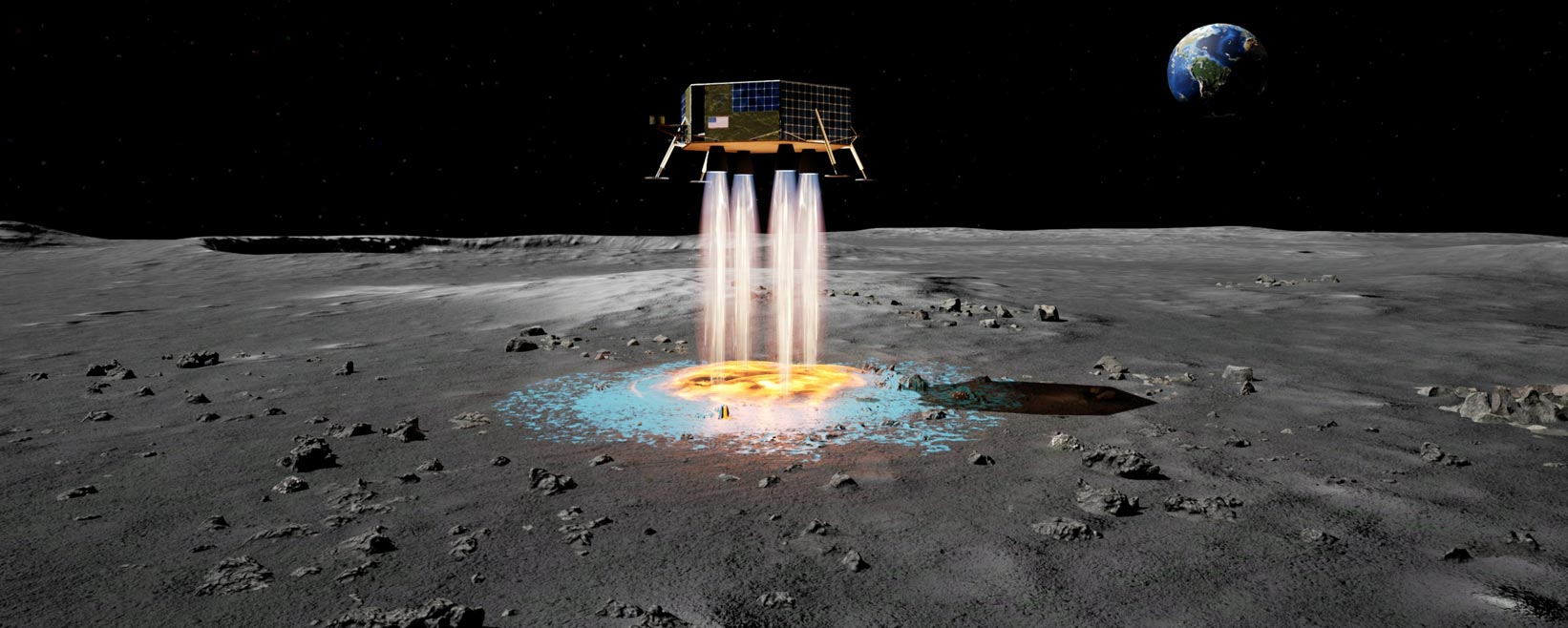
    Lunar Lander FAST Landing Pad Deposition Technology
    Artist depiction of a lunar lander utilizes the FAST landing pad deposition technology. Credit: Masten Space Systems

    Masten Space Systems has developed a method to create landing pads during a lunar descent using rocket exhaust and specially formulated alumina pellets. This could prevent dust damage and cost significantly less than traditional pads.

    Space exploration requires all kinds of interesting solutions to complex problems. There is a branch of NASA designed to support the innovators trying to solve those problems – the Institute for Advanced Concepts (NIAC). They occasionally hand out grant funding to worthy projects trying to tackle some of these challenges. The results from one of those grants are now in, and they are intriguing. A team from Masten Space Systems, supported by Honeybee Robotics, Texas A&M, and the University of Central Florida, came up with a way a lunar lander could deposit its own landing pad on the way down.

    Lunar dust poses a significant problem to any powered landers on the surface. The retrograde rockets needed to land on the moon’s surface softly will also kick dust and rock up into the air, potentially damaging the lander itself or any surrounding human infrastructure. A landing pad would lessen the impact of this dust and provide a more stable place for the landing itself.
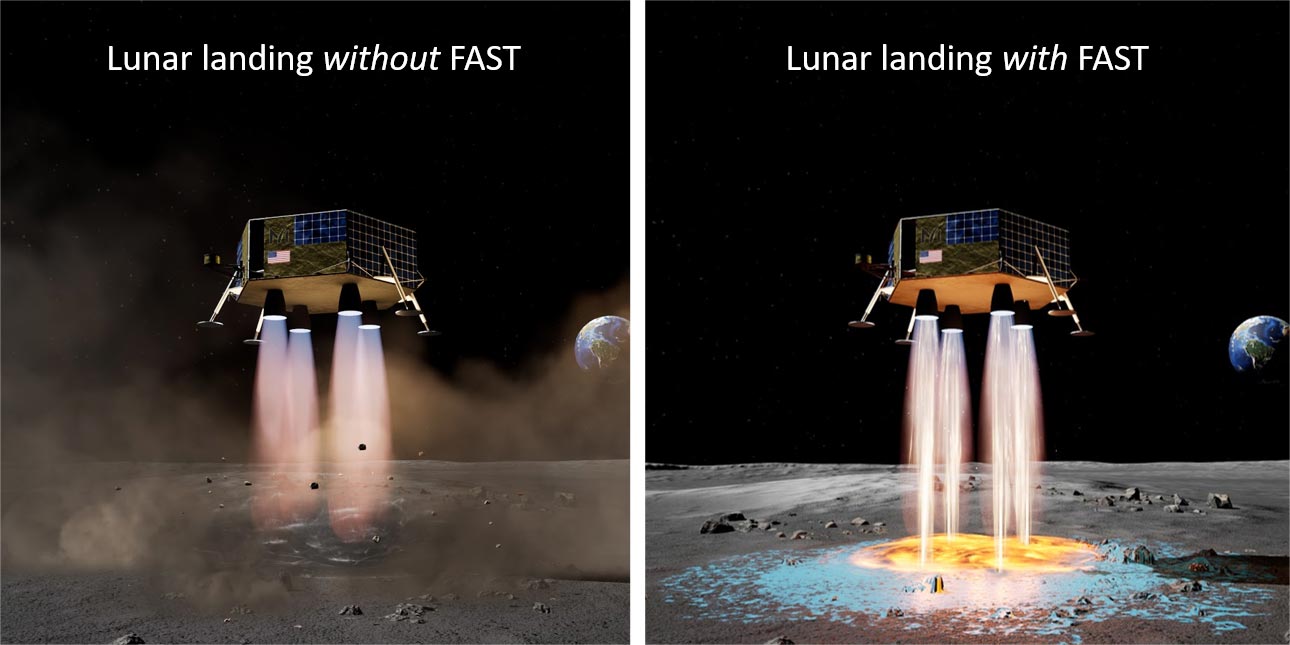
    Lunar Lander With and Without Landing Pad Deposition Technology
    Graphic showing the difference between landing with or without the deposition system. Credit: Masten Space Systems

    But constructing such a landing pad the traditional way would be prohibitively expensive. Current estimates put the cost of building a lunar landing pad using traditional materials at approximately $120 million. Any such mission also suffers from a chicken and egg problem. How to get the materials to build the landing pad land in place if there is no landing pad, to begin with?

    The technology Masten has developed is an ingenious solution to both of those problems. Depositing a landing pad while descending would allow spacefarers to have a landing pad in place before a spacecraft ever touches down there. It would also cost much less to install as all that is needed is a relatively simple additive to the rocket exhaust already being blasted into the surface.
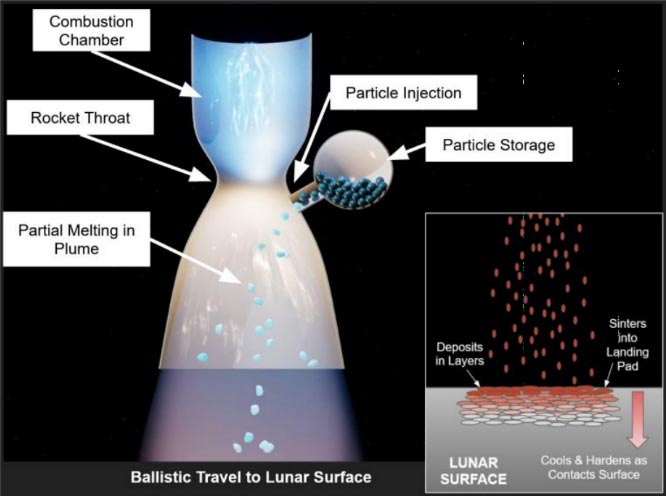
    FAST Particle Injector
    Graphic showing the whole system process of the FAST particle injector. Credit: Masten Space Systems

    Masten’s general idea is easy enough to understand. Adding solid pellets into the rocket exhaust would allow that material to partially liquefy and deposit onto the exhaust’s blast zone, potentially hardening it to a point where dust is no longer a factor as it is encapsulated in a hard external shell. Masten believed it could find the right material to add to rocket exhaust to do exactly that.

    Success or failure would come down to the physical properties of the additive pellets. Any additive with too much heat tolerance wouldn’t melt appropriately in the rocket exhaust, essentially bombarding the surface with tiny bullets. On the other hand, any additive with too little heat tolerance could be completely melted by the rocket exhaust and vaporized into a useless cloud.
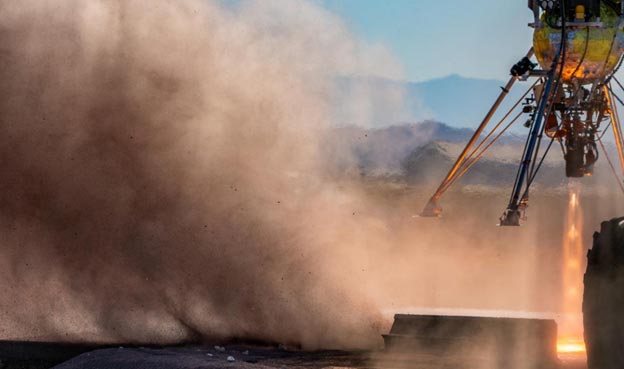
    Masten Rocket Test Fire
    Example of how much dust can be kicked up even on Earth as one of Masten’s rockets is test fired. Credit: Masten Space Systems

    To find the perfect balance, Masten developed a two-tiered system, with relatively large (.5mm) alumina particles used to create a base layer of 1mm of melted lunar surface combined with alumina. Then, as the lander got closer to the base layer, the additive would switch to a .024mm alumina particle, which would deposit at 650 m/s onto the base layer and create a 6m diameter landing pad that would cool in 2.5 seconds.

    That all sounds like a pretty impressive idea, but it is still early days. Like many federal grants, the NIAC grant focused on developing this depositable landing pad idea takes a phased approach. Most of the Phase I, which has just been completed, focused on proving the idea is feasible, which Masten believes it is.
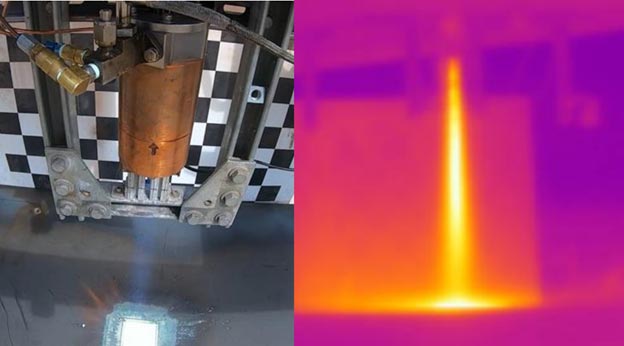
    Alumina Plate
    Example of the effects of an alumina plate, similar to what would be deposited on the moon’s surface in a fully scaled up system. An infrared image of the rocket exhaust can be seen to the right. Credit: Masten Space Systems

    Feasible is not the same as functional, but that is precisely what NIAC grants are supposed to support – wild ideas that might just fundamentally change some aspect of space exploration. If Masten is correct and the approach is possible and can be scaled up, landing pads might be seen cropping up all over the lunar surface. And eventually all over Mars as well.

    Never miss a breakthrough: Join the SciTechDaily newsletter.
    Follow us on Google and Google News.

    Moon NASA Popular
    Share. Facebook Twitter Pinterest LinkedIn Email Reddit

    Related Articles

    NASA Spacecraft Finds Pits on the Moon That Always Hover Around a Comfortable Temperature

    Don’t Miss: Buck Supermoon – AKA The Thunder Moon

    NASA CAPSTONE Launches Successfully – Will Test New Lunar Orbit for Artemis Moon Missions

    NASA’s Lunar Reconnaissance Orbiter Spots Mystery Rocket Impact Site on Moon

    Don’t Miss: The Strawberry Supermoon

    NASA Priority Artemis Science on Moon To Investigate Mysterious Gruithuisen Domes

    Don’t Miss: Total “Blood Moon” Lunar Eclipse

    NASA Scientists Begin Studying 50-Year-Old Frozen Apollo 17 Moon Samples

    NASA’s New “Lunar Backpack” Can Generate a Real-Time 3D Terrain Map To Aid Moon Explorers

    4 Comments

    1. B ThOmpson on October 5, 2021 1:26 pm

      “The retrograde rockets…will also kick dust and rock up into the air…”
      “Air”. On the Moon. Seriously?

      Reply
    2. Cyrstal on October 7, 2021 5:30 am

      Great Information ! Thank You For Sharing it.
      https://www.mybalancenow.vip/

      Reply
    3. njmcdirect.com on October 16, 2021 2:06 am

      This article is really amazing. Thanks for the information. Keep sharing such a post.
      https://njmcdirect.pw/

      Reply
    4. PK on October 18, 2021 1:09 am

      Could you make a living structure from this procedure?

      Reply
    Leave A Reply Cancel Reply

    • Facebook
    • Twitter
    • Pinterest
    • YouTube

    Don't Miss a Discovery

    Subscribe for the Latest in Science & Tech!

    Trending News

    First-of-Its-Kind Discovery: Homer’s Iliad Found Embedded in a 1,600-Year-Old Egyptian Mummy

    Beyond Inflammation: Scientists Uncover New Cause of Persistent Rheumatoid Arthritis

    A Simple Molecule Could Unlock Safer, Easier Weight Loss

    Scientists Just Built a Quantum Battery That Charges Almost Instantly

    Researchers Unveil Groundbreaking Sustainable Solution to Vitamin B12 Deficiency

    Millions of People Have Osteopenia Without Realizing It – Here’s What You Need To Know

    Researchers Discover Boosting a Single Protein Helps the Brain Fight Alzheimer’s

    World-First Study Reveals Human Hearts Can Regenerate After a Heart Attack

    Follow SciTechDaily
    • Facebook
    • Twitter
    • YouTube
    • Pinterest
    • Newsletter
    • RSS
    SciTech News
    • Biology News
    • Chemistry News
    • Earth News
    • Health News
    • Physics News
    • Science News
    • Space News
    • Technology News
    Recent Posts
    • New Research Challenges Long-Held Beliefs About How the Brain Makes Decisions
    • Breakthrough Technology Reveals New Treatment Targets for Cancer
    • Scientists Discover New Way To Make Drug-Resistant Cancer Treatable Again
    • This Simple Exercise Trick Builds Muscle With Less Effort, Study Finds
    • Middle Age Is Becoming a Breaking Point in America, Study Reveals
    Copyright © 1998 - 2026 SciTechDaily. All Rights Reserved.
    • Science News
    • About
    • Contact
    • Editorial Board
    • Privacy Policy
    • Terms of Use

    Type above and press Enter to search. Press Esc to cancel.