
Close Menu
    Facebook X (Twitter) Instagram
    SciTechDaily
    • Biology
    • Chemistry
    • Earth
    • Health
    • Physics
    • Science
    • Space
    • Technology
    Facebook X (Twitter) Pinterest YouTube RSS
    SciTechDaily
    Home»Space»Chandra Observations Reveal Magnetic Fields in Powerful Radio Jets
    Space

    Chandra Observations Reveal Magnetic Fields in Powerful Radio Jets

    By Harvard-Smithsonian Center for AstrophysicsDecember 28, 2015No Comments3 Mins Read
    Facebook Twitter Pinterest Telegram LinkedIn WhatsApp Email Reddit
    Share
    Facebook Twitter LinkedIn Pinterest Telegram Email Reddit
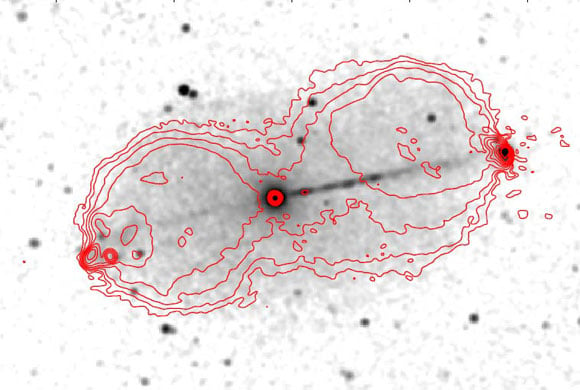
    Deep Chandra observations of Pictor A
    X-ray jets from the galaxy Pictoris A. The greyscale image was taken by the Chandra X-ray Observatory and reveals the detailed X-ray structure of the jets, which extend over nearly one million light-years. The red contours show the radio emission.

    New observations from the Chandra X-ray Observatory reveal that the X-ray emissions from Pictoris A are produced by rapidly moving charged particles in magnetic fields.

    Supermassive black holes at the centers of galaxies can spawn tremendous bipolar jets when matter in the vicinity forms a hot, accreting disk around the black hole. The rapidly moving charged particles in the jets radiate when they are deflected by magnetic fields; these jets were discovered at radio wavelengths several decades ago. In the most dramatic cases, the energetic particles move at speeds close to the speed of light and extend over hundreds of thousands of light-years, well beyond the visible boundaries of the galaxy. The physical processes that drive these jets and cause them to radiate are among the most important outstanding problems of modern astrophysics.

    One of the most significant and unexpected discoveries of the Chandra X-ray Observatory was that bright X-rays are also emitted by these jets. The X-rays are also produced by the acceleration of charged particles, at least according to some models, but there are other possible mechanisms as well. Fast-moving particles can scatter background light, boosting it into the X-ray band. Alternatively, shocks can generate X-ray emission (or at least a significant portion of it), either as the jets interact with stellar winds and interstellar medium or, within the jet, as a consequence of jet variability, instability, turbulence, or other phenomena.

    CfA astronomer Aneta Siemiginowska and her colleagues have studied the bright radio jet galaxy Pictoris A, located almost five hundred million light-years away, using very deep Chandra measurements – the observations used an accumulated total of over four days of time, spread over a fourteen-year period. These data enabled the first detailed analysis of the spectral character of the emission all along the jets. The emission turns out to be remarkably uniform everywhere, something that is extremely unlikely if scattering were responsible, but which is a natural consequence of the magnetic field process. The scientists therefore reject the scattering model in favor of the latter. However, the jets do have within them many small clumps, internal structures, and lobes. Shocks and/or scattering are possible explanations for the emission in some of these structures. Although these new results represent some dramatic improvements in our understanding of Pic A, high-resolution radio measurements of a large sample of similar jets are now needed to refine and extend the models. Large-scale X-ray jets, for example, have been also detected in very distant quasars. The results from Pic A, together with future Chandra observations, will help astronomers determine the extent to which these distant jets also rely on the same processes, or if they invoke other ones.

    Reference: “Deep Chandra observations of Pictor A” by M. J. Hardcastle, E. Lenc, M. Birkinshaw, J. H. Croston, J.L. Goodger, H. L. Marshall, E. S. Perlman, A. Siemiginowska, L. Stawarz and D. M. Worrall, 30 November 2015, MNRAS.
    DOI: 10.1093/mnras/stv2553
    arXiv:1510.08392

    Never miss a breakthrough: Join the SciTechDaily newsletter.
    Follow us on Google and Google News.

    Astronomy Astrophysics Chandra X-ray Observatory Harvard-Smithsonian Center for Astrophysics
    Share. Facebook Twitter Pinterest LinkedIn Email Reddit

    Related Articles

    Mega-Flares From Stars: 10 Million Times More Energetic Than the Most Powerful Flare Ever Observed on the Sun

    The Give and Take of Stellar Mega-Flares: By Studying Thousands of Young Stars, New Information Has Emerged

    Unprecedented New Panorama of the Center of Our Milky Way – Reveals Magnetized Threads Weaving Spectacular Galactic Tapestry

    How Habitable Are Planets That Orbit Red Dwarfs – The Most Common Type of Stars in the Galaxy?

    Fragments of Titanium Found Blasting Out of a Famous Supernova

    How Do the Most Massive Stars Explode? Bubbles With Titanium Trigger Titanic Explosions

    Massive X-ray Jet – Extending for 160,000 Light-Years – Spied From Supermassive Black Hole in Early Universe

    Chandra X-ray Observatory Studies Extraordinary Magnetar [Video]

    Chandra Studies Extraordinary Magnetar: Fastest Spinning and Possibly the Youngest Magnetar Known

    Leave A Reply Cancel Reply

    • Facebook
    • Twitter
    • Pinterest
    • YouTube

    Don't Miss a Discovery

    Subscribe for the Latest in Science & Tech!

    Trending News

    Massive Study Warns Marijuana Use in Teens Is Linked to Serious Mental Illness

    Scientists Discover a Completely Unexpected Way T Cells Kill Cancer

    Scientists Just Found the Solar System’s Original “Planet Factory”

    Study Warns Widely Used Food Preservatives Linked to High Blood Pressure and Heart Disease

    New Treatment Could Reverse Osteoarthritis Within Weeks

    Physicists Have Measured “Negative Time” in Bizarre Quantum Experiment

    The Deadly Tapeworm Spreading Across America Has Reached the Pacific Northwest

    Could Low Vitamin D Be Making Your Pain Worse?

    Follow SciTechDaily
    • Facebook
    • Twitter
    • YouTube
    • Pinterest
    • Newsletter
    • RSS
    SciTech News
    • Biology News
    • Chemistry News
    • Earth News
    • Health News
    • Physics News
    • Science News
    • Space News
    • Technology News
    Recent Posts
    • Streetlights Are Trapping Thousands of Isopods in Mysterious “Death Spirals”
    • Scientists Have Discovered These Deadly Parasites Are Secretly Swapping DNA
    • What Scientists Found Inside a 117-Year-Old Woman Reveals New Clues to Long Life
    • Breakthrough Technique Reveals Atomic Secrets of Record-Breaking Superconductors
    • The Future of Work Belongs to People Who Master AI
    Copyright © 1998 - 2026 SciTechDaily. All Rights Reserved.
    • Science News
    • About
    • Contact
    • Editorial Board
    • Privacy Policy
    • Terms of Use

    Type above and press Enter to search. Press Esc to cancel.