
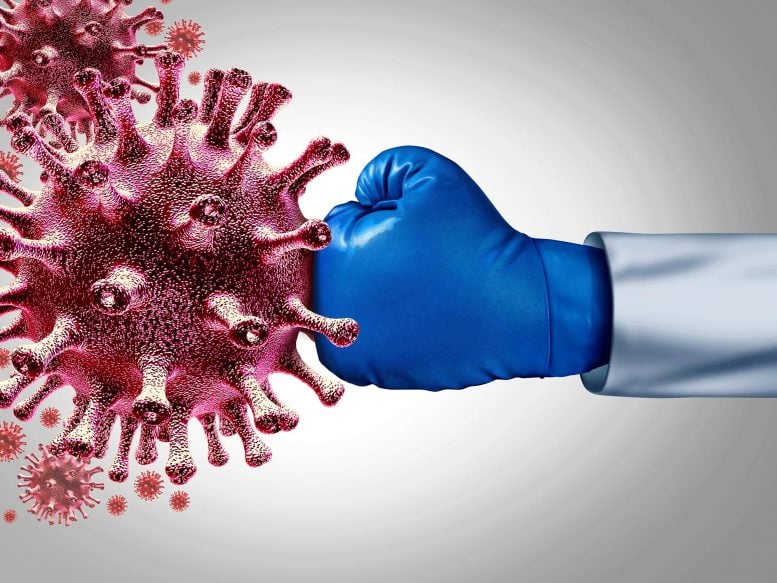
Two mutation-proof protein sites may hold the key to universal coronavirus drugs.
Safe and effective vaccines offer hope for an end to the COVID-19 pandemic. However, the possible emergence of vaccine-resistant SARS-CoV-2 variants, as well as novel coronaviruses, make finding treatments that work against all coronaviruses as important as ever. Now, researchers reporting in ACS’ Journal of Proteome Research have analyzed viral proteins across 27 coronavirus species and thousands of samples from COVID-19 patients, identifying highly conserved sequences that could make the best drug targets.
Drugs often bind inside “pockets” on proteins that hold the drug snugly, causing it to interfere with the protein’s function. Scientists can identify potential drug-binding pockets from the 3D structures of viral proteins. Over time, however, viruses can mutate their protein pockets so that drugs no longer fit. But some drug-binding pockets are so essential to the protein’s function that they can’t be mutated, and these sequences are generally conserved over time in the same and related viruses. Matthieu Schapira and colleagues wanted to find the most highly conserved drug-binding pockets in viral proteins from COVID-19 patient samples and from other coronaviruses, revealing the most promising targets for pan-coronavirus drugs.
The team used a computer algorithm to identify drug-binding pockets in the 3D structures of 15 SARS-CoV-2 proteins. The researchers then found corresponding proteins in 27 coronavirus species and compared their sequences in the drug-binding pockets. The two most conserved druggable sites were a pocket overlapping the RNA binding site of the helicase nsp13, and a binding pocket containing the catalytic site of the RNA-dependent RNA polymerase nsp12. Both of these proteins are involved in viral RNA replication and transcription. The drug-binding pocket on nsp13 was also the most highly conserved across thousands of SARS-CoV-2 samples taken from COVID-19 patients, with not a single mutation.
The researchers say that novel antiviral drugs targeting the catalytic site of nsp12 are currently in phase II and III clinical trials for COVID-19, and that the RNA binding site of nsp13 is a previously underexplored target that should be a high priority for drug development.
Reference: “Genetic Variability of the SARS-CoV-2 Pocketome” by Setayesh Yazdani, Nicola De Maio, Yining Ding, Vijay Shahani, Nick Goldman and Matthieu Schapira, 28 June 2021, Journal of Proteome Research.
DOI: 10.1021/acs.jproteome.1c00206
The authors acknowledge funding from the Natural Sciences and Engineering Research Council of Canada, the European Molecular Biology Laboratory and the Structural Genomics Consortium.
Never miss a breakthrough: Join the SciTechDaily newsletter.
Follow us on Google and Google News.
2 Comments
All the talk is about the spike proteins, but the real problem is in the virus and how coronaviruses may attack cells and why two of the most dangerous, MERS and Covid-19, are so infectious. My independent research has found multiple one-in-a-million nucleotide sequence matches between all the coronaviruses and the human genome. Those sequences are the same as some of the DHU loops of human tRNA. Using those loops and their anticodon matches, viruses may be able to fool the nucleus membrane in cells to allow the virus to enter and associate with the human DNA, creating more opportunities for further infection. Our immune system may be compromised and may no longer be able to stop the virus and other diseases from attacking organs throughout the body. Vaccines that attack the virus protein shells while ignoring their contents are doomed to failure from the Darwin effect, but recognizing these DHU loops suggests a possible approach to successful coronavirus vaccines. For MERS, eliminating the nucleotide sequence CAGTGGTAG from the virus may make it less infectious and stimulate the body to create antibodies to attack the entire virus. And eliminating the nucleotide sequence TAGTGGTGAG from Covid-19 may do the same thing. Only the infection process is considered in my work, not the innate virulence of the virus. For more info, check out this YouTube: https://www.youtube.com/watch?v=pd4OD4GpsJI
The Indians seem to be sure Ivermectin works well against covid, particularly as a prophylactic. In fact, The Indian Bar Association has taken legal action against the World Health Organization’s (WHO) Chief Scientist Dr. Soumya Swaminathan for her alleged role in spreading disinformation on the use of ivermectin to treat COVID-19.
Ivermectin is an inexpensive, old drug(out of patent) with a good safety record that is often used as a prophylactic for parasitic infections in the third world. The big drug corporations want to sell fancy new in patent drug at very high prices, so the media does not talk much about Ivermectin.