
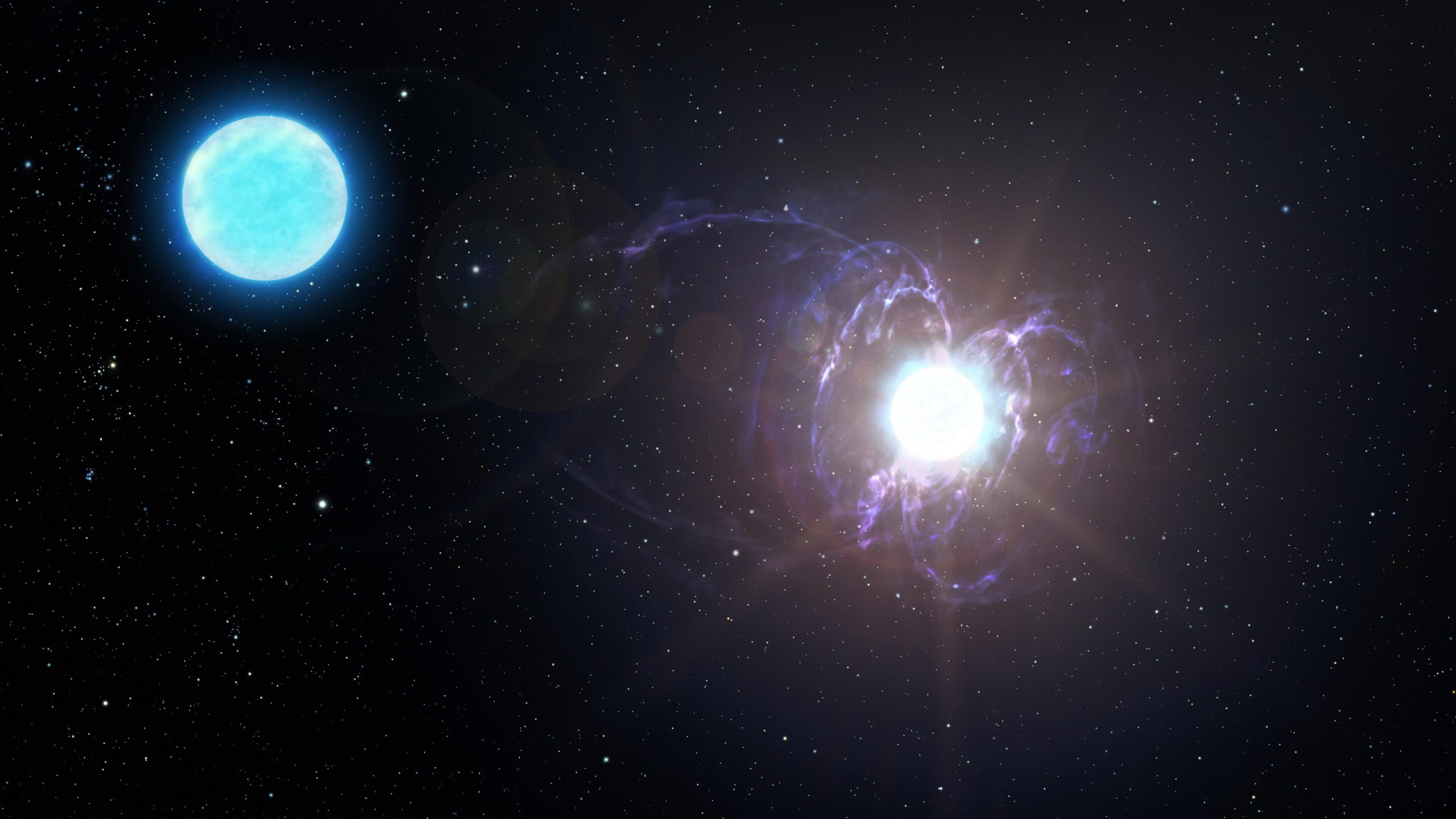
Research team identifies a highly unusual star that may evolve into a magnetar — the most magnetic object in the known Universe.
Astronomers found a highly unusual star that has the most powerful magnetic field ever found in a massive star — and that may become one of the most magnetic objects in the Universe: a variant of a neutron star known as a magnetar. This finding marks the discovery of a new type of astronomical object — a massive magnetic helium star — and sheds light on the origin of magnetars.
Understanding Neutron Stars and Magnetars
Neutron stars are the dense remnants left behind by a massive star after it explodes in a supernova. These remnants are considered the densest matter in the Universe. Some neutron stars, known as magnetars, also claim the record for the strongest magnetic fields of any object. How magnetars, which are a mere 15 kilometers (9 miles) across, form and produce such colossal magnetic fields remains a mystery.
The Link between Helium Stars and Magnetars
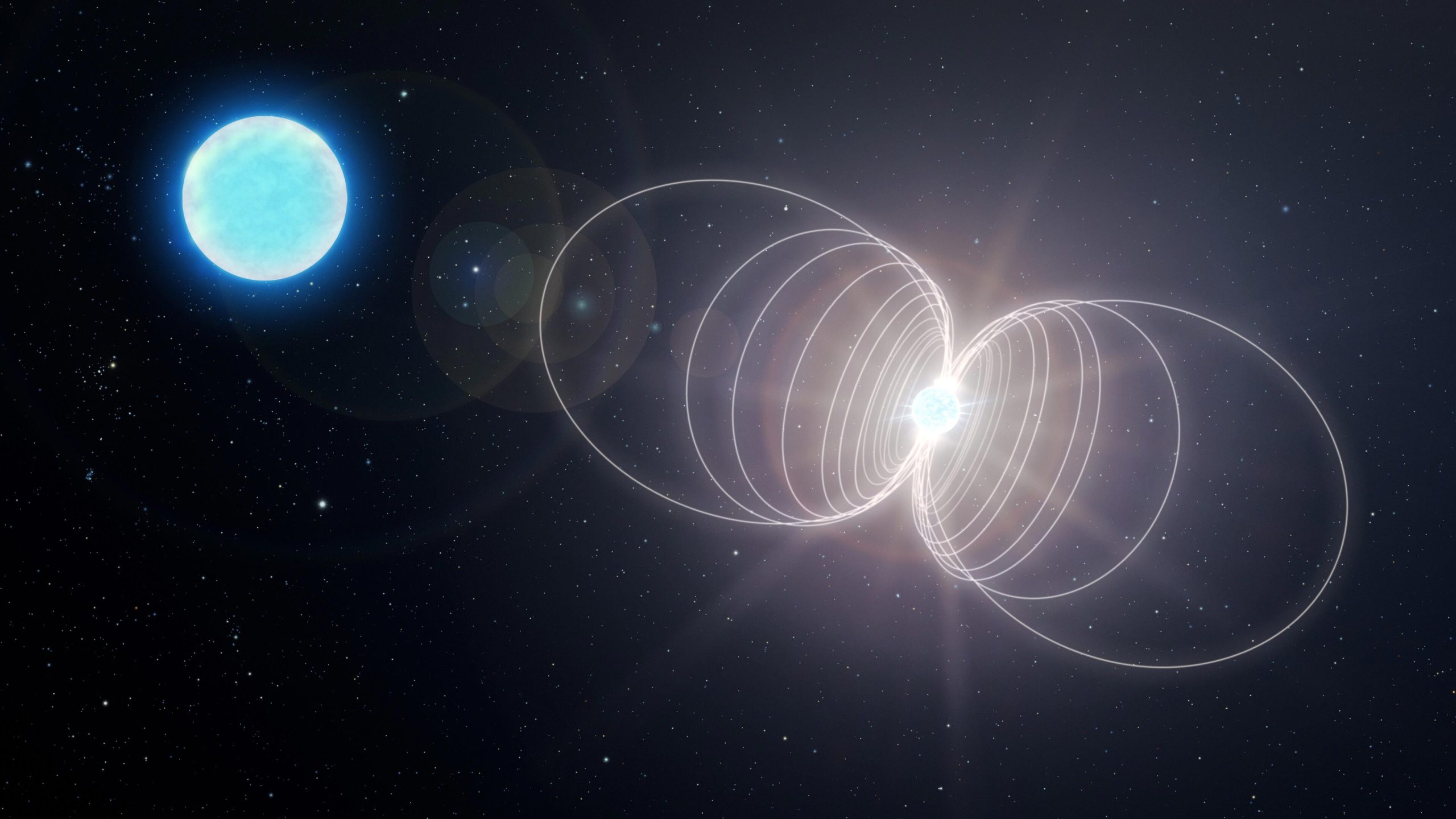
New observations by a team of astronomers, including NSF’s NOIRLab’s André-Nicolas Chené, may shed important light on the origin of these magnetic powerhouses. Using various telescopes around the globe, including the Canada-France-Hawai‘i Telescope (CFHT) on Maunakea,[1] the researchers have identified a new type of astronomical object — a massive magnetic helium star. This unusual variant of a Wolf-Rayet star may be the precursor of a magnetar.
Chené elaborated, “For the first time, a strong magnetic field was discovered in a massive helium star. Our study suggests that this helium star will end its life as a magnetar.”
Mysteries of HD 45166
Despite scrutiny from astronomers for over a century, the true nature of this star, named HD 45166, remained mostly unknown. Only basic facts had been uncovered, including that it was helium-rich, slightly larger than our Sun, and a part of a binary system.
“This star became a bit of an obsession of mine,” said Tomer Shenar, an astronomer at the University of Amsterdam and lead author of a study published in the journal Science. Having studied similar helium-rich stars before, Shenar was intrigued by the unusual characteristics of HD 45166, which has some of the characteristics of a Wolf-Rayet star, but with a unique spectral signature. He suspected that magnetic fields could explain these perplexing characteristics. “I remember having a Eureka moment while reading the literature: ‘What if the star is magnetic?’,” he said.
Shenar, Chené, and their collaborators set out to test this hypothesis by taking new spectroscopic observations of this star system with the CFHT. These observations revealed that this star has a phenomenally powerful magnetic field, about 43,000 gauss,[2] the most powerful magnetic field ever found in a massive star. By also studying its interactions with its companion star, the team were able to make precise estimates of its mass and age.
NOIRLab astronomer André-Nicolas Chené, discusses how astronomers have found a highly unusual star that has the most powerful magnetic field ever found in a massive star — and that may become one of the most magnetic objects in the Universe: a variant of a neutron star known as a magnetar. This finding marks the discovery of a new type of astronomical object — a massive magnetic helium star — and sheds light on the origin of magnetars. Credit: NOIRLab/AURA/NSF/P. Marenfeld
The researchers speculate that, unlike other helium stars that eventually evolve from a red supergiant, this particular star was likely created by the merger of a pair of intermediate-mass stars.
“This is a very specific scenario, and it raises the question of how many magnetars come from similar systems and how many come from other types of systems,” said Chené.
Future of HD 45166 and Magnetar Origins
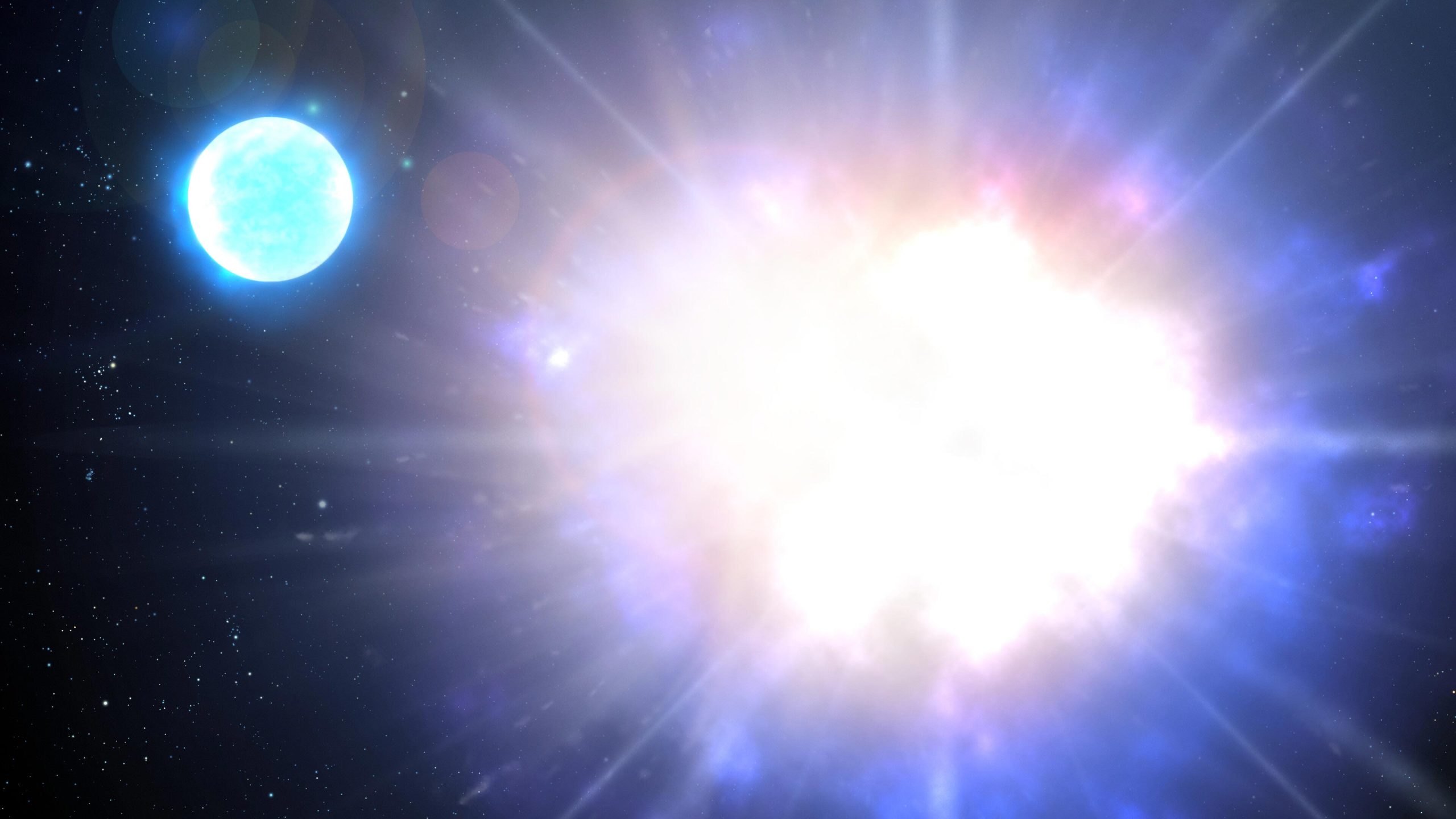
In several million years, HD 45166, which is located 3000 light-years away in the constellation Monoceros (the Unicorn), will explode as a very bright, but not particularly energetic, supernova. During this explosion, its core will contract, trapping and concentrating the star’s already daunting magnetic field lines. The result will be a neutron star with a magnetic field of around 100 trillion gauss — the most powerful type of magnet in the Universe.
“We thought that the most likely magnetar candidates would come from the most massive of stars,” said Chené. “What this research shows us is that stars that are much less massive can still become a magnetar, if the conditions are just right.”
For more on this research, see Massive Magnetic Helium Stars: A New Type of Astronomical Object.
Reference: “A massive helium star with a sufficiently strong magnetic field to form a magnetar” by Tomer Shenar, Gregg A. Wade, Pablo Marchant, Stefano Bagnulo, Julia Bodensteiner, Dominic M. Bowman, Avishai Gilkis, Norbert Langer, André Nicolas-Chené, Lidia Oskinova, Timothy Van Reeth, Hugues Sana, Nicole St-Louis, Alexandre Soares de Oliveira, Helge Todt and Silvia Toonen, 17 August 2023, Science.
DOI: 10.1126/science.ade3293
Notes
- The team also relied on key archive data taken with the Fiber-fed Extended Range Optical Spectrograph (FEROS) at ESO’s La Silla Observatory in Chile.
- Gauss is a unit of measurement of magnetic induction, also known as magnetic flux density (essentially, a measure of magnetic strength). The Sun’s typical polar magnetic field is 1–2 gauss, while sunspots can achieve a magnetic field strength of around 3000 gauss.
Never miss a breakthrough: Join the SciTechDaily newsletter.
Follow us on Google and Google News.
1 Comment
This quite some discovery, a magnetar missing link.