
Close Menu
    Facebook X (Twitter) Instagram
    SciTechDaily
    • Biology
    • Chemistry
    • Earth
    • Health
    • Physics
    • Science
    • Space
    • Technology
    Facebook X (Twitter) Pinterest YouTube RSS
    SciTechDaily
    Home»Space»Map to the Stars – Astronomers Trace Most Common Molecule in the Universe
    Space

    Map to the Stars – Astronomers Trace Most Common Molecule in the Universe

    By SRON Netherlands Institute for Space ResearchNovember 7, 20191 Comment3 Mins Read
    Facebook Twitter Pinterest Telegram LinkedIn WhatsApp Email Reddit
    Share
    Facebook Twitter LinkedIn Pinterest Telegram Email Reddit
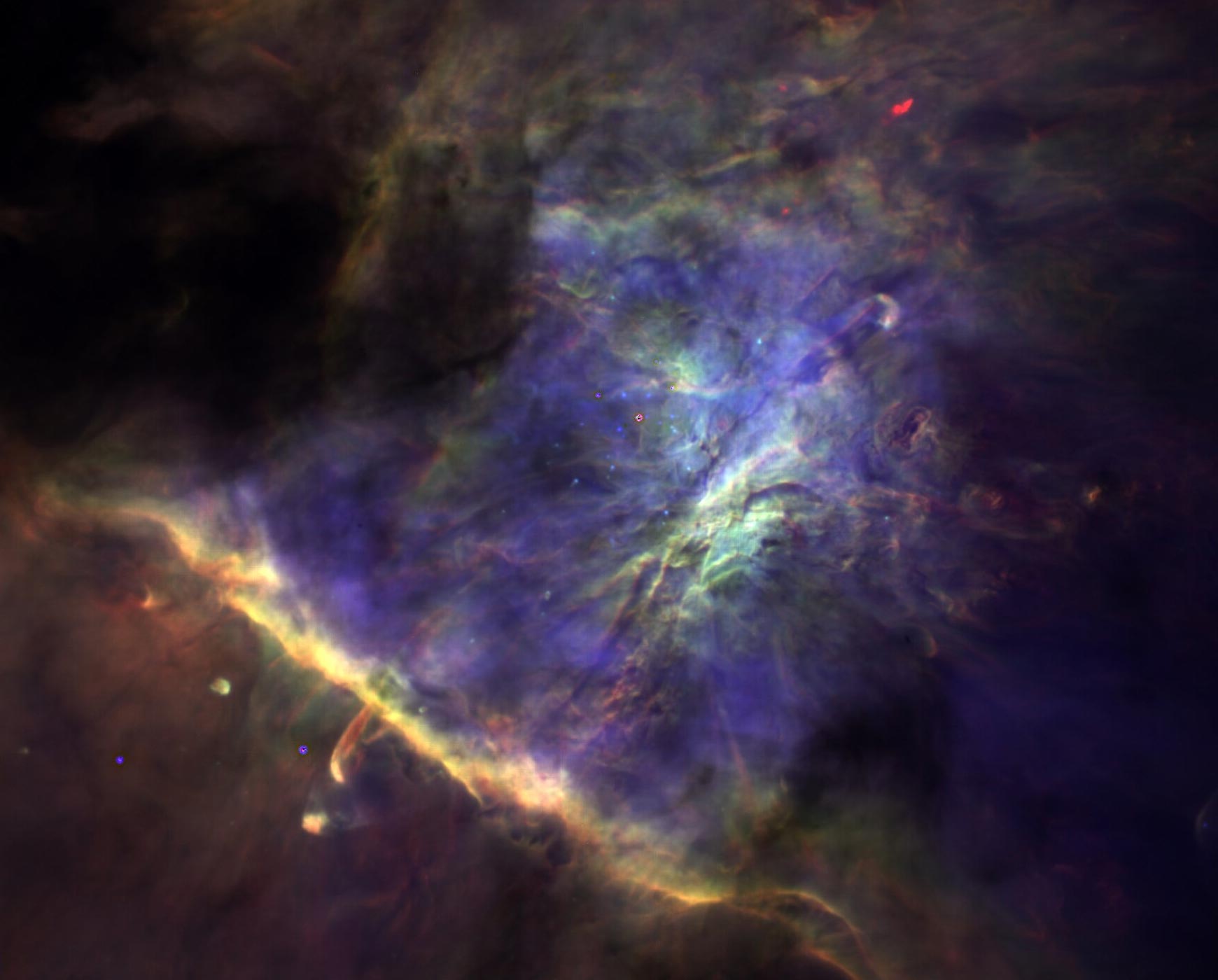
    Orion Bar
    Orion Bar. Credit: Weilbacher et al.

    Molecular hydrogen (H2) makes up 99% of the cold dense gas in galaxies. So mapping where stars are born basically means measuring H2, which lacks a strong characteristic signature at low temperatures. Astronomers from SRON Netherlands Institute for Space Research and the University of Groningen have now mapped an emission signal from the trace molecule hydrogen fluoride (HF), in a place where the standard trace molecule carbon monoxide is absent. They are the first to produce a map of HF for a region in space, creating a new tool to indirectly map H2. Publication in Astronomy & Astrophysics on November 6th.

    All across galaxies in our Universe, stars are dying and forming. And while our life on Earth is based on a rich jumble of various elements and molecules, the cold dense gas out of which stars form is pretty monotonous with 99% molecular hydrogen (H2). So if you want to map where stars are born, you’d better have a good grasp on how to detect H2. Unfortunately, this material is hard to observe due to a lack of a strong characteristic signal at low temperatures—unlike its atomic cousin (H) which emits radio waves at an easily distinguishable wavelength of 21 cm. Astronomers from SRON Netherlands Institute for Space Research and the University of Groningen have now discovered a new tool to indirectly measure H2, by mapping hydrogen fluoride (HF) and linking its abundance to that of H2.

    Hydrogen fluoride

    The new tool comes in handy when other tools fail, for example in the Orion Bar, in between regions around the Orion Trapezium stars, and the Orion Molecular Cloud. In these areas carbon is ionized, meaning that carbon monoxide (CO)—usually a reliable trace molecule to find H2—can’t work as a tracer in this case. Floris van der Tak (SRON/RuG) and his team were surprised to find a characteristic HF signal in data from the Herschel telescope coming from the Orion Bar, as astronomers have previously only detected hydrogen fluoride as a silhouette: HF absorbing other radiation. HF and H2 abundance can be linked because HF is produced in a chemical reaction where H2 reacts with atomic fluorine (F) to form HF and atomic hydrogen (H). Without H2 there is no HF.

    Collisions

    The team, led by SRON Ph.D. student Ümit Kavak, used their map of HF to examine a few mechanisms through which it could emit its signal. Collisions of HF molecules with electrons and molecular hydrogen turn out to be the main mechanism. The collisions excite the HF molecules to a higher energy state, after which they drop to their ground state while emitting infrared light at a characteristic wavelength of 1.2 THz.

    Publication

    “Origin of hydrogen fluoride emission in the Orion Bar: An excellent tracer for CO-dark H2 gas clouds” by Ü. Kavak, F. F. S. van der Tak, A. G. G. M. Tielens and R. F. Shipman, 6 November 2019, Astronomy & Astrophysics.
    DOI: 10.1051/0004-6361/201936127

    Never miss a breakthrough: Join the SciTechDaily newsletter.
    Follow us on Google and Google News.

    Astronomy Astrophysics Popular SRON Netherlands Institute for Space Research University of Groningen
    Share. Facebook Twitter Pinterest LinkedIn Email Reddit

    Related Articles

    Jupiter Discovered To Be Inhomogeneous – Metallicity Reveals New Clues About Planet’s Origin

    Dark Matter: Is It “Real Stuff” or Gravity Misunderstood?

    Astronomers See First Hint of Silhouette of Star Spaghettified by Black Hole

    Astronomers Discover Evidence for Substance on Liquid-Gas Boundary on Exoplanet WASP-31b

    Active Galactic Nuclei Core Ignition Triggered by Galaxy Mergers

    Black Hole Shredding a Star Leads to a New Astronomical Discovery

    Ancient Galactic Collision Created Stellar Swirls of NGC 5907

    The Bolshoi Simulation: Boxing the Universe

    Scientists Convene to Take a Picture of the Supermassive Black Hole at the Center of the Milky Way

    1 Comment

    1. Sarthak on November 14, 2019 3:21 am

      Chandaryaan2 3D images https://www.sarthtya.tech/2019/11/chandaryaan2-chandaryaan2-send-their.html?m=1

      Reply
    Leave A Reply Cancel Reply

    • Facebook
    • Twitter
    • Pinterest
    • YouTube

    Don't Miss a Discovery

    Subscribe for the Latest in Science & Tech!

    Trending News

    Even Occasional Binge Drinking May Triple Liver Damage Risk

    Liftoff! NASA’s Artemis II Launch Sends Astronauts Around the Moon for First Time in 50 Years

    Scientists Discover New Way To Eliminate “Zombie Cells” Driving Aging

    This New Quantum Theory Could Change Everything We Know About the Big Bang

    This One Vitamin May Help Protect Your Brain From Dementia Years Later

    Stopping Weight-Loss Drugs Like Ozempic Can Quickly Erase Heart Benefits

    A 500-Million-Year-Old Surprise Is Forcing Scientists to Rethink Spider Evolution

    Coffee and Blood Pressure: What You Need To Know Before Your Next Cup

    Follow SciTechDaily
    • Facebook
    • Twitter
    • YouTube
    • Pinterest
    • Newsletter
    • RSS
    SciTech News
    • Biology News
    • Chemistry News
    • Earth News
    • Health News
    • Physics News
    • Science News
    • Space News
    • Technology News
    Recent Posts
    • Breakthrough Study Reveals Why Damaged Nerves Struggle To Heal
    • 20-Year Study Reveals Cholera’s Surprising Weakness
    • $220 Billion Problem: Scientists Uncover the Secret Weapon Bacteria Use To Take Over Crops
    • Collapsing Plasma May Hold the Key to Cosmic Magnetism
    • DNA Meets Electronics: Scientists Create Ultra-Low Power Memory Breakthrough
    Copyright © 1998 - 2026 SciTechDaily. All Rights Reserved.
    • Science News
    • About
    • Contact
    • Editorial Board
    • Privacy Policy
    • Terms of Use

    Type above and press Enter to search. Press Esc to cancel.