
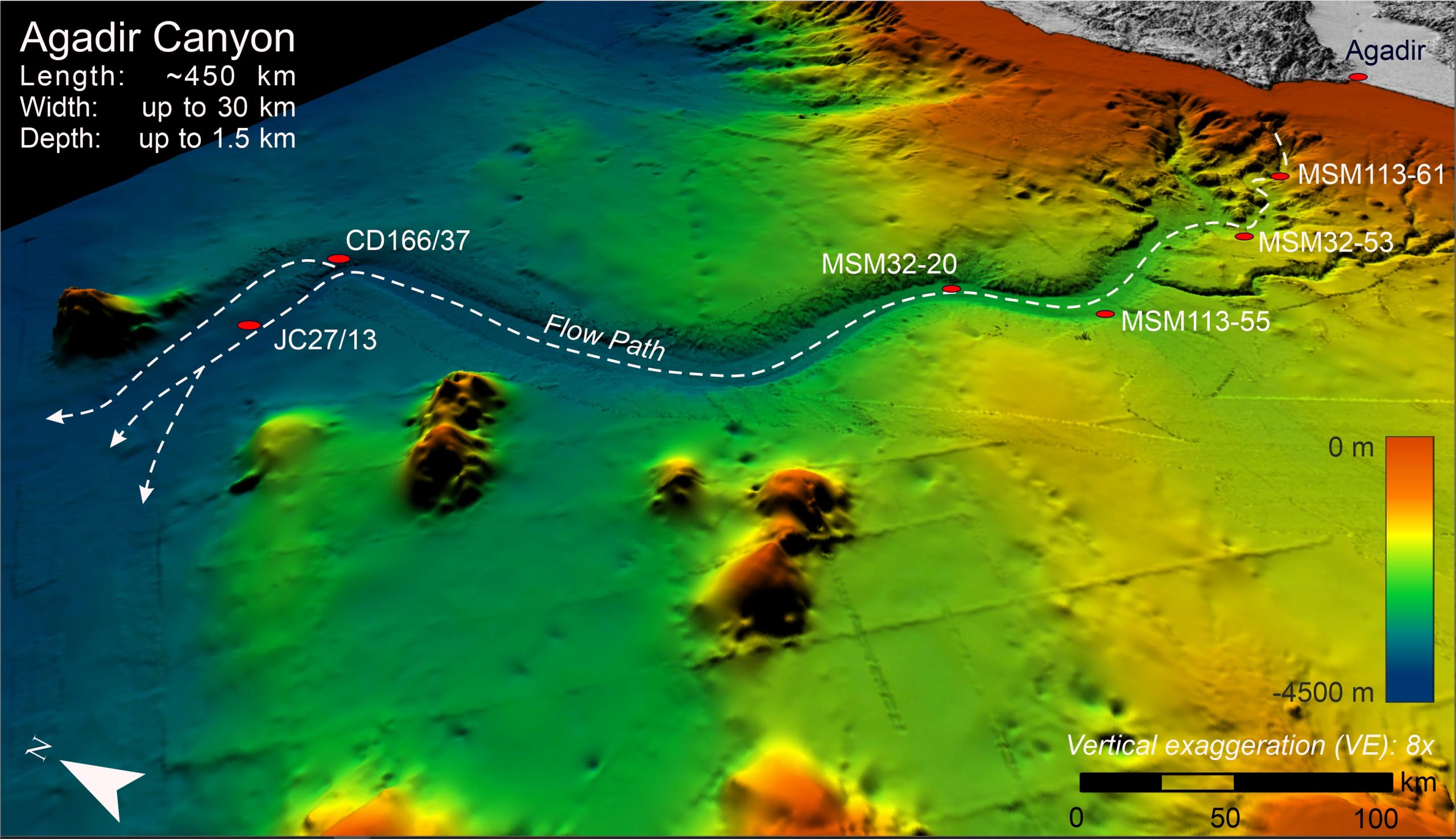
An international research team has mapped a giant underwater avalanche that took place nearly 60,000 years ago in the Agadir Canyon.
Researchers at the University of Liverpool have traced the path of a massive underwater avalanche that expanded over 100 times its initial size while wreaking havoc along the Atlantic seabed. This landmark study provides detailed insights into the dynamics and scale of such avalanches, emphasizing their potential threat to crucial underwater infrastructure like internet cables.
Groundbreaking Study on Submarine Cataclysm
New research by the University of Liverpool has revealed how an underwater avalanche grew more than 100 times in size causing a huge trail of destruction as it traveled 2000 km (~1250 miles) across the Atlantic Ocean seafloor off the North West coast of Africa.
In a study published today (August 21) in the journal Science Advances (and featured on the front cover), researchers provide an unprecedented insight into the scale, force, and impact of one of nature’s mysterious phenomena, underwater avalanches.
Mapping the Monstrous Underwater Avalanche
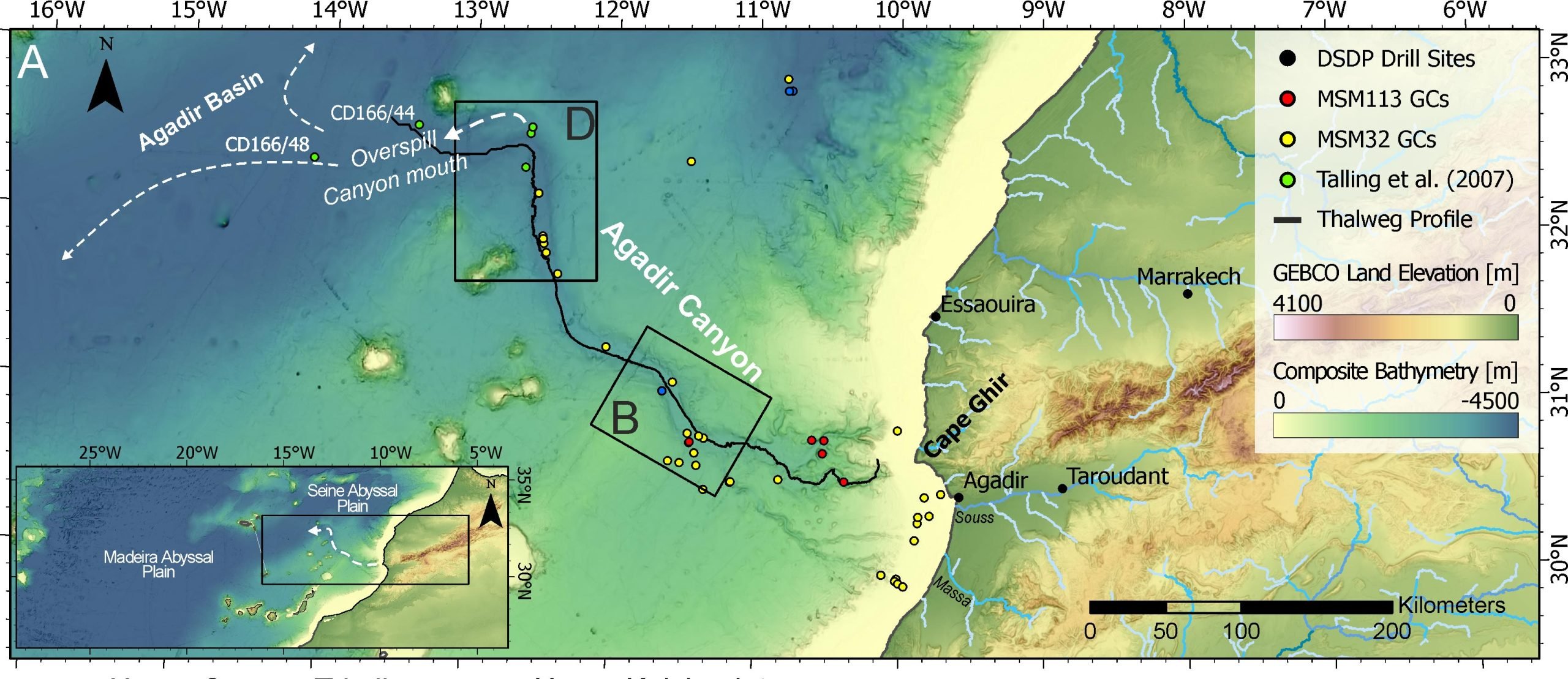
Dr. Chris Stevenson, a sedimentologist from the University of Liverpool’s School of Environmental Sciences, co-led the team that for the first time has mapped a giant underwater avalanche from head to toe, which took place nearly 60,000 years ago in the Agadir Canyon.
Their analysis reveals the event, which started as a small seafloor landslide about 1.5 km3 in volume, grew over 100 times in size picking up boulders, gravel, sand, and mud as it traveled through one of the largest submarine canyons in the world before traveling a further 1600km across the Atlantic Sea floor.
The avalanche was so powerful that it eroded the entire 400 km length of the canyon and several hundred meters up the sides – about 4500 km2 in total – and was so strong it carried cobbles more than 130m up the side of the canyon.
The Unseen Force Beneath the Waves
Unlike a landslide or snow avalanche, underwater avalanches are impossible to see and extremely difficult to measure. However, they are the primary mechanism for moving material such as sediments, nutrients, and pollutants across the surface of the earth and present a significant geohazard to the seafloor infrastructure such as internet cables.
The research team analyzed more than 300 core samples from the area taken during research cruises over the last 40 years. This, alongside seismic and bathymetry data, enabled them to map out the giant avalanche.
Insights and Implications of Underwater Avalanche Research
Dr. Stevenson said: “This is the first time anyone has managed to map out an entire individual underwater avalanche of this size and calculate its growth factor.”
“What is so interesting is how the event grew from a relatively small start into a huge and devastating submarine avalanche reaching heights of 200 meters as it moved at a speed of about 15 m/s ripping out the sea floor and tearing everything out in its way.
“To put it in perspective: that’s an avalanche the size of a skyscraper, moving at more than 40 mph from Liverpool to London, which digs out a trench 30 m deep and 15 km wide destroying everything in its path. Then it spreads across an area larger than the UK burying it under about a meter of sand and mud.”
Dr Christoph Bottner, a Marie-Curie research fellow at Aarhus University in Denmark, who co-led the team, said “We calculate the growth factor to be at least 100, which is much larger compared to snow avalanches or debris flows which only grow by about 4-8 times. We have also seen this extreme growth in smaller submarine avalanches measured elsewhere, so we think this might be a specific behavior associated with underwater avalanches and is something we plan to investigate further.”
Future Directions and Geohazard Assessments
Professor Sebastian Krastel, head of Marine Geophysics at Kiel University and chief scientist aboard the cruises that mapped the canyon, added: “Our new insight fundamentally challenges how we view these events. Before this study, we thought that big avalanches only came from big slope failures. But now, we know that they can start small and grow into extremely powerful and extensive giant events.
“These findings are of enormous importance for how we try and assess their potential geohazard risk to seafloor infrastructure like internet cables that carry almost all global internet traffic, which are critical to all aspects of our modern societies.”
The most recent cruises mapping the Agadir Canyon were led by the Institute of Geosciences, Kiel University, Leibniz Institute for Baltic Sea Research, and GEOMAR Helmholtz Centre for Ocean Research, Germany. A suite of archive core data was analyzed from the British Ocean Sediment Core Repository at NOCS Southampton, which was collected aboard NERC ships over the past 40 years.
Reference: “Extreme erosion and bulking in a giant submarine gravity flow” by Christoph Böttner, Christopher J. Stevenson, Rebecca Englert, Mischa Schönke, Bruna T. Pandolpho, Jacob Geersen, Peter Feldens and Sebastian Krastel, 21 August 2024, Science Advances.
DOI: 10.1126/sciadv.adp2584
Never miss a breakthrough: Join the SciTechDaily newsletter.
Follow us on Google and Google News.
1 Comment
Good documentation, but, not addressed is the presupposition of
Long years. Uniformitarian mindset
Imposes unproven presuppositions which call into question some of the conclusions.