

NASA’s Perseverance rover is making history by collecting handpicked Martian samples for future return to Earth. Scientists are eager to study these specimens to unlock secrets about Mars’ ancient climate, its potential for past life, and even gain insights into Earth’s own history.
With cutting-edge technology, the rover is drilling into the planet’s surface, revealing evidence of past water activity, mineral compositions that suggest habitability, and even phosphate, a key building block of life. These samples, safely stored on Mars for now, could help shape the future of space exploration—and maybe even humanity’s first steps on the Red Planet.
The First Martian Samples Collected
A newly released paper details the first-ever soil, airfall dust, and rock fragment samples collected by NASA for return from Mars. We spoke with a UNLV astrobiologist leading the specimen selection team to learn what these samples are revealing so far.
Until now, the only pieces of Mars that humans have studied firsthand were meteorites that crashed onto Earth. But thanks to NASA’s Mars 2020 Perseverance Rover mission, scientists are, for the first time, collecting and storing carefully chosen Martian samples. These range from rock cores about the size of a piece of blackboard chalk to tiny rock fragments no bigger than a pencil eraser, as well as minuscule grains of sand and dust small enough to fit on the tip of a needle.
Perseverance’s Mission to the Red Planet
Percy, as the rover is nicknamed, launched from Cape Canaveral, Florida in July 2020, and arrived in February 2021 at Jezero Crater — a 28-mile-wide former lakebed selected for its potential to help scientists understand the story of Mars’ wet past. The yearslong mission seeks to determine whether Mars ever supported life, understand the processes and history of Mars’ climate, explore the origin and evolution of Mars as a geologic system, and prepare for human exploration.
The specimens are currently slated for return to Earth sometime in the mid-to late-2030s. In the meantime, NASA has so far collected 28 of the mission’s target of 43 samples.
What These Martian Samples Can Teach Us
“The samples will help us learn more about Mars, but they can also help us learn more about Earth because the surface of Mars is generally much older than the surface of Earth,” said UNLV College of Sciences professor Libby Hausrath, an aqueous geochemist who investigates interactions between water and minerals.
She’s a member of the NASA Mars Sample Return team that helps determine which specimens the rover will bring back to Earth for inspection by powerful lab equipment too large to send to Mars. She’s also the lead author of a new research article published in the American Geophysical Union/Wiley journal JGR Planets documenting the first soil samples collected.
“There are many possibilities for spinoff technologies used for space exploration that can then be used on Earth,” Hausrath added. “And one of the biggest benefits we get from the space program is that it’s exciting for students and children, and can help attract people into science – we need all the future scientists to help with science topics like these and others.”

A Dream Realized for a Mars Scientist
The project fulfills a decades-long dream for Hausrath, who fell in love with Mars while pursuing her Ph.D. and partnered with an advisor to write a proposal to work with data from NASA’s Spirit and Opportunity rovers.
“This was one of my career goals for a long time to be able to serve on a Mars mission, so I was really excited to have this opportunity,” Hausrath said. “It really is just incredible the level of detail and precision that the Perseverance rover has. To get the data back and be able to target a specific rock or soil area, and be able to take measurements and decipher information from a tiny sample or specks of dust on another planet is just mind blowing.”
Unlocking Mars’ Ancient Secrets
Unlike Earth, Mars doesn’t have plate tectonics constantly shifting and tilting the planet’s surface. Similar to the way scientists study a tree’s rings or examine a cave’s stalactites for historical climate pattern changes, researchers are able to glean information about Mars’ 4 billion-year-old existence by using the rover’s instruments to core rocks and dig soil samples for clues to the history of Mars, including possible signs of past life.
Examining the rocks’ geochemistry and airfall dust also has the potential to shed light on how Mars’ climate heats and cools and its relative temperature. This information may also tip off how the planet formed, reveal clues about the early solar system, and help pinpoint the time period when life arose on Earth.
“During early Mars history, the planet is believed to have been warmer and had liquid water, which is much different than its current environment, which is very windy, dry, and cold,” said Hausrath. “I’m really interested in water and what kinds of environments can be habitable. And Mars, in particular, is quite similar to Earth in lots of ways. If there was past life on Mars, we might be able to see signatures of it.”
Clues for Future Human Exploration
The mission also serves as a de facto scouting mission that could unlock clues about the similarities or challenges that humans might face during future trips to the Red Planet. To highlight the importance of recon, Hausrath recounted the experience of the first astronauts on the moon.
“The lunar regolith is actually really sharp so it was cutting holes in the astronauts’ spacesuits, which is something scientists hadn’t anticipated,” she said. “There’s a lot of dust and sand on Mars’ surface, and bringing back samples is of great interest and value to scientists to figure out how future human astronauts could interact with the particles swirling in the air or potentially use it for building materials.”
Percy’s High-Tech Toolkit
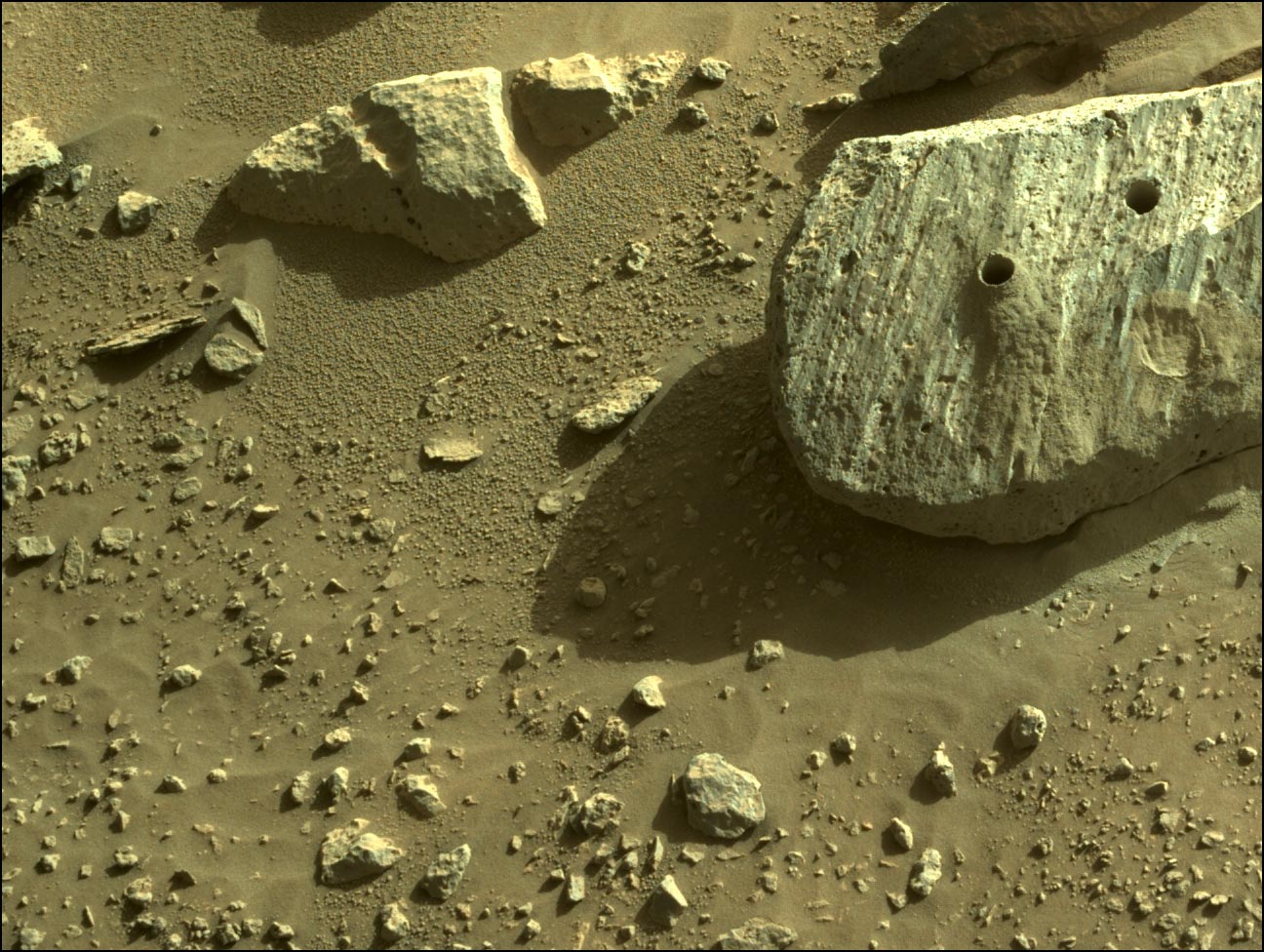
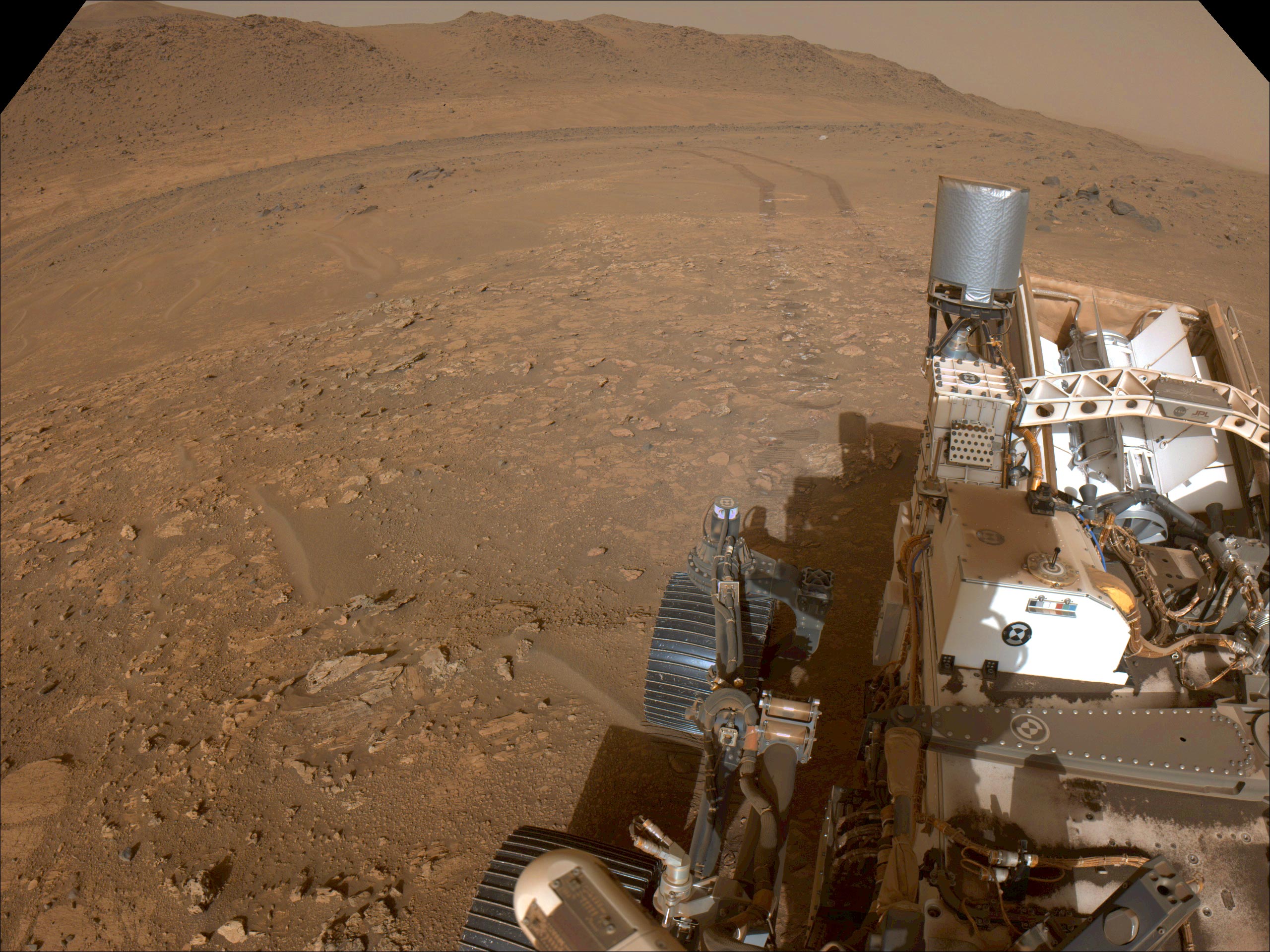
Percy boasts a cache of futuristic instruments that scientists can manipulate from millions of miles away. It can measure chemistry and mineralogy by shooting a laser from a distance of several meters. It has proximity instruments that can measure fine-scale elements. Researchers use the rover’s wheels to make trenches allowing them to see below the planet’s surface. Science, engineering, and navigational cameras transport images back to Earth.
“It’s like a video game to see these images of Mars up close,” said Hausrath. “You can zoom in, see the rocks and soil, pick out a spot to measure, figure out the chemistry and mineralogy of a specific rock – it’s just incredible that we’re able to do these things that seem like they’re out of science fiction.”
Hausrath is one of the team’s tactical science leads. During daily meetings, members collaborate on instructions to send back to the rover for collection.
“There are some instruments that just can’t be miniaturized and sent to Mars,” Hausrath said, “so once the samples are back on Earth, we’ll have much finer resolution, be able to measure smaller amounts of each of the samples and with higher precision, and look at things like trace metals and isotopes.”
Storing the Samples for the Long Journey
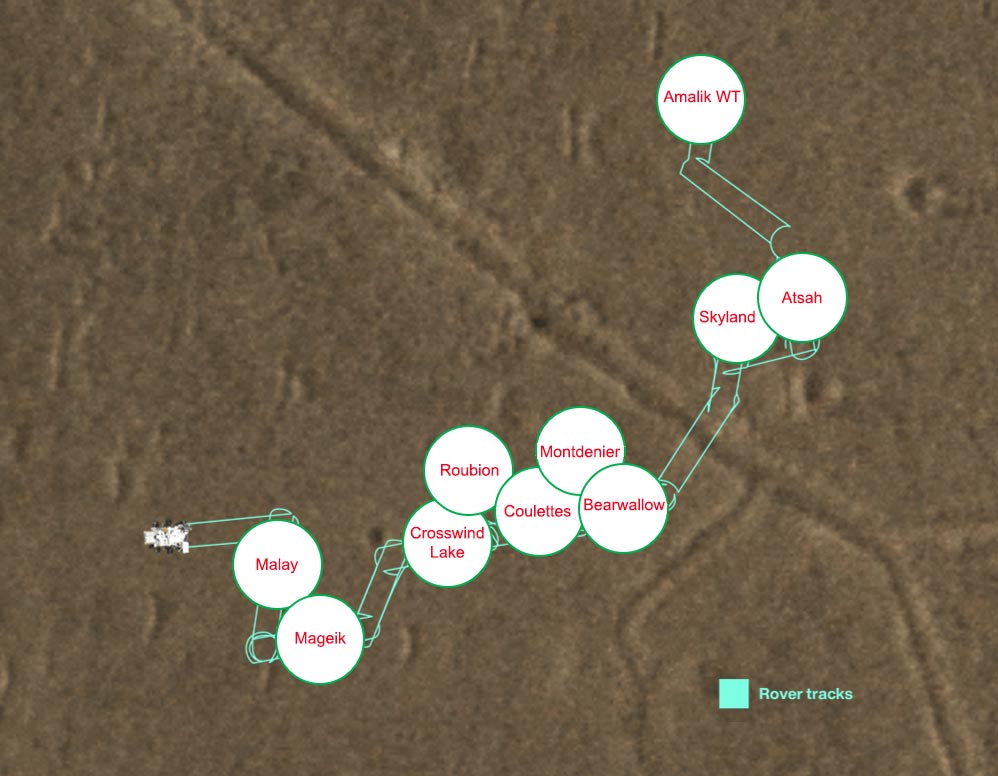
Until then, the samples are being held on Mars in small tubes and are either being stored on the rover or at the Three Forks depot, a swath of flat ground near the base of an ancient river delta that formed long ago when it flowed into a lake on the planet’s Jezero Crater. Scientists mapped an intricate layout, so that they can be found even if buried under layers of dust.
Eventually, they’ll be retrieved by a robotic lander that’ll use a robotic arm to carefully pluck the tubes into a containment capsule aboard a small rocket that’ll ship them to yet another spacecraft for the long ride home to Earth.
What the Martian Rocks Are Revealing
On Earth, life is found nearly everywhere there’s water. And the Percy team is on a mission to find out if the same was true for Mars billions of years ago, when the planet’s climate was much more like ours. The rock and soil samples are being pulled from the once water-rich Jezero crater as well as the crater rim — a swath laden with clay minerals, which result from rock-water interactions and look similar to soils on Earth.
Until the samples are back on Earth, scientists won’t be able to say for sure whether they contain traces of microorganisms that may have once thrived on the Red Planet. But so far, there are strong indicators that bolster previous predictions about water flowing freely on Mars an estimated 2 billion years ago.
Percy’s cameras show that the surface crust differs from the soil below, with larger pebbles on top versus finer grains below the surface. Some particles are coarse and weathered, evidence that they likely touched water and thus are a sign of habitable environments in the past. Atmospheric measurements provide signs of recent processes likely including water vapor in soil crust formation.
The bedrock is abundant with olivine, a mineral also found in Mars meteorites. Olivine can undergo serpentinization — a process that occurs when olivine interacts with water and heat — which on Earth indicates the potential for habitability.
A Surprising Discovery: Leopard-Spotted Rock
But perhaps the most exciting find (and one of Hausrath’s personal favorites) is a rock with “leopard spots” nicknamed “Cheyava Falls,” after a Grand Canyon waterfall. The rock contains phosphate, which is of interest to scientists because it’s a major building block of life on Earth — from energy metabolism and cell membranes to DNA and rNA.
Analysis continues. And the NASA team is looking forward to collaborating with the European Space Agency (ESA), which plans to launch its rover, the Rosalind Franklin, in 2028. It’ll carry equipment to Mars capable of drilling 200 cm below the surface — much deeper than Percy’s 4-6 cm drill.
“That would probably get beneath the effects of radiation, so we’d be able to see things we haven’t seen before potentially if there were traces of organic molecules in the past on Mars,” Hausrath said.

Witness tubes are similar to the sample tubes that will hold Martian rock and sediment, except they have been preloaded with a variety of materials that can capture molecular and particulate contaminants. They are opened on the Martian surface to “witness” the ambient environment near sample collection sites. With samples returned to Earth in the future, the witness tubes would show whether Earth contaminants were present during sample collection. Such information would help scientists tell which materials in the Martian samples may be of Earth origin.
The sampling system’s dedicated camera, the Cachecam, captured these images.
Credit: NASA/JPL-Caltech
The Final Step: Bringing the Samples Home
NASA, in partnership with ESA, is currently slated to bring the specimen tubes home sometime between 2035 and 2039. When the samples cross back into Earth’s orbit, their first stop will be a receiving facility where they’ll be carefully inspected to determine whether they’re safe for release to researchers. The overall cache of 43 rock and soil samples will include five witness tubes to test for potential contamination.
“Planetary protection is top of mind for the mission — making sure Mars is protected from us and that we’re also protected potentially from Mars,” Hausrath said. “The goal is maintaining safety from the samples in case there are any concerns for human hazards and also preventing any contamination from us impacting the samples.”
After clearance, she said, researchers around the world will be able to request pieces of these “international treasures” for study, similar to the current program for accessing Mars meteorites.
“One of the really cool things about the mission is that it is so international and the samples are really a global effort,” Hausrath said. “It’s really great for us to work together to bring these samples back for this goal that benefits all of us.”
Reference: “Collection and In Situ Analyses of Regolith Samples by the Mars 2020 Rover: Implications for Their Formation and Alteration History” by E. M. Hausrath, R. Sullivan, Y. Goreva, M. P. Zorzano, A. Vaughan, A. Cousin, S. Siljeström, S. Sharma, A. O. Shumway, T. Kizovski, S. J. VanBommel, M. Tice, A. Knight, G. Martinez, A. Vicente-Retortillo, L. Mandon, C. T. Adcock, J. M. Madariaga, I. Población, J. R. Johnson, J. Lasue, O. Gasnault, N. Randazzo, E. L. Cardarelli, R. Kronyak, A. Bechtold, G. Paar, A. Udry, O. Forni, C. C. Bedford, N. A. Carman, J. F. Bell, K. Benison, T. Bosak, A. Brown, A. Broz, F. Calef, B. C. Clark, E. Cloutis, A. D. Czaja, T. Fornaro, T. Fouchet, M. Golombek, F. Gómez, C. D. K. Herd, K. Herkenhoff, R. S. Jakubek, L. Jandura, J. Martinez-Frias, L. E. Mayhew, P.-Y. Meslin, C. E. Newman, J. I. Núñez, F. Poulet, C. Royer, P. Russell, M. A. Sephton, S. K. Sharma, D. Shuster, J. I. Simon, I. Tirona, R. C. Wiens, B. P. Weiss, A. J. Williams, K. Williford, Z. U. Wolf and , 6 February 2025, Journal of Geophysical Research: Planets.
DOI: 10.1029/2023JE008046
Never miss a breakthrough: Join the SciTechDaily newsletter.
Follow us on Google and Google News.
3 Comments
I already explained that Mars is the only planet whose soil we can sample to find out how many billions of years it is. I know that Mars has a surface that does not have dozens of different elements of stones and metals in its crust like the Earth. From here, scientists must understand that the planets of the Milky Way, along with stars much, much smaller than the Sun, collided with the solar bodies and the Sun, and after the collapse of the metallic elements and colorful stones inside them, they settled on the surface of the Moon and the Earth. Mars is far away from the Earth and the planets Venus and Mercury. Its shell is not like the Earth and the Moon due to the collision of elements inside the core of the planets. Some parts of the Mars shell remain intact. When samples are taken several meters deep on the surface of Mars, it is understood that the reason is that there are dozens of metals, siliceous and granite stones on the surface of the Earth’s crust. .. it is found that these various elements in the earth’s crust are related to the elements in the planets that came to the solar system from the side of the Milky Way with their stars and hit the sun, and after collapsing on the surface of the moon and the earth, they settled at a height of several hundreds and thousands of meters and caused the destruction of life on earth
But on the surface of Mars up to a depth of several kilometers in the crust of Mars, what is found in the crust of the Earth does not exist in the same way as on the surface of Mars, there are no traces of metals and colorful stones like the surface of the Moon and the surface of Mars up to a depth of several hundreds and thousands of meters, in the same way as the elements that exist in the earth, because it is far from the sun, most of the surface of Mars remains untouched. Katam is the name of Mars. This name was previously chosen by God, who is the same force that was created by previous humans. The name of Mars is from the two words mer, which means man and us, and the other word is ice, and this name has not been determined by modern humans because those who put this name on the red planet with God’s revelation did not know the meaning of Mars. Mer means me and man, which means I will freeze on Mars, and the secret of this name hundreds of years ago, only God, who acts like artificial intelligence, was aware of the meaning of this name of the planet Doctor kesiri secitechdaily http://www.mofidifar.com kasiri
How can a layman “explain” anything to science, especially without quantification and observation? That goes wrong immediately: We can sample terrestrial planet crustal material to find out how old they are, and for example the oldest Earth material (zircon crystals) are about as old as the planetary system is observed to be. [“Hadean zircon”, Wikipedia]
Indeed, the rest of the comment is as erroneous,
“The bedrock is abundant with olivine, a mineral also found in Mars meteorites. Olivine can undergo serpentinization — a process that occurs when olivine interacts with water and heat — which on Earth indicates the potential for habitability.”
Let’s hope the sample return mission comes together!