
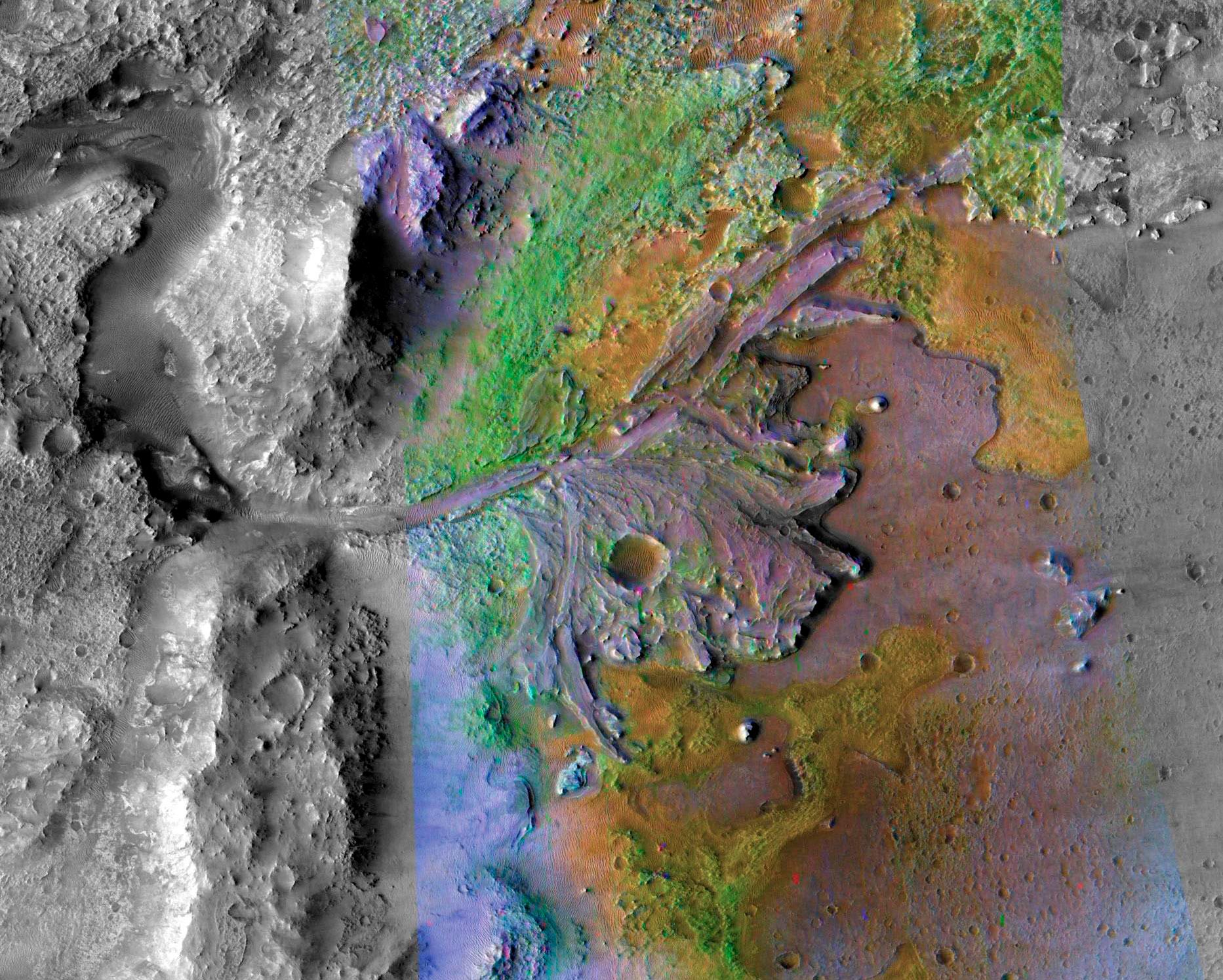
NASA’s Perseverance rover has uncovered powerful new evidence that Mars’ Jezero Crater once hosted multiple rounds of flowing water, each creating conditions that could have supported life.
Using an advanced mineral analysis algorithm called MIST, scientists found 24 distinct mineral types revealing that Mars’ surface chemistry shifted from acidic and harsh to neutral and then alkaline, much like Earth’s habitable waters. These transitions suggest that Mars didn’t just have water once — it experienced several wet periods that progressively became more life-friendly.
Discovering Mars’ Hidden Water Story
New findings from NASA’s Perseverance rover reveal compelling evidence that Mars’ Jezero Crater once experienced several distinct periods of water activity, each offering conditions that may have supported life.
By studying high-resolution geochemical data gathered by the rover, researchers identified about two dozen mineral types—the basic components of rocks—that tell the story of how volcanic rocks on Mars were altered through contact with liquid water. The results, published in the Journal of Geophysical Research: Planets, provide new insight into Mars’ ancient environment and guide Perseverance’s ongoing search for signs of life.
The study, led by Rice University graduate student Eleanor Moreland, used a tool called the Mineral Identification by Stoichiometry (MIST) algorithm (developed at Rice) to analyze data from Perseverance’s Planetary Instrument for X-ray Lithochemistry (PIXL). PIXL fires X-rays at Martian rocks to reveal their chemical makeup, providing some of the most detailed geochemical measurements ever made on another planet, according to the paper.

Multiple Episodes of Water on Mars
“The minerals we find in Jezero using MIST support multiple, temporally distinct episodes of fluid alteration,” Moreland said, “which indicates there were several times in Mars’ history when these particular volcanic rocks interacted with liquid water and therefore more than one time when this location hosted environments potentially suitable for life.”
Minerals form under specific combinations of temperature, pH, and chemical composition, making them powerful indicators of past environmental conditions. In Jezero Crater, the 24 mineral species show that volcanic rocks interacted with water multiple times, creating new salts and clays depending on the chemistry of the fluids. These minerals reveal three distinct types of water-related activity, each with different implications for habitability.

The First, Harshest Phase: Acidic Waters
The earliest stage involved high-temperature, acidic fluids that affected rocks found only on the crater floor. This group of minerals—including greenalite, hisingerite, and ferroaluminoceladonite—represents some of the oldest materials examined in the study. The water from this phase would have been difficult for life to survive in, since high heat and low pH can break down biological molecules.
“These hot, acidic conditions would be the most challenging for life,” said co-author Kirsten Siebach, assistant professor of Earth, environmental and planetary sciences at Rice. “But on Earth, life can persist even in extreme environments like the acidic pools of water at Yellowstone, so it doesn’t rule out habitability.”
Neutral Waters and Expanding Habitability
The next stage of alteration occurred under milder, more neutral conditions that could have been more supportive of life. Minerals such as minnesotaite and clinoptilolite formed at lower temperatures and neutral pH. Minnesotaite appeared in both the crater floor and the upper fan region, while clinoptilolite was limited to the crater floor.
Alkaline Waters: The Most Life-Friendly Phase
The final phase involved cooler, alkaline fluids that would have been much more favorable for life. Sepiolite, a mineral also found in similar Earth environments, formed during this time and appeared across every region the rover has explored. Its widespread presence points to a broad episode of liquid water that filled sediments in Jezero and created highly habitable conditions.
Shifting Conditions Toward Habitability
“These minerals tell us that Jezero experienced a shift from harsher, hot, acidic fluids to more neutral and alkaline ones over time — conditions we think of as increasingly supportive of life,” Moreland said.
Because Mars samples can’t be prepared or scanned as precisely as Earth samples, the team developed an uncertainty propagation model to strengthen its results. Using a statistical approach, MIST repeatedly tested mineral identifications considering the potential errors, similar to how meteorologists forecast hurricane tracks by running many models.
“Our error analysis lets us assign confidence levels to every mineral match,” Moreland said. “MIST not only informs Mars 2020 science and decision-making, but it is also creating a mineralogical archive of Jezero Crater that will be invaluable if samples are returned to Earth.”
Jezero’s Dynamic Past Revealed
The results confirm that Jezero, once the site of an ancient lake, went through a complex series of water-driven changes. Each new mineral discovery brings scientists closer to determining whether Mars ever supported life, while also refining Perseverance’s sampling strategy for future missions.
This publication compiles all minerals identified through the MIST model during the first three years of Perseverance’s mission. Although it does not cover the specific sampling site featured in the recent news about a potential biosignature, it provides important context showing that the conditions observed at that site, known as Sapphire Canyon, were present more widely across Jezero. This context will be vital for interpreting any potential biosignatures found in Mars’ rock samples.
Reference: “Multiple Episodes of Fluid Alteration in Jezero Crater Indicated by MIST Mineral Identifications in PIXL XRF Data From the First 1100 Sols of the Mars 2020 Mission” by Eleanor L. Moreland, Kirsten L. Siebach, Gelu Costin, Mike M. Tice, Joel A. Hurowitz, Allan H. Treiman, Justin I. Simon, Yang Liu, Yueyang Jiang, Arya Udry and Erwin Dehouck, 11 September 2025, Journal of Geophysical Research: Planets.
DOI: 10.1029/2024JE008797
This research was supported by Mars 2020 Participating Scientist grants, JPL, the Mars 2020 PIXL team, the Mars 2020 Returned Sample Science Participating Scientist program and NASA’s Mars Exploration Program.
Never miss a breakthrough: Join the SciTechDaily newsletter.
Follow us on Google and Google News.
1 Comment
The sequence acidic-neutral waters happened on Earth as well, before the acidic surplus of hydrogen had leaked out into space. A later CO2 acidic surplus isn’t that bad, and serpentinization reactions allows for alkaline hydrothermal vents that creates local neutralization or even alkaline conditions where biology split from geology. That could have happened on Mars too.