
Close Menu
    Facebook X (Twitter) Instagram
    SciTechDaily
    • Biology
    • Chemistry
    • Earth
    • Health
    • Physics
    • Science
    • Space
    • Technology
    Facebook X (Twitter) Pinterest YouTube RSS
    SciTechDaily
    Home»Space»MAVEN Spacecraft Successfully Enters Mars’ Orbit
    Space

    MAVEN Spacecraft Successfully Enters Mars’ Orbit

    By Dr. Tony Phillips, Science@NASASeptember 22, 2014No Comments3 Mins Read
    Facebook Twitter Pinterest Telegram LinkedIn WhatsApp Email Reddit
    Share
    Facebook Twitter LinkedIn Pinterest Telegram Email Reddit
    MAVEN Enters Orbit Around Mars
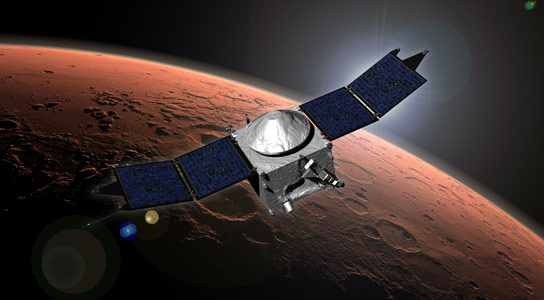
    This image shows an artist concept of NASA’s Mars Atmosphere and Volatile Evolution (MAVEN) mission. Credit: NASA/Goddard Space Flight Center

    After a 10-month journey, NASA has confirmed that the MAVEN spacecraft has successfully entered Mars’ orbit.

    NASA’s Mars Atmosphere and Volatile Evolution (MAVEN) spacecraft successfully entered Mars’ orbit at 10:24 p.m. EDT Sunday, September 21, where it now will prepare to study the Red Planet’s upper atmosphere as never done before. MAVEN is the first spacecraft dedicated to exploring the tenuous upper atmosphere of Mars.

    “As the first orbiter dedicated to studying Mars’ upper atmosphere, MAVEN will greatly improve our understanding of the history of the Martian atmosphere, how the climate has changed over time, and how that has influenced the evolution of the surface and the potential habitability of the planet,” said NASA Administrator Charles Bolden. “It also will better inform a future mission to send humans to the Red Planet in the 2030s.”

    Animation Shows MAVEN Orbiting Mars
    This animation depicts MAVEN orbiting Mars. Credit: NASA

    After a 10-month journey, confirmation of successful orbit insertion was received from MAVEN data observed at the Lockheed Martin operations center in Littleton, Colorado, as well as from tracking data monitored at NASA’s Jet Propulsion Laboratory (JPL) navigation facility in Pasadena, California. The telemetry and tracking data were received by NASA’s Deep Space Network antenna station in Canberra, Australia.

    “NASA has a long history of scientific discovery at Mars and the safe arrival of MAVEN opens another chapter,” said John Grunsfeld, astronaut and associate administrator of the NASA Science Mission Directorate at the agency’s Headquarters in Washington. “Maven will complement NASA’s other Martian robotic explorers—and those of our partners around the globe—to answer some fundamental questions about Mars and life beyond Earth.”

    Following orbit insertion, MAVEN will begin a six-week commissioning phase that includes maneuvering into its final science orbit and testing the instruments and science-mapping commands. MAVEN then will begin its one Earth-year primary mission, taking measurements of the composition, structure and escape of gases in Mars’ upper atmosphere and its interaction with the sun and solar wind.

    “It’s taken 11 years from the original concept for MAVEN to now having a spacecraft in orbit at Mars,” said Bruce Jakosky, MAVEN principal investigator with the Laboratory for Atmospheric and Space Physics at the University of Colorado, Boulder (CU/LASP). “I’m delighted to be here safely and successfully, and looking forward to starting our science mission.”

    The primary mission includes five “deep-dip” campaigns, in which MAVEN’s periapsis, or lowest orbit altitude, will be lowered from 93 miles (150 kilometers) to about 77 miles (125 kilometers). These measurements will provide information down to where the upper and lower atmospheres meet, giving scientists a full profile of the upper tier.

    “This was a very big day for MAVEN,” said David Mitchell, MAVEN project manager from NASA’s Goddard Space Flight Center, Greenbelt, Maryland. “We’re very excited to join the constellation of spacecraft in orbit at Mars and on the surface of the Red Planet. The commissioning phase will keep the operations team busy for the next six weeks, and then we’ll begin, at last, the science phase of the mission. Congratulations to the team for a job well done today.”

    Never miss a breakthrough: Join the SciTechDaily newsletter.
    Follow us on Google and Google News.

    Astronomy Mars MAVEN Planetary Science
    Share. Facebook Twitter Pinterest LinkedIn Email Reddit

    Related Articles

    MAVEN Spacecraft Detects Aurora and Mysterious Dust Cloud around Mars

    MAVEN Spacecraft Completes First Deep Dip Campaign of Martian Atmosphere

    MAVEN Identifies Links to Atmospheric Loss on Mars

    MAVEN Spacecraft Set to Continue Mars Exploration

    MAVEN Provides First Look at the Upper Atmosphere of Mars

    First Mars Observations from NASA’s MAVEN Spacecraft

    NASA MAVEN Spacecraft Prepares for Mars Orbit-Insertion Maneuver

    MAVEN Spacecraft Makes Final Preparations for Mars Orbit-Insertion Maneuver

    New ScienceCast Video Explores the Mystery of Mars

    Leave A Reply Cancel Reply

    • Facebook
    • Twitter
    • Pinterest
    • YouTube

    Don't Miss a Discovery

    Subscribe for the Latest in Science & Tech!

    Trending News

    Just a Few Breathless Minutes a Day Could Slash Your Risk of 8 Major Diseases

    This Simple Habit Could Cut Your Risk of Dementia by 30%

    Scientists Debunk Rattlesnake Myth That Fooled Hikers and Doctors for Decades

    Scientists Discover Plants Can “Count” – and May Be Smarter Than We Thought

    New Research Reveals Ancient Mars May Have Been Warm, Wet – and Possibly Alive

    This Surprising Daily Habit Could Cut Dementia Risk by 35%

    Just 10 Minutes a Day: Scientists Say This Ancient Chinese Practice Shows Powerful Blood Pressure Benefits

    Scientists Say This Popular Food Could Help Your Body Get Rid of Microplastics

    Follow SciTechDaily
    • Facebook
    • Twitter
    • YouTube
    • Pinterest
    • Newsletter
    • RSS
    SciTech News
    • Biology News
    • Chemistry News
    • Earth News
    • Health News
    • Physics News
    • Science News
    • Space News
    • Technology News
    Recent Posts
    • 160,000 Years Ago, Hominins in China Were Far More Advanced Than We Thought
    • Teenager’s Fossil Find Leads to Discovery of Shark Teeth in 5 Million-Year-Old Whale Skull
    • Weight-Loss Drugs Like Ozempic Are Creating a Hidden Environmental Disaster
    • Even Occasional Binge Drinking May Triple Liver Damage Risk
    • Quantum Circuits Have a Hidden Weakness and It Changes Everything
    Copyright © 1998 - 2026 SciTechDaily. All Rights Reserved.
    • Science News
    • About
    • Contact
    • Editorial Board
    • Privacy Policy
    • Terms of Use

    Type above and press Enter to search. Press Esc to cancel.