
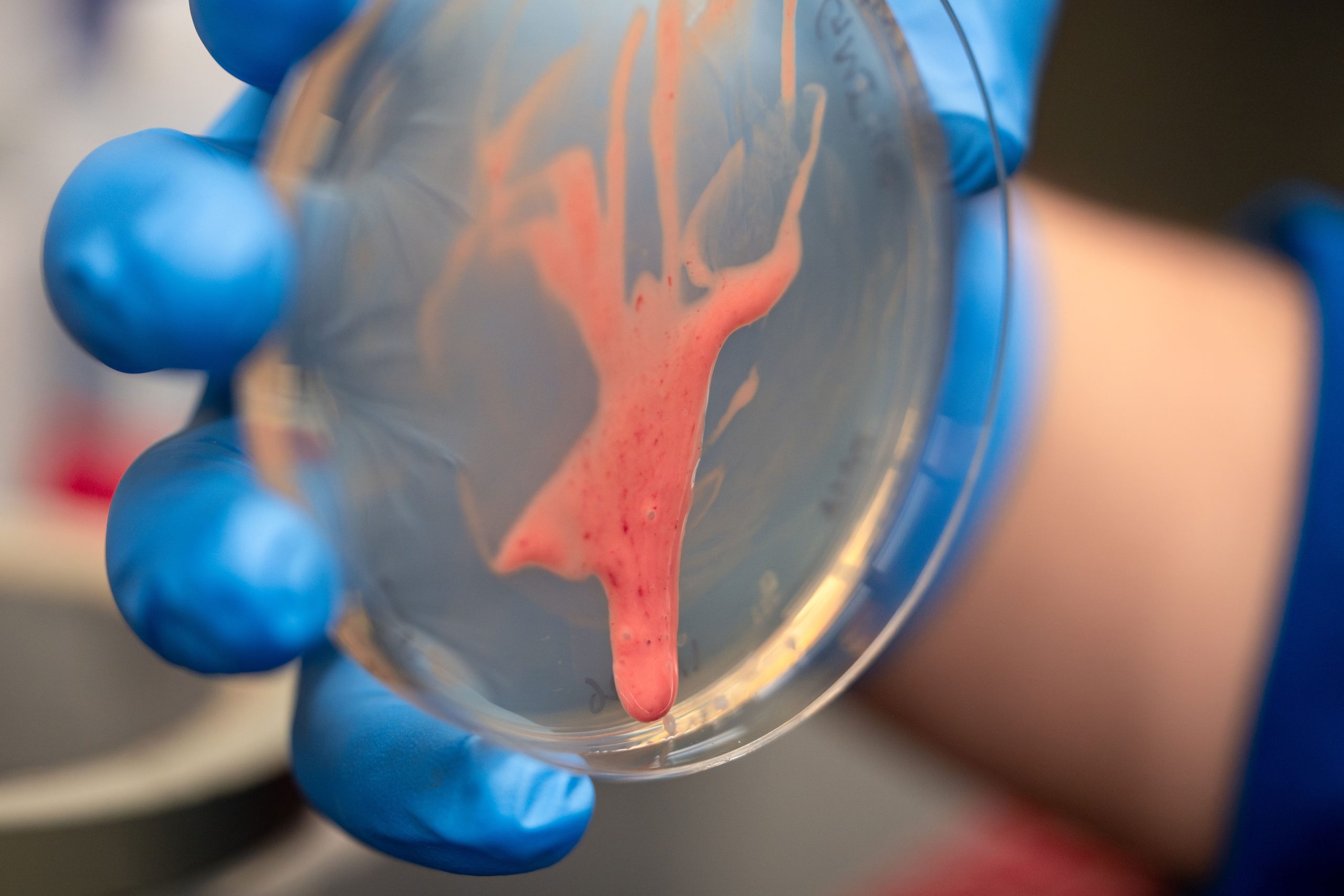
A destructive plant pathogen has long puzzled scientists with its ability to move swiftly through crops and cause sudden, fatal wilting.
A plant disease that can wipe out crops in a matter of days turns out to rely on something surprisingly simple: a sticky, flowing substance that behaves more like slime than a solid.
New research reveals that this unusual material helps Ralstonia bacteria move through plants with devastating efficiency, causing rapid collapse in tomatoes, potatoes, and many other important crops.
The study, published in Proceedings of the National Academy of Sciences, brings together plant pathology and engineering researchers at the University of California, Davis.
One species in particular, Ralstonia solanacearum, is especially dangerous because of its patience. The bacterium can survive for years in moist soil without causing visible damage. When it finally invades a plant, it races through the water transporting vessels (xylem), essentially moving through the plant’s internal plumbing. The result is often fast and dramatic: infected plants can wilt and die within days.
“My analogy is that they cause a heart attack for plants, because they clog up the vessels and cause plants to wilt and die,” said Tiffany Lowe-Power, associate professor of plant pathology in the UC Davis College of Agricultural and Environmental Sciences.
A Particularly Unpleasant Biofilm
Like many bacteria, Ralstonia protects itself by secreting a coating known as a biofilm. In many microbes, biofilms help retain moisture and provide structural support. In Ralstonia, however, this coating behaves very differently.
According to Lowe-Power, the material is unusually loose and runny, giving the bacteria a slimy quality that is both biologically important and notoriously unpleasant to handle in the lab.
“Ralstonia are charismatically disgusting, there’s this like, real grossness to them,” she said.
Ralstonia’s secreted film is made up of a long, sugar-like molecule called exopolysaccharide 1 (EPS-1). It has been known that EPS-1 is somehow tied to Ralstonia’s ability to kill plants. But how?
“With the ways that microbiologists and geneticists go about answering questions, we are able to get somewhat close, but not really to the mechanism,” Lowe-Power said. “We need a physicist.”
Enter the Physics of Goop
Hari Manikantan, associate professor in the UC Davis Department of Chemical Engineering, studies the mechanics and dynamics of complex multiphase fluids.
“I love goop of all forms — saliva, foams, lung surfactants, tears,” Manikantan said.
Goopy fluids are both viscous and elastic in different degrees. Elasticity measures whether a material can snap back after being stretched. Viscosity measures how easily it flows.
Silly putty, for example, is elastic over a short time scale.
“You bounce it, it’s a perfectly solid object. If you keep it on a table, it slowly flows out over minutes to hours,” Manikantan said. “The question is what’s the relevant time scale.”
A mutual love of goop
Manikantan and Lowe-Power discovered their mutual love of goop when they met during a new faculty training before the pandemic. Using equipment in Manikantan’s laboratory, they were able to make highly precise measurements of the viscoelastic properties of secretions collected from Ralstonia colonies by Matthew Cope-Arguello, a graduate student in Lowe-Power’s lab.
They discovered that the goop from pathogenic Ralstonia flows easily under the kind of shear forces that would be found in the xylem vessels of plants. This allows the bacteria to spread rapidly throughout an infected plant.
How common is this trait? Cope-Arguello developed a simple test. If you grow bacteria making a biofilm on a plate and hold the plate at an angle, does it drip? They looked at other Ralstonia strains, including those that don’t make EPS-1, and also asked colleagues around the country to test other bacteria that are evolutionary cousins of the Ralstonia wilt pathogens.
“We were really able to show, both from the data that our collaborators collected as well as data that we mined through publicly available genomes, that this polysaccharide is unique to the plant pathogens,” Cope-Arguello said.
Implications Across Disciplines
For biologists, the research shows why EPS-1 makes these bacteria especially pathogenic. For engineers and soft matter physicists, it provides an experimental system to study.
“Now we have this actual relevant change that’s guided by genetics that my community can begin to mathematically model. So I’m very excited about how this feeds back into that soft matter physics world,” Manikantan said.
Reference: “The EPS-I exopolysaccharide transforms Ralstonia wilt pathogen biofilms into viscoelastic fluids for rapid dissemination in planta” by Matthew L. Cope-Arguello, Jiayu Li, Zachary Konkel, Nathalie Aoun, Tabitha Cowell, Nicholas Wagner, A. Li Han Chan, Lan Thanh Chu, Samantha Wang, Mariama D. Carter, Caitilyn Allen, Lindsay J. Caverly, Loan Bui, Kristen M. DeAngelis, Matthew J. Wargo, Tuan M. Tran, Jonathan M. Jacobs, Harishankar Manikantan and Tiffany M. Lowe-Power, 22 January 2026, Proceedings of the National Academy of Sciences.
DOI: 10.1073/pnas.2512757123
The work was supported in part by grants from the Academic Senate at UC Davis, the U.S. Department of Agriculture and the National Science Foundation.
Never miss a breakthrough: Join the SciTechDaily newsletter.
Follow us on Google and Google News.