
Close Menu
    Facebook X (Twitter) Instagram
    SciTechDaily
    • Biology
    • Chemistry
    • Earth
    • Health
    • Physics
    • Science
    • Space
    • Technology
    Facebook X (Twitter) Pinterest YouTube RSS
    SciTechDaily
    Home»Technology»Meeting Growing Demand for Increased Storage Capacity With Improved Graphene-Based Supercapacitors
    Technology

    Meeting Growing Demand for Increased Storage Capacity With Improved Graphene-Based Supercapacitors

    By University of Technology SydneyAugust 5, 20201 Comment3 Mins Read
    Facebook Twitter Pinterest Telegram LinkedIn WhatsApp Email Reddit
    Share
    Facebook Twitter LinkedIn Pinterest Telegram Email Reddit
    Improving Supercapacitors
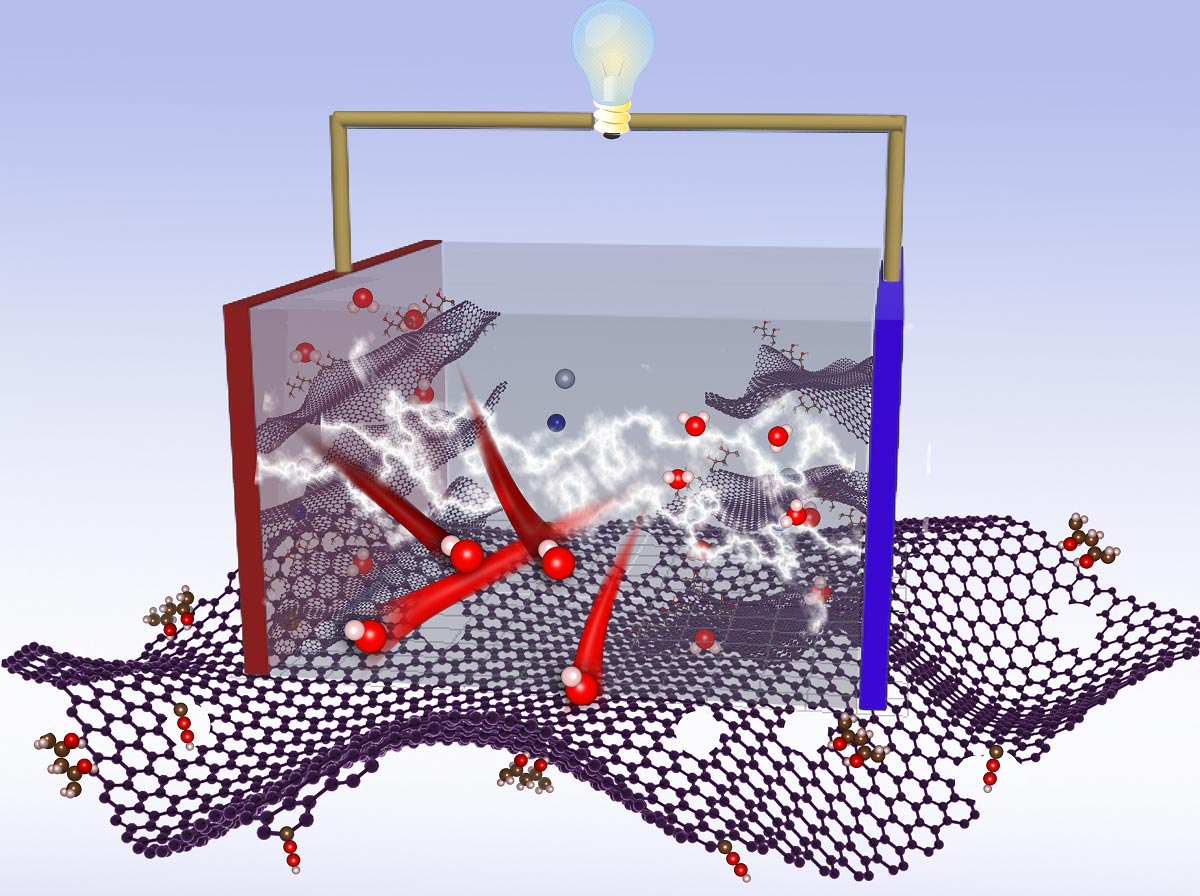
    An efficient pathway to improve the performance of supercapacitors. Credit: Dawei Su

    Demand for integrated energy storage devices is growing rapidly as people rely more and more on portable and wireless electronics, and the global need grows for clean energy sources such as solar and wind energies. 

    This is creating an exponential need for advanced energy storage technologies — reliable and maintenance-free batteries and supercapacitors (SC) with high power density capability as storage devices.  Supercapacitors are prominent candidates to meet this need due to their environmentally friendly and long cyclability characteristics.

    Researchers from the Integrated Nano Systems Lab (INSys Lab), in the Centre for Clean Energy Technology, have been working on a pathway to improve the performance of supercapacitors, and meet that demand for increased storage capacity.

    Dr. Mojtaba Amjadipour and Professor Francesca Iacopi (School of Data and Electrical Engineering) and Dr. Dawei Su (School of Mathematical and Physical Sciences) describe their cutting-edge work in the July 2020 issue of the journal Batteries and Supercaps.  The prominence given to Graphitic-Based Solid-State Supercapacitors: Enabling Redox Reaction by In Situ Electrochemical Treatment – designated a Very Important Paper with front coverage placement — signifies just how innovative their research is in developing alternate ways to extend storage capacity

    Dr. Iacopi said the multi-disciplinary approach within the team was beneficial in discovering what she says is a simple process.

    “This research has originated from our curiosity of exploring the operation limits of the cells, leading us to unforeseen beneficial results. The control of this process would not have been possible without understanding the fundamental reasons for the observed improvement, using our team’s complementary expertise.”

    Traditionally, supercapacitors are fabricated with liquid electrolytes, which cannot be miniaturized and can be prone to leakage, prompting research into gel-based and solid-state electrolytes. Tailoring these electrolytes in combination with carbon-based electrode materials such as graphene, graphene oxide, and carbon nanotubes is of paramount importance for an enhanced energy storage performance.

    Graphene or graphitic carbon directly fabricated on silicon surfaces offers significant potential for on-chip supercapacitors that can be embedded into integrated systems. The research insights indicate a simple path to significantly enhance the performance of supercapacitors using gel-based electrolytes, which are key to the fabrication of quasi-solid-(gel) supercapacitors.

    “This approach offers a new path to develop further miniaturized on-chip energy storage systems, which are compatible with silicon electronics and can support the power demand to operate integrated smart systems,” Dr. Iacopi said.

    Reference: “Graphitic‐Based Solid‐State Supercapacitors: Enabling Redox Reaction by In Situ Electrochemical Treatment” by Dr. Mojtaba Amjadipour, Dr. Dawei Su and Prof. Francesca Iacopi, 17 June 2020, Batteries & Supercaps.
    DOI: 10.1002/batt.202000129

    Batteries & Supercaps is published on behalf of Chemistry Europe, by Wiley VCH. Fields of interest include pure and applied battery research, battery electrochemistry, electrode materials, cell design, battery systems and applications, hybrid battery systems.

    Never miss a breakthrough: Join the SciTechDaily newsletter.
    Follow us on Google and Google News.

    Battery Technology Electrical Engineering Graphene Nanotechnology University of Technology Sydney
    Share. Facebook Twitter Pinterest LinkedIn Email Reddit

    Related Articles

    Supercapacitors Challenge Batteries: Powerful Graphene Hybrid Material for Highly Efficient Energy Storage

    Improving Lithium-Ion Battery Performance, Cell Lifetime for Renewable Energy Applications

    A New and Efficient Way to Create Nanographene for Power and Display Devices

    Quantum Materials Could Mimic Colossal Magnetic Fields Using Graphene That Buckles

    Improved Advanced Energy Storage Using New Nano-Engineering Strategy

    Next-Generation Energy Storage Breakthrough: Fast-Charging, Long-Running, Flexible

    Better Lithium-Ion Batteries Possible With Nanoscale Molecular View of Self-Assembling Structure

    A Cost-Effective Fabrication Method for Micro-Scale Graphene-Based Supercapacitors

    Multi-Walled Carbon Nanotubes May Eventually Replace Expensive Platinum Catalysts

    1 Comment

    1. Lloyd Dixon on October 18, 2020 11:35 pm

      How large can graphene-based supercapacitors be fabricated?

      Reply
    Leave A Reply Cancel Reply

    • Facebook
    • Twitter
    • Pinterest
    • YouTube

    Don't Miss a Discovery

    Subscribe for the Latest in Science & Tech!

    Trending News

    Popular Sugar-Free Sweetener Linked to Liver Disease, Study Warns

    What Is Hantavirus? The Deadly Disease Raising Alarm Worldwide

    Scientists Just Discovered How the Universe Builds Monster Black Holes

    Scientists Unveil New Treatment Strategy That Could Outsmart Cancer

    A Simple Vitamin May Hold the Key to Treating Rare Genetic Diseases

    Scientists Think the Real Fountain of Youth May Be Hiding in Your Gut

    Ravens Don’t Follow Wolves, They Predict Them

    This Common Knee Surgery May Be Doing More Harm Than Good

    Follow SciTechDaily
    • Facebook
    • Twitter
    • YouTube
    • Pinterest
    • Newsletter
    • RSS
    SciTech News
    • Biology News
    • Chemistry News
    • Earth News
    • Health News
    • Physics News
    • Science News
    • Space News
    • Technology News
    Recent Posts
    • Popular Supplement Ingredient Linked to Shorter Lifespan in Men
    • Scientists May Have Found a Way To Repair Nerve Damage in Multiple Sclerosis
    • GLP-1 Weight Loss Linked To Dramatically Lower Risk of Sleep Apnea, Kidney Disease and More
    • Scientists Uncover the Surprising Source of Strange Clouds Near the Milky Way’s Supermassive Black Hole
    • This Dazzling Green Snake Was Hiding in Plain Sight for Decades
    Copyright © 1998 - 2026 SciTechDaily. All Rights Reserved.
    • Science News
    • About
    • Contact
    • Editorial Board
    • Privacy Policy
    • Terms of Use

    Type above and press Enter to search. Press Esc to cancel.